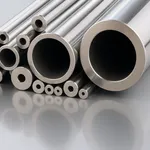
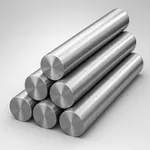
This image was created with artificial intelligence – marked under Art. 50 of the AI Act, Regulation (EU) 2024/1689. It is a placeholder until the company's photos arrive.
Aluminium rods – properties, applications and cut pieces
High-quality aluminium rods in various alloys and diameters. Now cut to size individually – configure & order.
What are aluminium rods?
Aluminium rods are cylindrical bars made of aluminium, offered in various diameters, lengths and alloys. They serve as semi-finished products for machining in industry. Their high dimensional stability, low weight and good machinability make them the ideal choice for applications where precision, corrosion resistance and a balanced strength-to-weight ratio matter. Aluminium rods are both manufactured and used in standard lengths and as individual cut pieces.
Typical properties of aluminium rods
Aluminium rods are characterised by a combination of technical advantages: they are light, corrosion-resistant, electrically conductive and easy to machine. Depending on the alloy chosen (e.g. EN AW-6060, EN AW-6082 or EN AW-7075), strength, hardness and anodising suitability vary. Aluminium rods made from EN AW-6082 are particularly in demand, as they can be milled and turned well while offering high strength.
Areas of application for aluminium rods
Mechanical and plant engineering
Aluminium rods are widely used in mechanical and special-purpose machine engineering. Here they are processed into shafts, bushes, holders or turned parts. The combination of stability and low weight enables efficient designs and simple assembly processes.
Vehicle construction & mobility
In automotive and aerospace engineering, aluminium rods are valued above all for their low weight and good machinability. They serve as the basis for connecting elements, frame structures and structural components.
Architecture & construction
Aluminium rods are also used in façade construction, for railings or individual load-bearing structures. Their weather resistance and elegant appearance make them a popular design element.
Model making & prototyping
In prototyping, model making or small-series production, aluminium rods can be used very flexibly. Easy processing by saw, milling machine or lathe enables rapid implementation without costly tooling.
Aluminium rods cut to size – what is possible?
Aluminium rods can be cut precisely to the desired dimension. Lengths of up to 3,000 mm are common, often in exact dimensions between 50 and 1,000 mm for industrial applications. The cut to size is carried out by saw or CNC control depending on requirements, with tight tolerances and a burr-free edge. Series cuts in consistent quality are also easy to achieve.
Alloys: which aluminium types are used?
The following alloys are particularly common for aluminium rods:
- EN AW-6082: high strength, very good machinability, anodisable
- EN AW-6060 / 6061: good surface properties, high corrosion resistance
- EN AW-7075: very high strength, for highly stressed parts
- EN AW-1050 / 5083: softer, easily formable alloys for special applications
The choice of alloy depends on load, surface requirement and machining process.
Machining options for aluminium rods
Aluminium rods can be further processed in a variety of ways: turning, milling, drilling, grinding or welding are among the common processes. Thanks to good chip formation and thermal properties, they are particularly suitable for CNC machining. Subsequent anodising or powder coating is also possible with many alloys.
Advantages over other round materials
Compared with steel or brass, aluminium rods offer significantly lower weight while still providing high strength. Their corrosion resistance also makes them low-maintenance and durable. Unlike plastics, they retain their shape even with temperature changes and are at the same time sufficiently load-bearing for many technical applications.
Buying dimensionally accurate aluminium rods – what to look out for?
When buying aluminium round material, tolerances and surface quality matter above all, alongside the alloy. Cut pieces should be delivered exactly, burr-free and protected by packaging.
Origin and manufacturing process can also be relevant when it comes to safety-related components or high quality requirements. In our configurator for aluminium cut pieces you can enter your desired dimensions directly and have them precisely manufactured.
Aluminium rods versatile in use & precisely available
Aluminium rods are a versatile, durable and precise solution for technical components. They combine low weight with high strength and offer excellent machining options. Thanks to individual cut pieces and numerous alloy variants, they are suitable both for industrial series production and for one-off applications.
Frequently asked questions about aluminium rods (FAQ)
Which diameters are available for aluminium rods? Depending on the supplier, aluminium rods are available in diameters from approx. 4 mm to over 200 mm. Cut-to-size pieces can usually be manufactured flexibly.
Which alloy is best suited to CNC machining? EN AW-6082 is particularly suitable for machining processes such as turning or milling. This alloy combines high strength with very good machinability.
Can aluminium rods be anodised? Yes, many alloys – in particular EN AW-6060, 6061 and 6082 – are anodisable and can be visually and functionally finished after cutting.
Are aluminium rods also suitable for outdoor use? Yes, aluminium rods made from corrosion-resistant alloys such as EN AW-6060 or 6082 are ideal for outdoor use, as they are weather-resistant and do not rust.