Cut piece, semi-finished product or finished part: which is worth it for which application?
Cut piece, semi-finished product or finished part? This guide explains the differences, advantages and areas of application – for a well-founded decision in plastics processing and industrial manufacturing.
In the world of engineering plastics and industrial manufacturing, companies often face a central question: Should they order cut pieces, semi-finished products or directly finished components? The right choice has a direct influence on cost-effectiveness, flexibility, delivery times and in-house manufacturing depth. In this article, we look at the differences, advantages and disadvantages as well as typical applications – so that you can make the optimal decision for your project.
Whether mechanical engineering, medical technology or plastics processing: depending on internal equipment and objectives, the right procurement form can make a decisive difference – not only in costs, but also in throughput time, quality and plannability.
What is the difference?
Cut piece
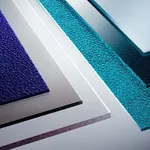
A cut piece is raw material cut to size – for example a sheet or a rod – that has neither been machined nor further processed. You receive the material exactly in the desired dimensions, for example 500 × 300 mm for an HPL sheet. The edges are generally deburred, and the cut piece serves as the basis for further processing steps at the customer's premises.
Cut pieces are particularly useful when companies require precise dimensions but want to carry out the machining in their own operation. The advantage lies in the simple ordering and delivery as well as the wide variety of materials, which covers many plastics, colours and thicknesses.
Typical for:
- HPL sheets
- Acrylic glass
- Polycarbonate
- PVC rigid foam
Suitable for: Customers with their own further processing (e.g. sawing, drilling, milling).
Advantages of cut pieces
Cut pieces are generally inexpensive to purchase and allow a high degree of flexibility. They can be ordered exactly to size and individually further processed in your own operation. Cut pieces can also be stored without any problems.
Disadvantages of cut pieces
Anyone using cut pieces needs their own processing machines and skilled personnel. Without further processing, direct use is generally not possible. The quality of the end product depends heavily on your own processing.
Semi-finished product
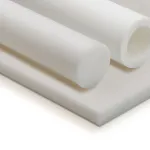
A semi-finished product is a standardised starting product (e.g. rod, sheet, tube) intended for industrial further processing. Unlike a cut piece, it is not cut to customer size. Semi-finished products serve as raw material for milling, turning or injection moulding processes and are usually available in standardised dimensions.
Standardisation makes semi-finished products a particularly economical starting point for a wide range of industrial applications. They can be stored, processed automatically and are available in different qualities and material versions – from standard plastics to high-performance polymers.
Examples:
- POM rod Ø 50 × 1,000 mm
- PA sheet 1,000 × 2,000 mm
- PE tube
Suitable for: Machining companies, plastics processors, mechanical engineering companies with their own production.
Advantages of semi-finished products
Semi-finished products are immediately available, standardised and available in a wide variety. They offer maximum flexibility for different processing methods and are cheaper than individually manufactured components. They are an economical basis, especially for series production.
Disadvantages of semi-finished products
Processing must take place in your own operation. This requires suitable machines, know-how and capacities. In addition, offcuts are generated and additional storage space is required.
Finished part
A finished part is a fully machined and ready-to-use component – often based on a technical drawing. Boreholes, milled edges, threads or fits are already included. Finished parts are ideal for companies that want to save time or do not operate their own CNC production.
Production usually takes place on modern CNC machines according to customer specifications and saves not only time but also resources. It also eliminates the error rate that could arise during manual processing in-house. Finished parts are often used when precision, speed and assembly capability are the priority – for example for one-off productions, small series or time-critical projects.
Typical for:
- Machine components
- Housing covers
- Brackets, guides, seals
Suitable for: Companies without their own processing or with a need for high precision and immediate usability.
Advantages of finished parts
Finished parts are ready for immediate use and are characterised by high dimensional accuracy. They require no machine park of your own and therefore save not only time but also investment costs. Sources of error are also minimised, as processing is carried out by specialised suppliers.
Disadvantages of finished parts
The higher price per unit is a decisive factor – especially for smaller quantities. Changes are only possible to a limited extent after production, and you are dependent on the supplier's delivery times and availability.
Decision aid: When is what worthwhile?
The following table provides an overview of the most important criteria in comparison:
| Criterion | Cut piece | Semi-finished product | Finished part |
|---|---|---|---|
| Degree of processing | Cut to size, unprocessed | Standard size, unprocessed | Fully processed |
| Individualisability | High (through own work) | High (through own work) | Low (determined before production) |
| Acquisition costs | Low | Medium | High |
| Processing effort | High | High | None |
| Storability | Good | Good | Limited |
| Flexibility for changes | High | High | Low |
| Ready for use? | No | No | Yes |
Conclusion: The right choice saves time and money
Cut piece, semi-finished product or finished part – each of these options has its justification. Anyone with their own workshop who wants to remain flexible is well served by cut pieces or semi-finished products. Anyone who wants to save time and minimise sources of error, on the other hand, relies on custom-made finished parts.
The decision should always be made along the lines of your operational processes, personnel resources and quality requirements. A mixed strategy is often worthwhile: semi-finished products for in-house series production, finished parts for complex one-off productions.
If you would like advice on the optimal procurement form for your project, we will be happy to support you with practical experience.