What is the difference between PA6 and PA66?
Learn the difference between PA6 and PA66: properties, applications in mechanical engineering and automotive, processing and decision-making aids for the optimal use of engineering polyamides.
Polyamides belong to the group of engineering thermoplastics and are used in many branches of industry thanks to their outstanding mechanical properties, their versatility and good chemical resistance. The two variants PA6 (polyamide 6) and PA66 (polyamide 66) are particularly widespread.
Although they are similar at the molecular level, there are decisive differences that affect their areas of application and processing properties. In this article you will receive a detailed comparison of both materials with a focus on industrial use, particularly in mechanical engineering and in the automotive industry.
What are polyamides in general?
Polyamides are linear polymers with recurring amide groups (-CO-NH-) in the main chain. They are produced by polycondensation or ring-opening polymerisation. Because of their structure they form semi-crystalline regions that give them strength, toughness and thermal resistance. In engineering in particular they are used as a metal substitute where weight, sliding properties or chemical resistance are required.
What is PA6?
PA6 is obtained by the ring-opening polymerisation of ε-caprolactam. The material has an amorphous-crystalline structure and is characterised by high toughness and good processability.
Typical properties of PA6:
- High impact strength, even at low temperatures
- Good sliding properties and abrasion resistance
- Excellent damping capacity under mechanical vibration
- Higher water absorption (up to 3 % at saturation), which can affect dimensional stability
- Easy to extrude and to injection mould
Typical PA6 formats:
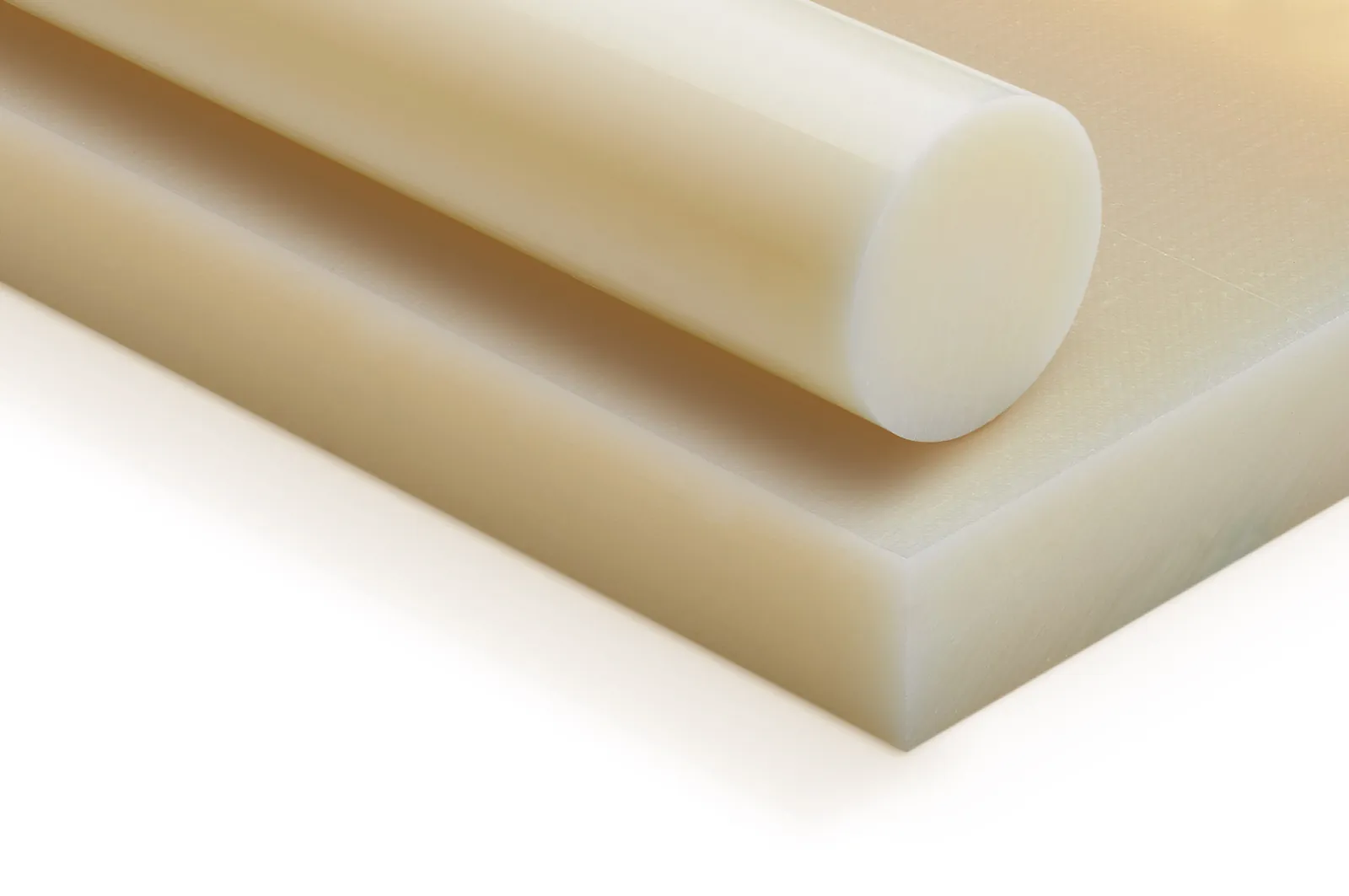
- Semi-finished products (sheets, rods, hollow rods)
- Injection-moulded parts (bearings, gears, housing parts)
- Fibres for the textile industry (nylon)
What is PA66?
PA66 is produced by the polycondensation of hexamethylenediamine with adipic acid. Thanks to the more uniform crystal structure, PA66 achieves higher rigidity, better thermal stability and lower water absorption.
Typical properties of PA66:
- High mechanical strength and rigidity
- Low creep tendency under long-term load
- Lower water absorption than PA6 (approx. 2 % at saturation)
- Higher continuous service temperature (up to 120 °C)
- Good resistance to oils, greases and many solvents
- Better dimensional stability compared with PA6
Typical PA66 products:
- Structural components with high strength
- High-load machine elements
- Design components in safety-relevant areas (e.g. airbag mounts)
Direct comparison of PA6 and PA66
| Property | PA6 | PA66 |
|---|---|---|
| Production process | Ring-opening polymerisation | Polycondensation |
| Crystallinity | Lower | Higher |
| Density | approx. 1.13 g/cm³ | approx. 1.14 g/cm³ |
| Tensile strength | good | very good |
| Rigidity | medium | high |
| Impact strength | very good | good |
| Continuous service temperature | approx. 100–105 °C | approx. 110–120 °C |
| Melting point | approx. 220 °C | approx. 260 °C |
| Water absorption | high (up to 3 %) | medium (up to 2 %) |
| Dimensional stability | limited under moisture | better under moisture load |
| Cost | lower | higher |
Examples of use in industry and engineering
Mechanical engineering
- PA6 is outstandingly suitable for applications with dynamic load, such as bearings, sliding guides, rollers or gears. The good damping makes PA6 the ideal choice for machines subject to vibration.
- PA66 is preferred for heavily loaded structural components, for example in drive elements, gear rims or assembly fixtures. Thanks to the lower water absorption, tolerances are maintained even under changing ambient conditions.
Automotive industry
- PA6 is used in interior trim, tank systems, air filter housings or small assembly parts.
- PA66 excels in thermally and mechanically highly stressed components such as intake manifolds, belt tensioners, structural supports and fastening elements under the bonnet.
Other sectors
Electrical engineering
Thanks to its high rigidity and low water absorption, PA66 is outstandingly suitable for electrical engineering. It is used in connectors, switches, terminal strips and insulators, as it remains dimensionally stable and exhibits good electrical insulation values.
Household appliances
In the household appliance segment, PA6 is used in housings, handles, hinges and components not exposed to heat. PA66, by contrast, is used in thermally highly stressed components such as heating element holders or structurally stressed connections.
Textile engineering
PA6 is used on a large scale for the production of fibres, particularly in the textile sector under the name "nylon". It offers good value for money and can be used in many ways. PA66, by contrast, is suitable for technical fabrics, industrial filters, textile belts and applications with higher mechanical requirements.
Differences in processing technology
Both plastics can be processed well by injection moulding and extrusion, but differ in some parameters:
- PA6 has a lower melting temperature and can therefore be processed more energy-efficiently. However, crystallisation is slower, which can lead to longer cycle times.
- PA66 requires higher mould temperatures and faster crystallisation, as a result of which dimensional stability is reached earlier. However, the energy requirement is higher.
Conclusion
PA6 and PA66 are two versatile engineering plastics, each with specific advantages. While PA6 convinces through its high impact strength, good damping and lower costs, PA66 offers higher mechanical strength, better dimensional stability and greater temperature and moisture resistance. Both materials have their justification – the decision for one or the other material should always be made on the basis of the concrete requirements for mechanical load capacity, thermal conditions, moisture influence and economic efficiency. This allows the optimum result to be achieved for every technical application.
FAQ
Which polyamide is more heat-resistant: PA6 or PA66? PA66 has a higher continuous service temperature and is therefore better suited to applications with constant thermal load.
Is PA6 or PA66 more resistant to moisture? PA66 absorbs less moisture and better retains its mechanical properties even at high humidity.
Which material is more cost-effective? As a rule, PA6 is cheaper, both in terms of material costs and processing.
Are there differences in machining? Both plastics can be machined well. Thanks to its somewhat softer structure, PA6 offers more favourable chip behaviour.
When should glass-fibre-reinforced variants be used? For applications requiring particularly high rigidity or for long, thin-walled components, the use of PA6 GF30 or PA66 GF30 is recommended. These combinations offer significantly improved dimensional stability and mechanical strength.