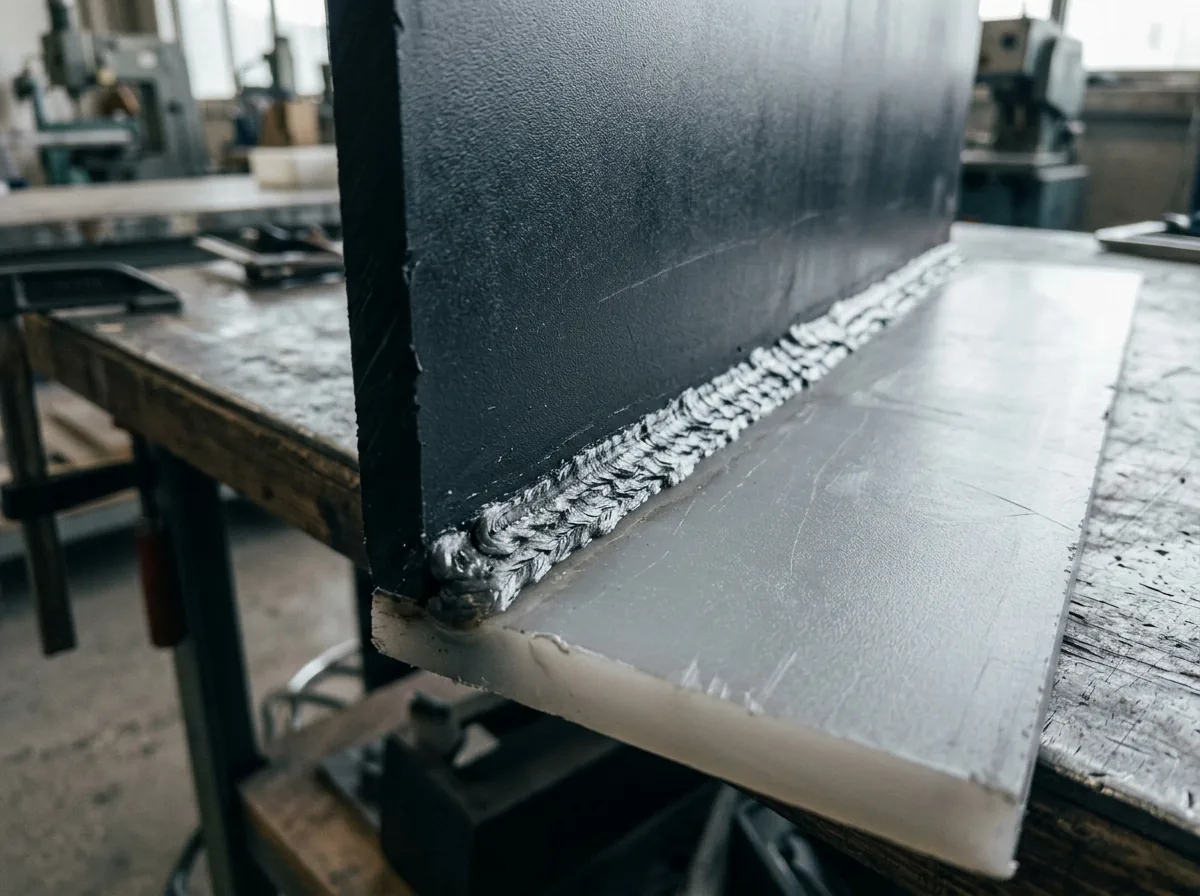
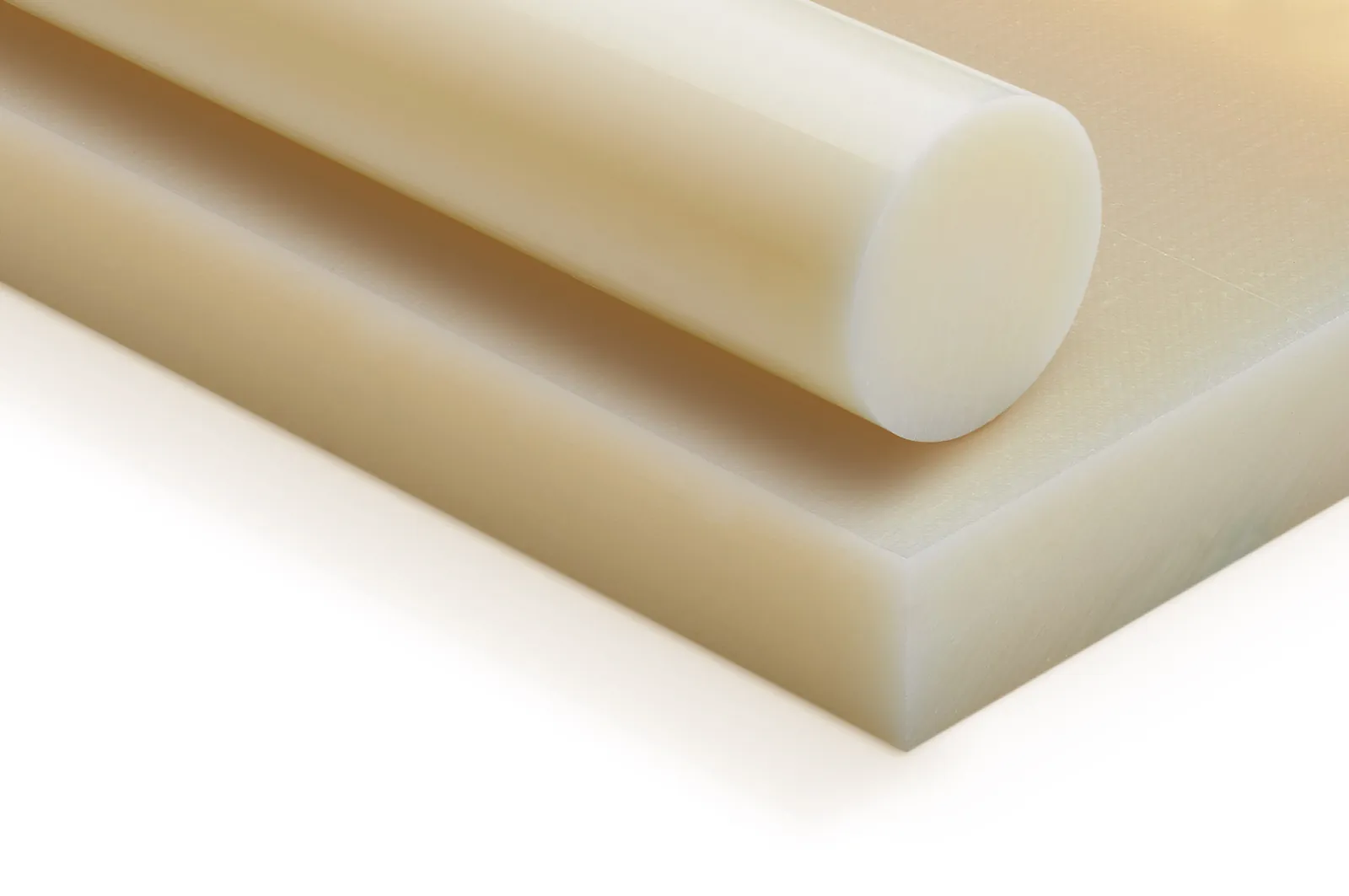
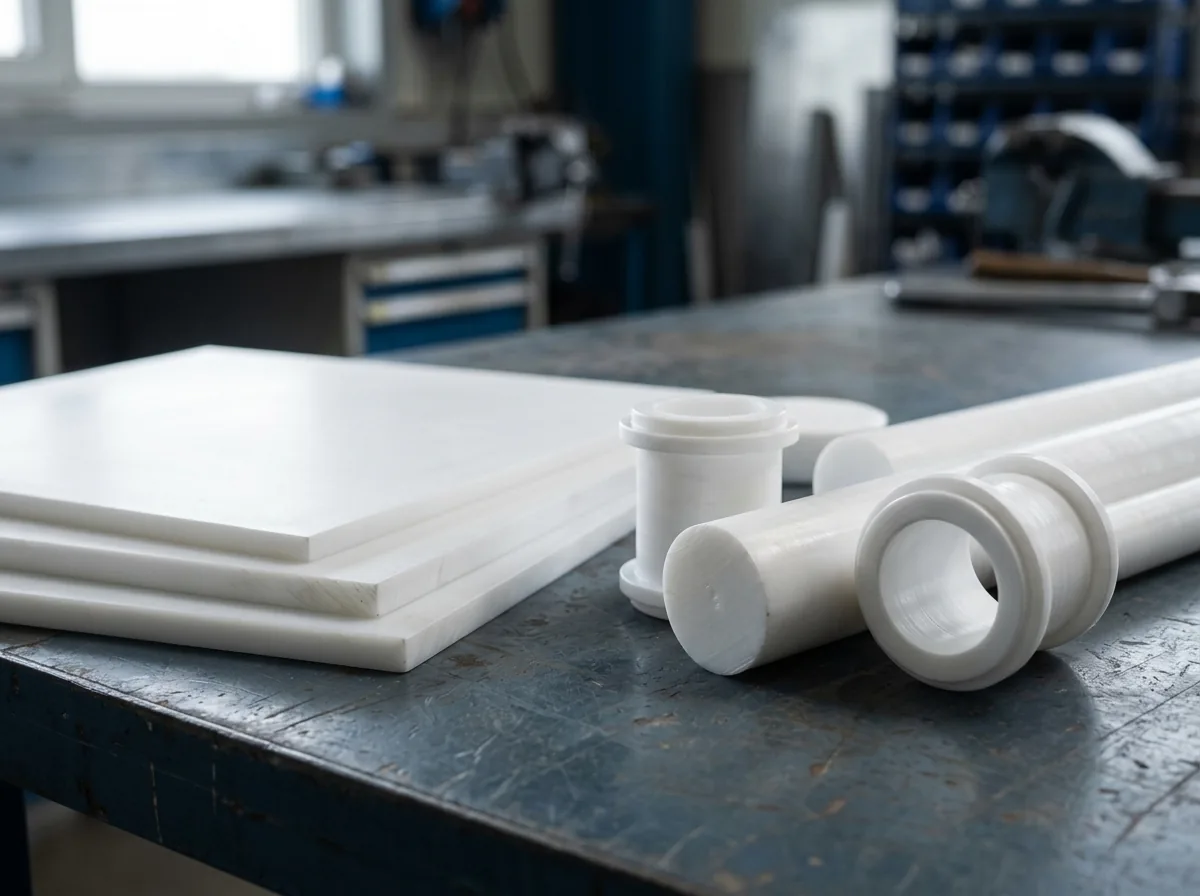
 This image was created with artificial intelligence – marked under Art. 50 of the AI Act, Regulation (EU) 2024/1689. It is a placeholder until the company's photos arrive.
PTFE, POM or PA6: Which plastic is suitable for plain bearings?
Which plastic is suitable for plain bearings? PTFE, POM-C and PA6 compared: friction, wear, load capacity, moisture and dimensional stability.
Anyone looking for the right plastic for plain bearings often ends up with PTFE, POM-C or PA6. All three materials have good sliding properties, but differ significantly in wear resistance, load capacity, dimensional stability, moisture absorption and temperature resistance. That is why the coefficient of friction alone does not determine which plastic is suitable as a plain bearing material.
For precise bearing bushes, POM-C is often the most balanced solution. PA6 offers advantages under high mechanical and impact loads. PTFE comes into consideration above all where low friction, high chemical resistance or a wide temperature range are required.
Which plastic is suitable for plain bearings
A plain bearing made of plastic must guide the shaft reliably, limit friction and resist mechanical wear. At the same time, the bearing bush must not change so much under pressure, heat or moisture that the shaft jams or the operating clearance becomes too large.
Anyone who wants to select the right plain bearing material must therefore consider several factors together:
- surface pressure
- sliding speed
- temperature
- duty cycle
- moisture
- chemical exposure
- shaft material
- surface roughness
- lubrication
- contamination
- manufacturing tolerances
The plastic with the lowest coefficient of friction is not automatically the best plastic for bearing bushes. A material can slide very easily but deform more under continuous load or wear faster. Conversely, a somewhat higher coefficient of friction can be acceptable if the component remains more dimensionally stable and mechanically loadable as a result.
A supplementary overview of the fundamental differences between the engineering materials is provided by the comparison of PA6, POM-C or PE-HD.
PTFE, POM-C and PA6 as plain bearing material in comparison
| Property | PTFE | POM-C | PA6 |
|---|---|---|---|
| Sliding properties | Very good | Good | Good |
| Wear resistance | Limited with pure PTFE | Good | Good to very good |
| Compressive strength | Comparatively low | High | High |
| Creep behaviour | Pronounced | Low | Low to medium |
| Dimensional stability | Limited under continuous load | Very good | Dependent on moisture |
| Moisture absorption | Very low | Low | Comparatively high |
| Chemical resistance | Very high | Good | Dependent on media |
| Temperature resistance | Very high | Medium | Medium |
| Impact strength | Rather low | Good | Very good |
| Vibration damping | Medium | Medium | Very good |
| Machinability | More demanding | Very good | Good |
| Typical strength | Friction and media resistance | Precision and cost-effectiveness | Load capacity and toughness |
The table shows why there is no universally best plastic with good sliding properties. The material selection always depends on the specific combination of load, movement and environment.
Which plastic has the best sliding properties?
Of the three materials, PTFE fundamentally has the lowest coefficient of friction. However, this does not automatically mean that a PTFE plain bearing achieves the longest service life.
Friction and wear must be considered separately. A material can slide easily but deform under continuous load or wear away comparatively quickly. Conversely, a mechanically more loadable plastic with a somewhat higher coefficient of friction can last longer under real operating conditions.
At least three questions are decisive when selecting a wear-resistant plastic for plain bearings:
- How high is the mechanical load?
- How fast and for how long does the shaft move?
- How well can the resulting frictional heat be dissipated?
Add to this start-stop operations, changing loads, dirt, lubrication and the condition of the mating surface.
When is a PTFE plain bearing suitable?
PTFE has very good sliding properties, absorbs practically no moisture and is resistant to many chemicals. The material is therefore suitable for bearing points where low friction, aggressive media or unusual temperatures play a central role.
Typical operating conditions for a PTFE plain bearing are:
- contact with aggressive chemicals
- very low or high temperatures
- low sliding speeds
- dry or emergency running
- sensitive process media
- low breakaway forces
- changing ambient conditions
For milled sliding elements, interlayers and larger bearing components, PTFE sheet cut pieces can be used as the starting material.
Why PTFE creep behaviour can be problematic
PTFE creep behaviour is one of the most important disadvantages in mechanically loaded bearing bushes. Pure PTFE can slowly deform under continuous compressive load. This changes wall thickness, bearing clearance and pressure distribution.
This is particularly critical with:
- high surface pressure
- thin-walled bushes
- tight fits
- continuous static load
- changing load directions
- long service lives under pressure
A plastic for high surface pressure must not only have a low coefficient of friction but also sufficient compressive and creep strength. Pure PTFE often reaches its limits here faster than POM-C or PA6.
Is PTFE more wear-resistant than POM?
In unmodified form, PTFE is not more wear-resistant than POM-C in many loaded plain bearing applications. Although PTFE has a lower coefficient of friction, POM-C often offers higher dimensional stability and mechanical load capacity.
The decision PTFE or POM therefore depends on the priority:
- very low friction and chemical resistance: more likely PTFE
- precision, compressive strength and dimensional stability: more likely POM-C
- high temperature combined with aggressive media: often PTFE
- cost-effective bearing bush in general mechanical engineering: often POM-C
For higher mechanical and thermal requirements, a different high-performance plastic may be necessary instead of PTFE. The comparison of PEEK or PTFE shows where the differences lie in load capacity, temperature and chemical resistance.
When does a POM plain bearing make sense?
POM-C is one of the most important materials for precise sliding and guide elements. A POM plain bearing combines good sliding properties with high strength, low water absorption and very good machinability.
POM-C is particularly suitable for:
- precise bearing bushes
- guide rings
- rollers
- slide rails
- small and medium bearing diameters
- intermittent movements
- moderate sliding speeds
- series parts that are cost-effective to manufacture
For turned bearing bushes and guide rings, POM-C rods can be used as the starting material. For flat sliding elements, rings or individually machined components, POM-C discs are also available.
Why POM-C is often the universal material
POM-C offers a balanced compromise between friction behaviour, wear resistance, compressive strength, dimensional stability and cost. Especially with a precise plain bearing bush made of plastic, low moisture absorption is an advantage.
The POM dimensional stability enables tight and reproducible tolerances. Compared with PA6, the material changes significantly less with fluctuating humidity. This reduces the risk of a bush swelling and the shaft jamming.
POM-C is therefore often suitable for:
- precise fits
- fluctuating humidity
- automated assemblies
- mechanical guides
- food and conveyor technology
- general machine components
The limits lie above all at higher temperatures and with certain chemical media. Before contact with acids, oxidising agents or permanently hot water, the chemical resistance of the plastic should be checked.
Is POM-C suitable for dry running?
POM-C can be used as a plastic for dry running if surface pressure, sliding speed and running time remain moderate. For permanently high running performance, however, a specially modified material may be more suitable.
A POM-PTFE compound contains solid lubricants that can reduce friction and wear. Such materials are often better suited for a plastic plain bearing without lubrication than unmodified standard POM.
Whether POM-C is sufficient in dry running depends, among other things, on:
- shaft material
- surface roughness
- surface pressure
- speed
- operating temperature
- duty time
- cooling
- dirt ingress
POM-C is therefore not universally self-lubricating. The term self-lubricating plastic should only be used for materials that have been specially modified for tribological applications.
When is a PA6 plain bearing suitable?
PA6 has high toughness, good wear resistance and pronounced damping properties. A PA6 plain bearing is therefore particularly suitable for larger, mechanically loaded and impact-stressed bearing points.
Typical areas of application are:
- larger bearing bushes
- high mechanical loads
- impact loads
- oscillating constructions
- rollers
- guides
- slow-running bearings
- low-noise bearing points
- plastic bearings in mechanical engineering
For individually turned or milled components, PA6 discs can serve as semi-finished products.
Which material is suitable for high bearing loads?
Under high mechanical loads, PA6 is often more suitable than pure PTFE. The material can better absorb impact loads and vibrations and has higher toughness.
Whether PA6 or POM-C is more suitable depends on the type of load:
- high impact load and vibration: more likely PA6
- tight tolerances and high dimensional stability: more likely POM-C
- larger bearing diameters: often PA6
- fluctuating moisture: often POM-C
- mechanical robustness: often PA6
- precise series bush: often POM-C
The decision POM or PA6 is therefore not purely a question of strength. POM-C is more dimensionally stable, PA6 is tougher and damps load peaks better.
How does moisture change a PA6 plain bearing?
The PA6 moisture absorption is the most important design difference from POM-C and PTFE. PA6 absorbs moisture from the environment. This can change dimensions, stiffness, strength and toughness.
For a plastic plain bearing in moisture, this means:
- The inner diameter can change.
- The operating clearance can become smaller.
- The bush can jam on the shaft.
- The stiffness can decrease.
- The toughness can increase.
- Dry datasheet values can differ from the later operating values.
Moisture absorption does not rule out PA6 as a plain bearing material. However, it must be taken into account in the design. A larger initial clearance, realistic manufacturing tolerances and, if necessary, conditioning of the component may be required.
The material comparison of PA6, POM-C or PE-HD explains the differences in water absorption and dimensional behaviour further.
Is PA6 suitable for dry running?
PA6 can run dry under suitable conditions. For continuous dry running with high running performance, however, modified variants are often more suitable.
A PA6 G + oil plain bearing contains incorporated lubricants that reduce friction and wear. A PA6 MoS2 plain bearing can also exhibit better tribological properties than unmodified PA6.
Such materials come into consideration when:
- external lubrication is undesirable,
- the bearing point is difficult to access,
- dirt would adhere to lubricants,
- longer maintenance intervals are required,
- friction and wear are to be reduced compared with standard PA6.
Whether PA6 or PTFE is more suitable again depends on the application. In the decision PA6 or PTFE, PA6 usually offers higher mechanical load capacity, while PTFE has advantages in friction, chemical resistance and temperature.
Do plastic plain bearings need lubrication?
Many plastic plain bearings can be used without additional lubrication. However, this does not mean that every bearing point operates permanently maintenance-free.
Lubrication can:
- reduce the coefficient of friction,
- decrease wear,
- improve heat dissipation,
- reduce noise,
- increase service life.
At the same time, lubrication can be undesirable with plastic bearings. Oil or grease can bind dirt, contaminate process media or chemically attack the plastic.
Before using a lubricant, it should be checked:
- Is the lubricant compatible with the plastic?
- May it come into contact with the process medium?
- Can it be washed out?
- Does it change the plastic?
- Is a dry-running compound more suitable?
A plastic plain bearing without lubrication is particularly useful when maintenance is difficult or clean operating conditions are required. In such cases, the material grade should be specifically designed for dry running.
What role does the PV value play in plastic plain bearings?
The PV value of a plain bearing combines surface pressure and sliding speed:
PV = surface pressure × sliding speed
It serves as an initial guide for the mechanical and thermal load on the bearing point. A high load at low speed can be just as critical as a lower load at high speed.
The permissible PV value depends on:
- material grade
- fillers
- ambient temperature
- cooling
- lubrication
- shaft material
- surface roughness
- bearing geometry
- duty cycle
- type of movement
A datasheet value must not be applied to every design without verification. Especially with oscillating movements, frequent starting or poor heat dissipation, the actual load limits can be lower.
How can plain bearing wear be calculated?
Calculating plain bearing wear is only possible approximately with plastics. In addition to pressure and speed, temperature, surface roughness, lubrication, contamination and material pairing also influence service life.
For an initial design, the following can be used:
- PV value
- specific wear rate
- sliding distance
- surface pressure
- sliding speed
- duty cycle
- expected temperature
In critical applications, the calculated design should be supplemented by a practical test. Even small changes in the shaft surface or the material modification can significantly change the wear rate.
Which shaft surface is suitable for plastic plain bearings?
The mating surface has a direct influence on friction and wear. A shaft that is too rough can abrasively wear away the plastic. An unsuitable, very smooth surface can also be problematic with certain material pairings because no stable transfer film forms.
The following must be taken into account:
- shaft material
- surface hardness
- roughness
- coating
- corrosion resistance
- concentricity
- edges
- dirt particles
With filled or fibre-reinforced sliding materials, it must additionally be checked whether hard fillers attack the shaft. A wear-resistant plastic for plain bearings can thus last longer but at the same time place greater stress on the mating partner.
What role does bearing clearance play?
Plastics react more strongly to temperature and moisture than metallic bearing materials. The required bearing clearance must therefore accommodate several influences:
- manufacturing tolerances
- thermal expansion
- water absorption
- deformation under load
- press-fit deformation
- shaft deviations
- contamination
With POM-C, tighter and more stable tolerances can generally be achieved than with PA6. With PA6, the later moisture condition must be taken into account. Although PTFE absorbs hardly any moisture, it can deform under continuous load due to creep.
Material properties also change at low temperatures. Anyone using plastic bearings in cold environments should therefore also consider the behaviour of plastics at low temperatures.
When should a modified sliding material be used?
Standard PTFE, standard POM-C and standard PA6 are not sufficient for every bearing point. For high running performance, dry running or demanding loads, modified materials are often the better solution.
Typical variants are:
- PA6 G with incorporated oil
- PA6 with molybdenum disulphide
- POM with PTFE
- filled PTFE
- fibre-reinforced compounds
- special tribological high-performance plastics
The additives can:
- lower the coefficient of friction,
- reduce wear,
- improve compressive strength,
- reduce creep behaviour,
- increase emergency running properties.
At the same time, fillers can reduce impact strength, place greater stress on the mating surface or restrict suitability for food contact. It is therefore not enough to specify only the polymer group. The specific material grade is decisive.
Which plastic is suitable for which application?
Precise bearing bush in a machine
For a dimensionally accurate bearing bush at normal temperatures and moderate load, POM-C is often the most cost-effective choice. The material is easy to machine, absorbs little moisture and enables reproducible tolerances. POM-C rods, for example, are suitable as the starting material.
Large and impact-loaded bearing point
For larger dimensions, changing loads and vibrations, PA6 can be more suitable. The high toughness and damping speak in favour of the material. However, the necessary bearing clearance must take moisture absorption into account. For individually machined components, PA6 discs can be used.
Chemically aggressive plant
In contact with aggressive media, much speaks in favour of PTFE or a suitable PTFE compound. For larger sliding elements and interlayers, PTFE sheets cut to size can be used. Before selection, however, the specific chemical resistance of the plastic should be checked.
Continuous dry running
For continuous dry running, pure PTFE is not automatically the best choice. A POM-PTFE compound or oil-modified PA6 can achieve a better combination of wear resistance, load capacity and cost-effectiveness.
Bearing point with fluctuating moisture
POM-C offers advantages when tight tolerances must be maintained. PA6 can be used when dimensional changes are taken into account in the design and toughness is more important than maximum dimensional stability.
Elevated or very low temperatures
PTFE fundamentally has the widest temperature range of the three materials. Nevertheless, load, creep behaviour and material modification must be checked. At very low temperatures, the notes on plastics at low temperatures should also be taken into account.
Selecting PTFE, POM-C or PA6 by priority
PTFE is particularly suitable when very low friction, high chemical resistance or a wide temperature range are the focus. Under high continuous load, a filled variant or a composite system should be checked.
POM-C is often the best starting basis for precise, cost-effective and moderately loaded plastic plain bearings. The material offers high dimensional stability, good machinability and low water absorption.
PA6 is particularly interesting when toughness, damping, size and mechanical robustness are decisive. Moisture absorption and the resulting dimensional changes must be taken into account in the design.
For permanently high loads, high speeds or demanding temperatures, the rough choice between PTFE, POM and PA6 is not enough. Then PV value, specific material grade, mating surface, bearing clearance and expected wear rate must be assessed together.
Which plastic is best suited for plain bearings?
For precise and moderately loaded plain bearings, POM-C is often the most balanced standard material. PA6 is particularly suitable for high mechanical and impact loads. PTFE is advantageous when very low friction, high chemical resistance or a wide temperature range are required.
Is PTFE or POM more wear-resistant?
In many mechanically loaded plain bearing applications, unmodified POM-C is more wear-resistant and dimensionally stable than pure PTFE. Although PTFE has a lower coefficient of friction, it tends to creep more under continuous load. Filled PTFE materials can achieve significantly better wear properties.
Can PA6 run dry as a plain bearing?
PA6 can run dry with suitable load, speed and mating surface. For permanently high running performance, however, modified variants such as PA6 G with oil or molybdenum disulphide are often better suited. The specific suitability should be checked via the permissible PV value and the expected wear rate.
What role does moisture play in a PA6 plain bearing?
PA6 absorbs moisture from the environment. This can change dimensions, stiffness and strength. With tight fits, the possible dimensional change must be taken into account already in the bearing clearance, in the manufacturing tolerances and, if necessary, in the conditioning of the component.