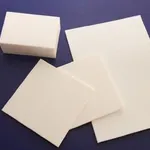
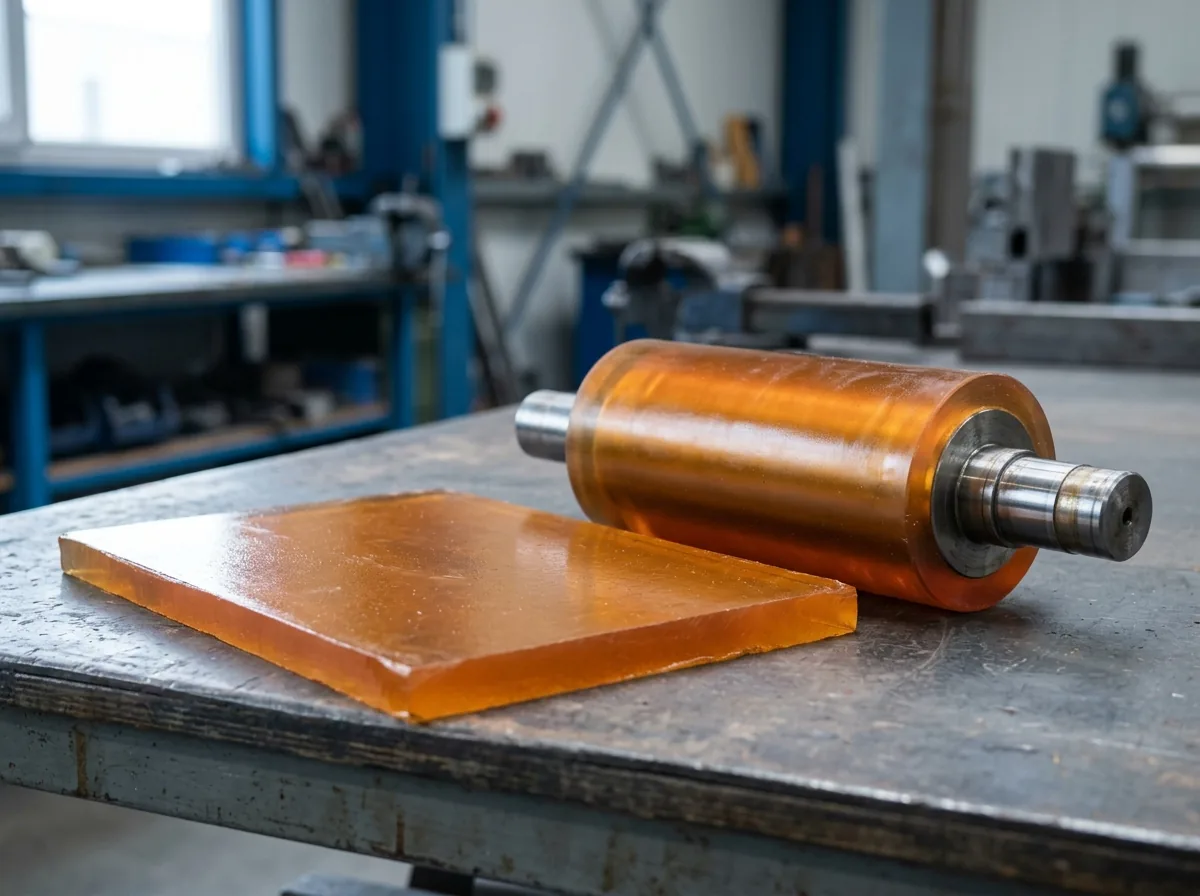
 This image was created with artificial intelligence – marked under Art. 50 of the AI Act, Regulation (EU) 2024/1689. It is a placeholder until the company's photos arrive.
Fibre gaskets
Fibre gasket materials in industrial use: construction, mode of operation, areas of application and selection criteria explained concisely.
Fibre gasket materials
Properties, areas of application and selection
Your partner for elastomers
Polyurethane elastomers are a family of elastic polymers formed from the reaction of polyols and isocyanates. They are distinguished by a wide range of properties that make them suitable for a broad spectrum of applications in various industries.
Contact us
Benefits you can expect from Martan Gummi
Large selection of rubber mats, rubber sheets, O-rings
Individual solutions on site
Rubber processing and sealing technology
Designing, drafting and drawing your parts
The highest degree of precision
XXL machine park, plotting, punching, bonding
Contact us
Fibre gasket materials are among the established sealing solutions in industry and engineering. They are used wherever liquids or gases must be reliably sealed and, at the same time, a certain adaptability to flange or housing surfaces is required. Through their balanced combination of mechanical stability, elasticity and media resistance, they cover a large proportion of classic industrial applications.
The following article provides a structured overview of the structure, mode of operation and properties of fibre gasket materials. In addition, typical areas of application, selection criteria and notes on processing and installation are explained in order to support a well-founded material decision in an industrial environment.
What are fibre gasket materials?
Fibre gasket materials are industrial flat gaskets made from fibre-reinforced materials with elastomeric binders. They serve to reliably seal liquids or gases between two components while at the same time compensating for manufacturing tolerances, unevenness or slight deformation of the sealing surfaces. Because of these properties, fibre gasket materials are among the most widely used sealing solutions in mechanical and plant engineering as well as in many adjacent industrial sectors.
Typical of fibre gasket materials is their combination of mechanical stability and elastic behaviour. As a result, they can be well compressed, adapt to the flange geometry and retain their sealing effect over long periods.
Structure and material composition
The structure of a fibre gasket material is based on a composite material whose properties are specifically tailored to industrial requirements. The central components are:
- Fibrous materials such as cellulose, aramid or mineral fibres to increase tensile and compressive strength
- Elastomeric binders, often based on NBR, for elasticity and resilience
- Fillers and additives to optimise media resistance, ageing behaviour and temperature stability
Depending on the composition, fibre gasket materials can be optimised for different areas of application. High-quality grades are distinguished by a uniform material structure and reproducible technical characteristics.
Mode of operation of fibre gasket materials
The mode of operation of fibre gasket materials is based on the targeted interaction of surface pressure, controlled material deformation and permanent resilience. When the bolted connection is tightened, the gasket is uniformly compressed between the components. In doing so, the material fills microscopic unevenness, scores or tolerances of the sealing surfaces and forms a closed sealing line.
The elastomeric binders within the fibre gasket material provide the necessary adaptability and ensure that the gasket retains its sealing effect even under temperature fluctuations, pressure changes or slight settling movements. These restoring forces compensate for changes in the system and prevent leaks during operation.
At the same time, the embedded fibrous materials perform a load-bearing function. They limit the flow of the material under load, increase compressive strength and secure the dimensional stability of the gasket even under prolonged stress. As a result, the gasket thickness remains largely constant over a long period.
Technical properties
Fibre gasket materials have a balanced technical property profile that makes them suitable for many standard and industrial applications.
Typical properties are:
- Good adaptability to flange surfaces with slight unevenness
- Resistance to oils, fuels and water depending on the material grade
- Stable compressive elasticity over a long period of use
- Mechanical load capacity even under changing operating conditions
- Low settling behaviour with proper installation
The exact characteristics such as compressive strength, resilience or media resistance are material-dependent and should always be checked against technical data.
Temperature and pressure ranges
Fibre gasket materials are designed for medium temperature and pressure ranges, as are customary in many industrial applications. They cover a broad range of typical operating conditions and are suitable for numerous flanged connections in plant and mechanical engineering.
For applications with elevated temperatures, high pressures or extreme load cycles, alternative gasket materials are available. Precise matching to the application contributes significantly to operational safety.
Media resistance
The media resistance of fibre gasket materials depends strongly on the respective material composition. Typical media used are:
- Water and steam
- Mineral oils and lubricants
- Fuels
- Air and technical gases
For chemically demanding applications or special media, a targeted material test is recommended in order to rule out interactions or material damage.
Typical areas of application
Fibre gasket materials are used wherever reliable sealing is required under medium temperature and pressure requirements and, at the same time, a certain adaptability to the sealing surfaces remains necessary. Through their balanced material properties, they are suitable for numerous industrial applications in which cost-effectiveness, availability and stable sealing performance are the priority.
Mechanical and plant engineering
In mechanical and plant engineering, fibre gasket materials are used above all in flange, cover and housing connections. They compensate for manufacturing tolerances and slight unevenness of the sealing surfaces and help to avoid leaks even under changing loads. Particularly in modular plants, they offer a practical and maintenance-friendly sealing solution.
Pump and valve technology
In pump and valve technology, fibre gasket materials seal housings, flanges and screwed connections. They support uniform surface pressure and ensure a stable sealing effect under pressure and temperature fluctuations, as frequently occur during operation.
Engine and gearbox construction
In engine and gearbox construction, fibre gasket materials are used to seal oil and lubricant circuits. They offer a reliable sealing effect at moderate temperatures and mechanical loads and are suitable for applications in which dimensional accuracy and dimensional stability are required.
Heating, sanitary and air-conditioning technology
In heating, sanitary and air-conditioning technology, fibre gasket materials are used in water, steam and heating circuits. They offer an economical solution for standardised flanged connections and support reliable operation over long service lives.
Energy and supply technology
In energy and supply technology, fibre gasket materials are used in pipelines, units and auxiliary systems. There they contribute to the safe sealing of technical media and support stable plant operation under continuous load.
General industrial flange and housing connections
For numerous general industrial applications, fibre gasket materials represent a proven standard solution. They are used when medium temperature and pressure ranges are to be covered and reliable, low-maintenance sealing is required.
Advantages of fibre gasket materials
Compared with many other gasket materials, fibre gasket materials offer several practice-relevant advantages:
- Broad application spectrum for different media
- Good adaptation to uneven or slightly damaged flange surfaces
- Economical solution for series and one-off applications
- Simple processing and reliable installation
- Good availability in different thicknesses and formats
These properties help to shorten installation times and reduce maintenance effort.
Selecting the right fibre gasket material
The selection of a suitable fibre gasket material should always be application-related. Essential criteria are:
- Type and temperature of the medium to be sealed
- Operating pressure and pressure fluctuations
- Flange geometry, surface quality and bolt arrangement
- Desired service life and maintenance intervals
Careful matching of the gasket material to the operating conditions increases process reliability and contributes to long-term operational safety.
Processing, cutting and installation
Fibre gasket materials can be processed flexibly and are suitable both for series production and for individual applications. The material can be punched, cut or plotted and is available as sheet material, ring gasket or manufactured to drawing. As a result, even complex contours or short-notice replacement solutions can be implemented precisely.
Careful installation is decisive for reliable sealing. The sealing surfaces should be clean, flat and free of residues so that the gasket can adapt evenly. When bolting, care must be taken to tighten the connection evenly in order to achieve homogeneous surface pressure. Recommended tightening torques help to operate the gasket within its intended working range.
Over-compression should be avoided, as it can impair the material structure and reduce the long-term sealing effect. With proper processing and installation, fibre gasket materials make a reliable contribution to stable and low-maintenance connections.
Standards, quality and industrial requirements
High-quality fibre gasket materials meet defined industrial quality requirements and are manufactured according to reproducible production processes. Technical data sheets provide information on pressure, temperature and media resistance and form the basis for safe design.
In many branches of industry, documented material quality plays a central role for approvals and maintenance concepts.
Distinction from other gasket materials
Compared with rubber gaskets, fibre gasket materials offer higher dimensional stability and better compressive strength. Compared with PTFE or graphite gaskets, they score with their cost-effectiveness and their broad application spectrum in the medium load range.
For applications with extreme requirements, high-performance gaskets are often used, while fibre gasket materials cover the majority of industrial standard cases.
Summary
Fibre gasket materials have established themselves as a versatile and economical solution for numerous industrial sealing tasks. They combine mechanical stability, elastic behaviour and broad media resistance in one material and are therefore suitable for a large proportion of classic flange and housing connections.
Through the targeted selection of the material composition, fibre gasket materials can be precisely adapted to temperature, pressure and media requirements. In combination with proper installation, they contribute significantly to operational safety, to the reduction of maintenance effort and to stable process flows.
For many applications in mechanical and plant engineering, fibre gasket materials therefore represent a technically proven and economically sensible sealing solution.
Frequently asked questions about fibre gasket materials
For which applications are fibre gasket materials particularly suitable? Fibre gasket materials are suitable for industrial applications with moderate temperature and pressure requirements, such as flange and housing connections in mechanical and plant engineering, in pumps, valves and supply technology.
Which media can be sealed with fibre gasket materials? Depending on the material composition, they are suitable for water, steam, mineral oils, lubricants, fuels as well as air and technical gases.
Are fibre gasket materials resistant to oil and fuel? Many grades are suitable for oils and fuels. The exact resistance depends on the binder and fibre structure and should be checked against technical data.
Which temperature ranges are possible with fibre gasket materials? Fibre gasket materials are designed for the medium temperature range. For permanently higher temperatures, specially designed gasket materials are intended.
Can fibre gasket materials be manufactured individually? Yes, fibre gasket materials can be punched or cut to size, drawing or sample and are also suitable for special geometries.
What must be observed when installing fibre gasket materials? Clean sealing surfaces, even bolting and compliance with recommended tightening torques are decisive.
How do fibre gasket materials differ from rubber or PTFE gaskets? They offer more dimensional stability than rubber gaskets and are more economical than PTFE or graphite gaskets in many standard applications.
How long is the service life of fibre gasket materials? The service life depends on the medium, temperature, pressure and installation and, with suitable selection and installation, achieves long service lives.
REQUEST YOUR NON-BINDING QUOTE NOW
Submit individual enquiry
Our industries
Mechanical & plant engineering
Conveyor technology
Food industry
Automotive industry
Packaging industry
Medical / laboratory technology
Vehicle technology
Water technology
Aerospace industry
Rail technology
Shopfitting
Aviation industry
Mechanical & plant engineering
Conveyor technology
Food industry
Automotive industry
Packaging industry
Medical / laboratory technology
Vehicle technology
Water technology
Aerospace industry
Rail technology
Shopfitting
Aviation industry
Contact us