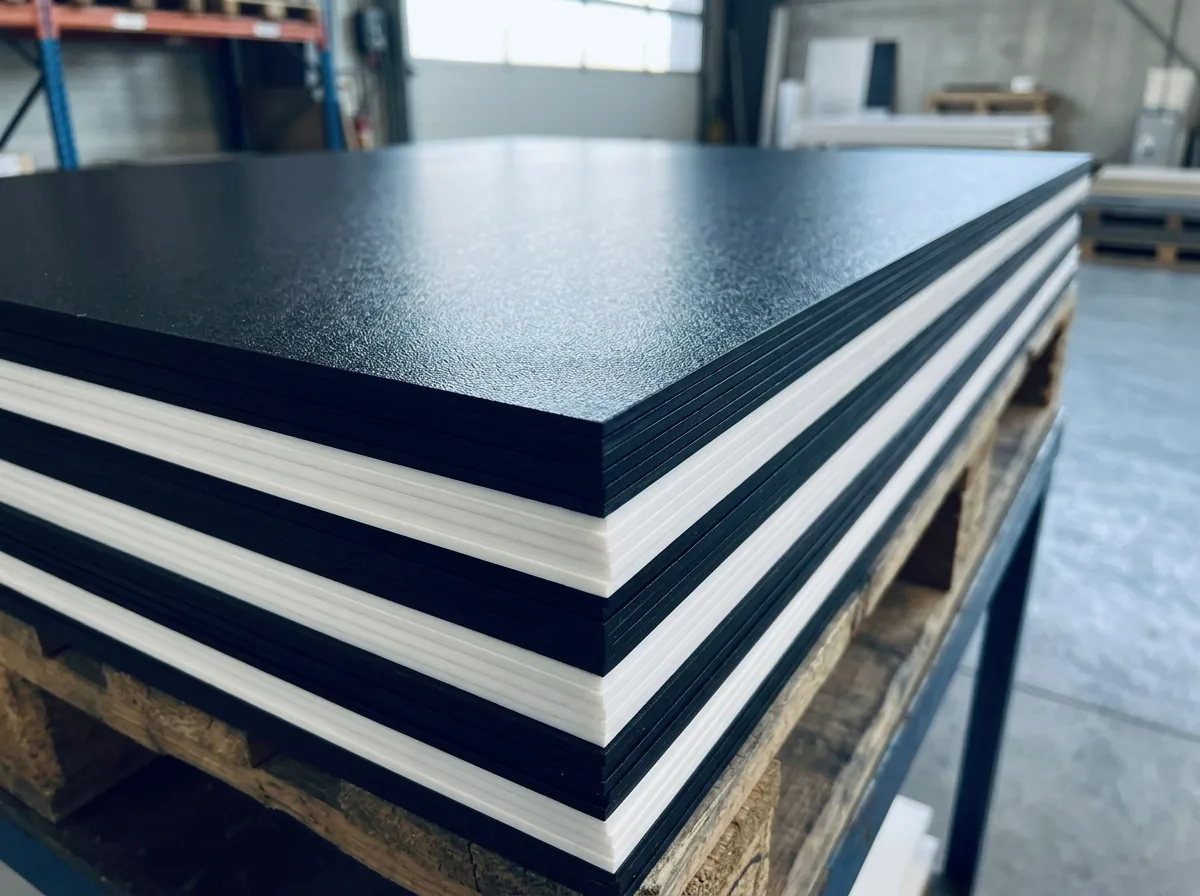
 This image was created with artificial intelligence – marked under Art. 50 of the AI Act, Regulation (EU) 2024/1689. It is a placeholder until the company's photos arrive.
Mechanical properties and advantages of ABS plastic sheets
What are ABS plastic sheets? More about the properties, advantages, machining and areas of application of ABS sheets in industry and engineering.
ABS plastic sheets are among the versatile thermoplastic semi-finished products. They combine good impact strength with low weight, high dimensional stability and easy processing. This makes ABS sheets suitable for numerous applications, such as housings, cladding, covers or technical components.
Below you will find out what ABS is as a material, what properties distinguish ABS plastic sheets, what advantages the material offers and for which areas of application it is particularly suitable.
What are ABS plastic sheets?
ABS stands for acrylonitrile butadiene styrene. This is a thermoplastic whose property profile is made up of three components: acrylonitrile contributes to chemical and thermal resistance, among other things, butadiene provides toughness and impact strength, while styrene supports rigidity and an easily processable surface.
As a sheet material, ABS therefore combines strength, impact strength and good machinability with a comparatively low weight. ABS plastic sheets are available in different colours, thicknesses and surface structures and can be milled, sawn, drilled, glued, painted or thermally formed.
Detailed information on the base material can be found in the material profile ABS.
For specific applications, ABS sheets are particularly interesting when a robust surface, good formability and economical processing are required.
Mechanical properties of ABS plastic sheets
ABS plastic sheets are characterised by a combination of properties that make them particularly robust and versatile. The specific values can vary depending on the ABS type, manufacturer and modification.
| Property | Typical property profile | Benefit in practice |
|---|---|---|
| Tensile strength | good | Suitable for mechanically stressed components |
| Flexural strength | good | Dimensionally stable in structural applications |
| Impact strength | high | Resistant to impacts and vibrations |
| Surface hardness | good | Suitable for housings and visible parts |
| Heat deflection resistance | depends on the ABS quality | Use under moderate thermal load |
| Density | approx. 1.04–1.05 g/cm³ | Comparatively low weight |
| Chemical resistance | good against selected oils and greases | Suitable for numerous technical applications |
| Electrical properties | electrically insulating | Suitable for many housings and covers |
When selecting the material, the technical data of the respective ABS quality should be checked. Temperature, media contact, mechanical load and, where applicable, UV exposure can significantly influence suitability.
Advantages of ABS plastic sheets
ABS plastic sheets offer numerous advantages for technical and design applications:
- High impact strength: ABS can absorb impact loads well and is therefore suitable for housings, cladding and protective components.
- Easy processing: ABS sheets can be sawn, milled, drilled, glued and thermally formed.
- Uniform surface: Depending on the version, the material can be painted, printed or coated well.
- Low weight: ABS is suitable for constructions in which weight and simple assembly play a role.
- Electrical insulation: The material is therefore suitable, among other things, for housings and components in the electrical and electronics industry.
- Good formability: ABS is particularly suitable for deep-drawing and thermoforming applications.
- Various versions: Depending on the requirement, different colours, surfaces and modified ABS types are available.
For outdoor applications, a UV-stabilised ABS quality should be selected specifically, as standard ABS has only limited resistance to long-term UV radiation.
Typical areas of application for ABS sheets
Mechanical engineering
ABS sheets are used in mechanical engineering for housings, covers, machine cladding and protective devices. They can be adapted to the required dimensions comparatively easily and provided with holes, cut-outs or mounting points.
Thanks to the combination of impact strength, low weight and good machinability, they are particularly suitable for applications in which no extreme thermal or mechanical loads occur.
Automotive industry
In the automotive industry, ABS is frequently used for interior components, cladding, consoles, covers and other moulded parts. The good thermoformability enables complex geometries, while the surface offers various design options.
Electronics and electrical engineering
ABS is suitable for housings, control panels, covers and other components. The electrical insulating effect and the good machinability facilitate the production of custom cut-outs, holes and fastenings.
For applications with special requirements regarding flame protection, electrostatic properties or temperature resistance, a correspondingly modified material quality must be selected.
Trade fair and advertising technology
In trade fair and advertising technology, ABS sheets are used, among other things, for displays, cladding, stand construction elements and signs. The low weight facilitates transport and assembly, while the surface can be designed well.
Furniture and interior fitting
ABS sheets can be used for cladding, covers, fronts and decorative components. The robust surface and the possibility of cutting the material to size individually and processing it further are particularly advantageous.
Model making and prototype construction
ABS is also a frequently used material in model making and prototype construction. Sheets can be machined comparatively easily and enable quick adjustments during the development phase.
Machining ABS sheets: sawing, milling, drilling and forming
ABS plastic sheets can be machined using different processes:
- Sawing: Fine-toothed saw blades and an adapted cutting speed support clean cut edges.
- Milling: ABS can be machined well by cutting and is suitable for precise contours, cut-outs and hole patterns.
- Drilling: With suitable tools, fastening and through holes can be made.
- Gluing: Depending on the application, suitable plastic adhesives and bonding methods are available.
- Thermoforming: ABS can be heated and then formed into complex geometries.
- Surface treatment: Depending on the sheet quality, painting, printing and other finishing processes are possible.
During cutting machining, tool geometry, speed and feed should be matched to the material so that excessive heat generation and unclean cut edges are avoided.
ABS sheet or ABS film – what is the difference?
ABS can be used both as a sheet and in thinner delivery forms or films. The essential difference lies primarily in material thickness, rigidity and further processing.
ABS sheets are used when a dimensionally stable semi-finished product is required for housings, cladding, technical components or structural applications.
ABS films are considerably thinner and are used, for example, for surfaces, cladding or as a starting material for certain thermoforming applications.
Which delivery form is suitable depends on the component geometry, the required rigidity and the intended manufacturing process.
When are ABS plastic sheets the right choice?
ABS sheets are particularly suitable when the following requirements come together:
- good impact strength
- low component weight
- easy cutting machining
- good thermoformability
- high-quality or designable surface
- economical production of housings and cladding
- moderate thermal load
For permanently high temperatures, particularly aggressive chemicals, high wear stress or extreme mechanical loads, other engineering or high-performance plastics may be more suitable.
An initial overview of different materials is provided by the article plastics in comparison.
Buy ABS plastic sheets or have them individually machined
If you need an ABS sheet for a specific application, the selection should not be made solely on the basis of sheet thickness. Relevant factors include service temperature, mechanical load, desired surface, colour, ambient conditions and the intended machining.
Suitable ABS semi-finished products can be found, for example, as ABS sheets and as black ABS sheets.
For individual components, ABS can then be cut to size and machined according to the respective technical requirements.
Frequently asked questions about ABS plastic sheets
What is ABS material?
ABS is the abbreviation for acrylonitrile butadiene styrene. It is a thermoplastic that offers a good combination of impact strength, rigidity, low weight and easy processing.
What are ABS sheets?
ABS sheets are sheet-shaped semi-finished products made of acrylonitrile butadiene styrene. They are used, among other things, for housings, cladding, covers, displays, prototypes and thermally formed components.
What advantages do ABS plastic sheets have?
The most important advantages include high impact strength, good machinability, low density, good thermoformability and a uniform, easily designable surface.
How can ABS sheets be machined?
ABS sheets can be sawn, milled, drilled, glued and thermally formed, among other things. Painting and printing are also possible with suitable surface preparation.
Are ABS sheets heat-resistant?
ABS has a moderate temperature resistance. The actually permissible service temperature depends on the respective material quality and the operating conditions. For permanently higher temperatures, specially modified ABS types or alternative engineering plastics should be considered.
Are ABS sheets UV-resistant?
Standard ABS is only suitable to a limited extent for long-term UV exposure. Specially UV-stabilised ABS qualities are available for outdoor applications.
What is the difference between ABS sheets and ABS films?
ABS sheets are thicker, dimensionally stable semi-finished products for technical and structural applications. ABS films are thinner and are used, among other things, for surfaces, cladding or certain thermoforming applications.
ABS plastic sheets for technical applications
ABS plastic sheets combine impact strength, good surface quality and versatile processing options. Particularly for housings, cladding, covers, thermoformed parts and prototypes, the material offers a balanced ratio of technical performance and economical processing.
For the specific material selection, however, temperature, load, media contact, UV exposure and the intended production should always be taken into account. On this basis, it is possible to determine which ABS quality and sheet version is suitable for your application.