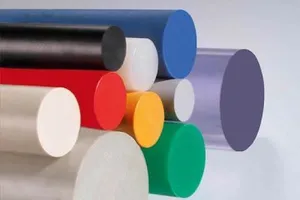
Plastic rods
PET rod – cut to size
PET Rods Natural: Versatile plastic for demanding applications PET rods natural, also known as polyethylene terephthalate rods, are a versatile…
Configure your cut
Description
PET Rods Natural: Versatile plastic for demanding applications
PET rods natural, also known as polyethylene terephthalate rods, are a versatile high-performance plastic used in many industrial and technical applications. These rods are characterised by high strength, excellent dimensional stability and low friction, which makes them an ideal choice for mechanically demanding uses. PET rods offer an outstanding combination of thermal, chemical and mechanical properties that make them particularly attractive for a wide range of technical applications.
Polyethylene terephthalate (PET) is a semi-crystalline thermoplastic characterised by its high wear resistance and resistance to chemicals. PET also has low water absorption and excellent dimensional accuracy, which means that components made from PET remain precise even under changing conditions. This makes PET rods suitable for many demanding applications in the automotive industry, in mechanical engineering and in the food industry.
Below you will find detailed information on the properties, technical data and areas of application of PET rods, which make them an indispensable material for numerous technical applications.
Processing and advantages of PET rods natural
Machining of PET rods
PET rods can be readily processed with conventional machining methods such as turning, milling or drilling. Due to the high hardness and rigidity of the material, care should be taken to use sharp tools during machining in order to ensure clean and precise production. PET can also be further processed by thermal methods such as extrusion, which offers a wide range of possible uses.
The material can also be readily bonded and welded, which enables versatile use and assembly of the components. The thermal stability of PET ensures that the components retain their shape and precision even with temperature fluctuations.
Weather and chemical resistance
PET rods are resistant to many chemicals, including oils, greases and a wide range of organic solvents. This chemical resistance makes them the ideal choice for industrial environments in which contact with aggressive substances is unavoidable. PET also exhibits good resistance to weather influences, which means that the rods remain stable even under prolonged exposure to moisture and UV radiation.
The low moisture absorption of PET ensures that the mechanical properties are not impaired even under damp conditions. This makes the material particularly suitable for outdoor applications or in environments with high humidity.
Properties
PET rods are characterised by high strength and rigidity. The material offers excellent wear resistance and low sliding friction, which makes PET an outstanding choice for moving parts. The good impact strength, even at low temperatures, ensures a long service life of the components, even under harsh operating conditions.
A further advantage of PET rods is their low moisture absorption. This ensures that the mechanical properties are retained even at high humidity. PET is also chemically resistant to many solvents, oils and greases, which makes it particularly suitable for use in industrial environments.
Applications
Use in mechanical engineering
In mechanical engineering, PET rods are frequently used as sliding bearings, guide elements or for gears, as the material offers high wear resistance and low friction. PET is ideal for moving components that work under high load and require a long service life. The dimensional accuracy of PET ensures that the components remain precise even with repeated movement.
Automotive industry
In the automotive industry, PET rods are used for precise components that are exposed to chemical substances such as lubricants or fuels. Typical applications include sliding guides, pump parts or also switch elements, where reliability and durability are the priority. PET rods are ideally suited to such applications, as they retain their mechanical properties even under adverse conditions.
Food industry
Due to their food safety and their low water absorption, PET rods are also widely used in the food industry. They are suitable for conveying elements, cutting boards and other machine components that have direct contact with food. The material is easy to clean and offers high resistance to cleaning agents, which makes it particularly attractive for hygienic applications.
FAQ on PET rods natural
Are PET rods food-safe?
Yes, PET rods are food-safe and therefore suitable for applications in which direct contact with food is required. They comply with the common EU and FDA regulations for contact with food.
How can PET rods be machined?
PET rods can be readily processed by conventional machining processes such as turning, milling and drilling. Sharp tools are required in order to achieve precise and clean results.
What are PET rods particularly suitable for?
PET rods are particularly suitable for use in mechanical engineering, the automotive industry and the food industry. Their high dimensional accuracy, wear resistance and low water absorption make them a versatile material for many technical applications.
Technical data
- Material: Polyethylene terephthalate (PET)
- Density: Approximately 1.39 g/cm³
- Temperature resistance: Service temperatures between -20 °C and +115 °C
- Chemical resistance: Good resistance to many acids, alkalis, oils and solvents
- Abrasion resistance: High wear resistance, ideal for mechanically stressed components
- Coefficient of friction: Low sliding friction, ideal for moving applications
- Water absorption: Very low water absorption, as a result of which dimensional accuracy remains stable even in damp environments
Thanks to their strength and dimensional accuracy, PET rods are a preferred choice for precisely manufactured components that must work reliably under high mechanical loads. The excellent wear resistance makes them ideal for applications where a long service life is required.