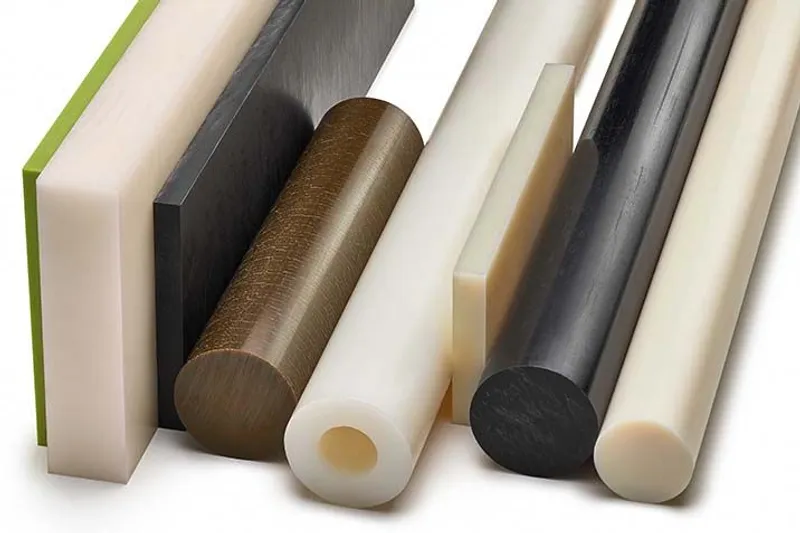
Plastic rods
PCTFE rod – cut to size
PCTFE rods PCTFE rods (polychlorotrifluoroethylene) are a high-quality material for technical applications that require the highest precision, chemical…
Configure your cut
Description
PCTFE rods (polychlorotrifluoroethylene) are a high-quality material for technical applications that require the highest precision, chemical resistance and thermal stability. These rods are used primarily in industries where conventional materials are not sufficient.
What are PCTFE rods?
PCTFE is a thermoplastic fluoroplastic that stands out for its exceptional mechanical strength and low gas permeability. Rods made from PCTFE are manufactured from this material to serve as blanks for turned and milled parts. Thanks to their exceptional properties, they are suitable for highly specialised applications.
Machining of PCTFE rods
PCTFE rods are optimised for mechanical machining. Some important notes on machining:
- Turning and milling: Due to the hardness of the material, tools with carbide or diamond tips should be used.
- Cooling: Continuous cooling during machining is important in order to avoid overheating and material deformation.
- Finishing: PCTFE rods can be finely reworked for high-precision applications in order to meet the tightest tolerances.
Advantages and disadvantages of PCTFE rods
| Advantages | Disadvantages |
| Excellent chemical resistance | High material costs |
| Wide temperature range | Limited flexibility |
| Low gas permeability | Difficult availability |
| High strength and stability | High demands on tools |
Buying PCTFE rods: what should you look out for?
When buying PCTFE rods, quality is decisive. Important criteria are:
- Diameter and length: Depending on the specific requirements of your application.
- Certifications: In particular for applications in medical technology or aerospace.
- Availability: Choose a supplier with experience in the field of high-performance plastics.
Properties
PCTFE rods have numerous properties that predestine them for demanding applications:
- High chemical resistance: PCTFE is resistant to acids, alkalis, solvents and other aggressive media.
- Thermal stability: The material remains stable in a temperature range from -240 to +150 degrees Celsius.
- Mechanical strength: The high tensile and compressive strength enables use in loaded environments.
- Low gas permeability: Ideal for seals and applications with high demands on sealing.
- Dimensional stability: Even under thermal loads, PCTFE rods remain dimensionally stable.
Applications
Aerospace engineering
In aerospace, PCTFE rods are used for components such as valves, seals and insulations. The high stability and low gas permeability are decisive here.
Chemical industry
Due to their chemical resistance, PCTFE rods are suitable for pump components, valve seats and components in aggressive chemical environments.
Cryogenics
PCTFE rods are outstandingly suitable for use in cryogenic applications, as they remain stable even at extremely low temperatures.
Medical technology
The purity and chemical neutrality of PCTFE make rods ideal for use in sterile and high-precision applications, such as in analytical instruments.
Frequently asked questions about PCTFE rods (FAQ)
How do PCTFE rods differ from PTFE rods?
Compared with PTFE, PCTFE offers a better gas barrier, higher strength and thermal stability. PTFE, on the other hand, is more flexible and less expensive.
Are PCTFE rods environmentally friendly?
PCTFE is less environmentally friendly due to the high energy input during production. However, the durability in specific applications offers sustainable advantages.
Can PCTFE rods be recycled?
Recycling is technically possible, but due to the complex material structure it is elaborate and cost-intensive.
Which tolerances are possible with PCTFE rods?
During machining, PCTFE rods can achieve extremely precise tolerances in the micrometre range, which predestines them for highly sensitive applications.
PCTFE rods are an indispensable material for applications that place the highest demands on chemical, thermal and mechanical resistance. Their versatile possible uses make them an optimal choice for specialised industries.
Technical data
| Property | Value |
|---|---|
| Density | 2.1 - 2.2 g/cm³ |
| Temperature resistance | -240 to +150 °C |
| Tensile strength | approx. 30 MPa |
| Chemical resistance | Excellent against acids, bases |
| Gas permeability | Very low |