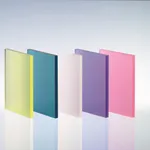
What is acrylic glass? Properties, production and advantages of PMMA
What is acrylic glass? Find out more about the properties, production, temperature resistance and areas of application of PMMA and acrylic glass sheets.
Due to its versatility, acrylic glass is used in numerous industries and is a popular material both indoors and outdoors. With its excellent combination of optical clarity, impact resistance and ease of processing, it offers versatile application possibilities.
What is acrylic glass?
Acrylic glass is a transparent plastic based on polymethyl methacrylate (PMMA). The material is often referred to under trade names such as Plexiglas® or acrylic glass and is one of the most popular transparent plastics for industry, construction and technical applications.
Acrylic glass is characterised by very high light transmission, good UV and weather resistance and a comparatively low weight. Compared with classic glass, acrylic glass is significantly lighter and more impact-resistant, making it suitable for numerous applications.
The material is used, among other things, for protective covers, machine cladding, viewing panels, advertising installations, displays, roofing and technical components.
Acrylic glass belongs to the group of thermoplastics. This means that the plastic can be processed, formed and cut under the influence of heat. As a result, PMMA is suitable both for standard sheets and for individual cut pieces and complex components.
In brief:
- Acrylic glass = transparent plastic made from PMMA
- high transparency and good appearance
- UV and weather resistant
- lighter than glass
- versatile to process and form
Why acrylic glass?
Acrylic glass offers an ideal mix of functionality and aesthetics. It combines outstanding transparency with high resistance to environmental influences and is considerably lighter and safer than conventional glass. Its durability and versatility make it indispensable in modern industry.
Is acrylic glass a plastic?
Yes, acrylic glass is a plastic. The material consists of polymethyl methacrylate (PMMA) and belongs to the group of thermoplastic plastics.
Thermoplastics can be formed and processed by heat. As a result, acrylic glass can be sawn, milled, laser-cut, drilled or bent. These properties make PMMA a versatile material for technical and optical applications.
In everyday use, acrylic glass is often compared with glass, as it has very high transparency and appears similarly clear. Technically, however, it is clearly a plastic with its own material-specific properties.
Compared with conventional glass, acrylic glass offers several advantages:
- significantly lower weight
- good impact resistance
- high UV and weather resistance
- very good machinability
- high light transmission
Acrylic glass is therefore used in many areas – for example in mechanical engineering, in advertising technology, for protective covers, displays or transparent plastic sheets cut to size.
The outstanding properties of acrylic glass
Acrylic glass is characterised by its excellent optical clarity and its high weather resistance. It is considerably lighter than conventional glass and offers outstanding impact resistance. In addition, acrylic glass is easy to process, whether by cutting, milling or thermoforming. These properties make it one of the most versatile plastics on the market.
Key properties at a glance:
- Outstanding transparency (up to 92 % light transmission)
- Weather resistant and UV resistant
- Low weight (half as heavy as glass)
- High impact resistance and scratch resistance
- Easy to process by cutting, bending or bonding
Alongside these advantages, acrylic glass is also resistant to chemicals and resistant to many environmental factors, which makes it ideal for outdoor applications. It remains colourfast and does not yellow even under extreme weather conditions.
| Property | Acrylic glass |
|---|---|
| Transparency | very high |
| UV resistance | high |
| Weather resistance | high |
| Weight | light |
| Temperature resistance | limited |
How is acrylic glass produced?
The production of acrylic glass takes place through the polymerisation of methyl methacrylate (MMA). In this process, liquid monomer is cast or extruded into shape to produce sheets, tubes or other formats. There are two main processes for producing acrylic glass:
The most important production processes:
Casting process: Produces high-quality and dense sheets with excellent optical quality. These sheets are characterised by their homogeneity and load-bearing capacity, making them particularly suitable for demanding applications.
Extrusion process: Cost-efficient and ideal for standardised products that require consistent quality characteristics.
Through these processes, the properties of acrylic glass can be adapted to the specific requirements of the respective application. For example, the surface structure can be varied or UV resistance increased through additives.
Versatile application possibilities of acrylic glass
Thanks to its versatility, acrylic glass is used in numerous industries. It is particularly popular in the construction industry, in design and in advertising. It also finds versatile applications in everyday life.
Important areas of application:
- Advertising technology: illuminated signs, displays, shop windows, POS elements
- Construction industry: windows, partition walls, protective cladding, roofs
- Furniture design: table tops, shelves, decorative elements
- Aerospace: cockpit canopies, windows, technical cladding
- Automotive industry: light guides, tail lights, covers
In medical technology, acrylic glass is used for hygienic covers and protective screens. Thanks to its easy cleaning and resistance to germs, it is particularly well suited to sterile environments. In automotive construction, it serves as a material for light guides, tail lights and other lighting elements. It is also used in aerospace, where it is preferred due to its low weight and high load-bearing capacity.
Innovative areas of application:
- Aquariums: large panoramic windows and protective glazing
- Art installations: sculptures and light-transmitting structures
- Smart home: light-diffusing elements and modern designs
The advantages of acrylic glass at a glance
The use of acrylic glass brings numerous advantages. It is light, durable and offers high optical clarity. It is also scratch-resistant and resistant to environmental influences such as UV radiation and moisture. Acrylic glass is also considerably more impact-resistant compared with glass, which makes it attractive for safety-critical applications.
A further advantage lies in its ease of processing. Acrylic glass can be brought into various shapes without great effort, which makes it particularly flexible for creative designs. It also offers excellent insulating capability, meaning it can also be used in energy-efficient construction projects.
Acrylic glass temperature resistance
The temperature resistance of acrylic glass is one of the most important properties of the material. Acrylic glass (PMMA) is suitable for many applications indoors and outdoors, but has clear thermal limits.
Typically, the continuous temperature resistance of acrylic glass is around 70 to 80 °C. For short periods, higher temperatures are also possible depending on material quality. From higher temperature ranges, however, acrylic glass begins to soften and can deform.
At low temperatures, acrylic glass remains dimensionally stable and retains its transparency. As a result, the material is also suitable for applications with changing weather conditions or outdoor use.
The temperature resistance of acrylic glass at a glance:
| Temperature range | Behaviour of acrylic glass |
|---|---|
| up to approx. 70–80 °C | suitable for continuous use |
| from approx. 90–100 °C | increasing softening |
| higher temperatures | risk of deformation |
For applications with continuously high thermal load, more temperature-resistant plastics such as polycarbonate, PEEK or special engineering plastics may be advisable. The choice always depends on the area of application, load and processing.
Acrylic glass or polycarbonate?
Acrylic glass and polycarbonate are among the most popular transparent plastics, but differ significantly in their properties and areas of application. Which material is better suited depends on requirements such as impact resistance, transparency or temperature load.
Acrylic glass (PMMA) stands out above all for its high light transmission, UV resistance and high-quality appearance. The material is particularly suitable for applications with high requirements for transparency and weather resistance.
Polycarbonate (PC), by contrast, offers significantly higher impact resistance and load-bearing capacity. This plastic is therefore often used for safety glazing, machine covers or technically heavily stressed components.
The most important differences at a glance:
| Property | Acrylic glass (PMMA) | Polycarbonate (PC) |
|---|---|---|
| Transparency | very high | high |
| UV resistance | very good | dependent on coating |
| Impact resistance | good | very high |
| Scratch resistance | higher | lower |
| Temperature resistance | approx. 70–80 °C | higher |
| Machinability | very good | very good |
Acrylic glass is often suitable for optical applications, advertising technology, displays or transparent covers. Polycarbonate is preferably used when high impact loads or increased safety requirements exist.
A detailed comparison of the two materials can be found in the article on acrylic glass vs. polycarbonate.
Production of acrylic glass
The production of acrylic glass is based on the plastic polymethyl methacrylate (PMMA). The starting material is the monomer methyl methacrylate (MMA), which is processed into solid acrylic glass through a chemical process – known as polymerisation.
In principle, a distinction is made between two production processes:
Cast acrylic glass
In cast acrylic glass, liquid MMA is filled between two glass plates and polymerised there. This process produces particularly high-quality acrylic glass sheets with high surface quality, good optical properties and high chemical resistance.
Cast acrylic glass is often suitable for technical applications, displays or demanding processing such as milling and polishing.
Extruded acrylic glass
Extruded acrylic glass is created by continuously pressing the heated plastic through a die system. This process is more economical and enables uniform series production of large quantities of sheets.
Extruded acrylic glass also exhibits high transparency, but in processing it sometimes reacts differently from cast variants – for example when milling or thermal forming.
These production processes create acrylic glass sheets with different properties, thicknesses and areas of application – from transparent protective screens through to technical components and cut-to-size pieces.
Specifications of our acrylic glass sheets
Our acrylic glass sheets are the perfect choice for applications where both functionality and aesthetics are the focus. They are available in different thicknesses and formats and can be cut to size individually.
Advantages of our acrylic glass sheets:
- High optical clarity and light transmission
- UV resistant and durable
- Light and easy to process
Our acrylic glass sheets are particularly valued in advertising technology, shopfitting and furniture design. Thanks to their impact resistance and high load-bearing capacity, they are also suitable for safety-critical applications.
Technical specifications (example table):
| Property | Value |
|---|---|
| Light transmission | Up to 92 % |
| Density | 1.18 g/cm³ |
| Temperature resistance | -40 °C to +80 °C |
| UV resistance | Excellent |
| Impact resistance | 5 times higher than glass |
Why acrylic glass is indispensable
Acrylic glass is a versatile and modern plastic that is used in numerous industries. Its transparency, durability and weather resistance make it an ideal replacement for glass, especially in safety-relevant or creative areas.
Thanks to its ease of processing and its superiority in terms of weight and impact resistance, acrylic glass is a popular choice for numerous applications. With the right products and the right processing, acrylic glass offers an optimal solution for modern design and construction projects.
In addition, its recyclability makes an important contribution to sustainable material use.