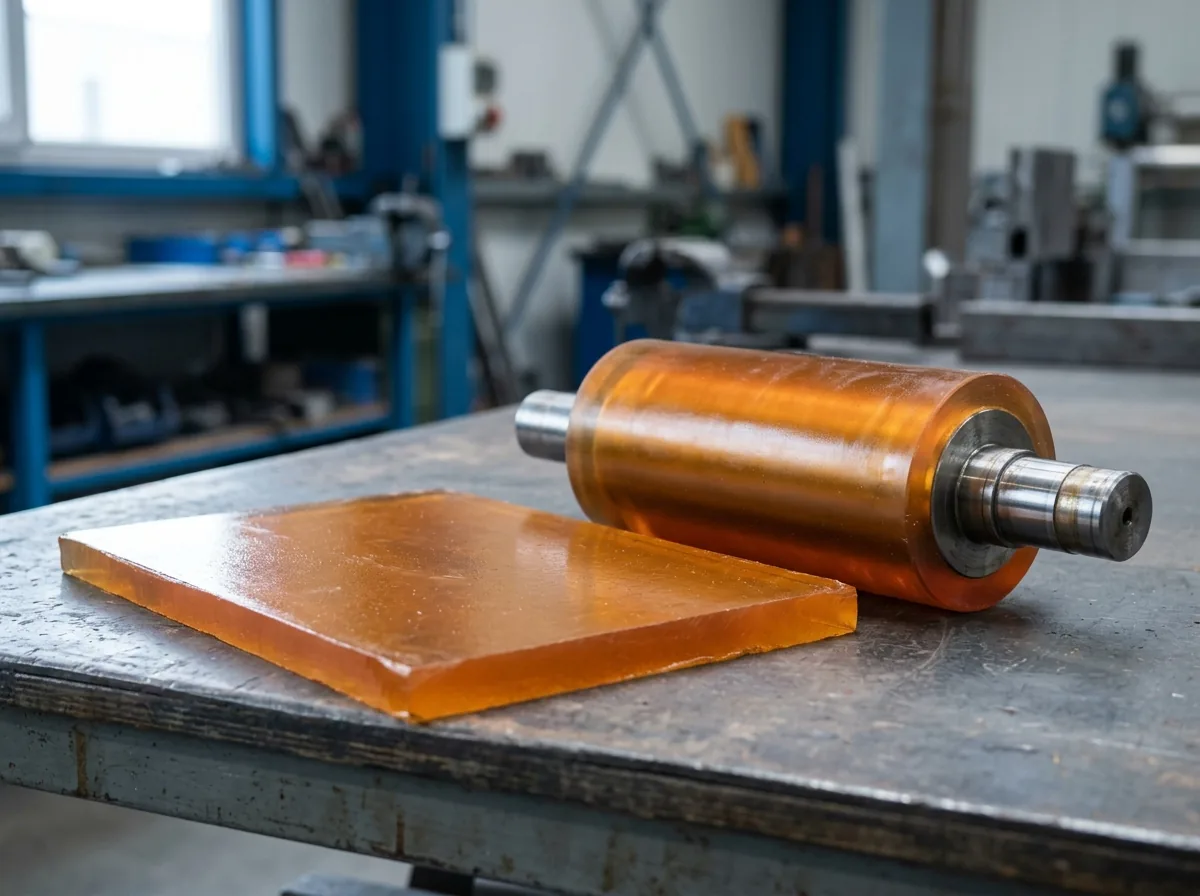
 This image was created with artificial intelligence – marked under Art. 50 of the AI Act, Regulation (EU) 2024/1689. It is a placeholder until the company's photos arrive.
PUR
What is PUR? Everything about polyurethane: properties, areas of application, advantages and technical special features for industrial applications.
In brief
Polyurethane (PUR, sometimes also called PU) is a polymer material whose properties can be precisely adjusted via the formulation – from elastic to hard.
In technical applications, PUR plays a role above all where abrasion, mechanical load and permanent dimensional stability are relevant, for example in sealing technology and in wear-exposed components and linings.
When it comes to sheet material for cutting to size and further processing, the product page PUR rubber sheet is the appropriate starting point for dimensions and variants.
Fundamentals and properties of polyurethane (PUR)
Polyurethane is formed by the chemical reaction of polyols with isocyanates. The material can be precisely adjusted via the type, ratio and additives of these components.
As a result, PUR covers a broad property spectrum, ranging from soft-elastic to very hard, highly load-bearing grades. In industrial practice, elastomeric PUR types are predominantly used.
Typical properties of PUR
- high abrasion resistance under dynamic load
- very good mechanical strength and tear propagation resistance
- good recovery properties even under continuous stress
- adjustable hardness ranges for different applications
This combination makes PUR particularly suitable for components that are permanently subjected to mechanical stress and must nevertheless remain dimensionally stable. Typical designs are found in the form of sheets from which cut pieces are produced, for example as PUR rubber sheets for technical applications.
Hardness ranges and mechanical characteristics of polyurethane (PUR)
Polyurethane is available in a very broad hardness spectrum. Depending on the formulation, the range extends from soft-elastic grades to almost plastic-like designs.
In practice, hardness is usually stated in Shore A or Shore D. Soft PUR types start at around 60 Shore A, hard variants can reach values of over 70 Shore D.
Typical characteristics of PUR elastomers
- hardness range: approx. 60 Shore A to >70 Shore D
- very high abrasion resistance compared with classic elastomers
- high tear strength under dynamic load
- good compression set values under continuous load
These properties make PUR particularly interesting for applications where rubber materials such as NBR or SBR reach their limits. A material-related distinction can be found in the overview of elastomers.
Fields of application and typical uses of polyurethane (PUR)
Polyurethane is used wherever components are permanently exposed to mechanical loads and a long service life is required. The material combines elasticity with exceptional wear resistance.
Typical industrial fields of application
- wear protection sheets and linings in conveyor and transport technology
- damping and stop elements in mechanical engineering and plant construction
- scrapers, guides and sliding components
- moulded and punched parts with high dynamic stress
In many of these applications, PUR is used as sheet material from which precisely fitting cut pieces are produced. For this application, the page PUR rubber sheet offers an overview of available variants and dimensions.
For functional components with a defined geometry, PUR is also frequently used as a cut piece or finished part when alternative elastomers wear prematurely.
Resistances of polyurethane (PUR)
The resistance of polyurethane depends strongly on the respective formulation. In general, PUR shows very good mechanical stability, while chemical and thermal influences must be assessed depending on the material.
Chemical resistance
PUR has good resistance to many oils, greases and fuels. Resistance to acids, alkalis and solvents varies considerably depending on the composition and should be tested for the specific application.
Temperature resistance
Typical service temperatures are in the range of about −30 °C to +80 °C. Higher temperatures are possible for short periods, depending on the PUR type and the mechanical load.
Environmental influences
PUR shows limited resistance to ozone and UV radiation. For outdoor applications or continuous weathering, appropriate material selection or protective measures are required.
For applications with special media or temperature influences, comparison with alternative materials from the field of elastomers is recommended.
Distinction of polyurethane (PUR) from other elastomers
Polyurethane differs from classic elastomers above all through its combination of very high abrasion resistance and adjustable hardness. These properties mean that PUR is frequently used where standard rubbers wear more quickly.
PUR compared with NBR, EPDM and SBR
- NBR: good oil and fuel resistance, but lower abrasion resistance than PUR
- EPDM: very good weathering and ozone resistance, but mechanically less load-bearing
- SBR: economical all-round material, but limited resistance and service life
PUR offers significantly higher wear resistance than these materials, while chemical or weather-related requirements are better covered by specialised elastomers depending on the application.
A structured overview of common materials can be found in the elastomers section, which serves as a decision-making aid for material selection.
Manufacturing processes for polyurethane (PUR)
Depending on the requirement, polyurethane is processed using different methods. These largely determine the achievable dimensions, tolerances and possible applications.
Typical manufacturing processes:
Centrifugal casting: Standard formats such as 2,000 × 1,000 mm or 3,000 × 1,000 mm, thicknesses approx. 0.5 to 16 mm Uniform material distribution and reproducible quality
Table casting: Large sheet formats up to approx. 5,500 × 1,300 mm Long strip solutions also possible (up to approx. 6,000 mm)
Mould casting: Individual geometries, complex components and series production Inserts or fabric can be integrated Components from a few grams up to several tonnes feasible
Finishing: Mechanical post-processing to drawing, e.g. drilling, milling, chamfering or radii Joining of several parts by welding possible
These processes enable both simple sheet cut pieces and highly complex components for industrial applications.
Dimensions, thicknesses and tolerances
Defined sizes and tolerances are available for PUR sheets and components, based on industrial standards.
Typical values:
Sheet formats: approx. 2,000 × 1,000 mm to >5,000 mm length Thicknesses: approx. 0.5 mm to 100 mm+ Hardness: approx. 60 Shore A to >70 Shore D Tolerances: according to DIN ISO 3302-1 M4, optionally tighter
Depending on the process and material type, the tolerances can be adjusted.
Material variants and special designs
Polyurethane can be precisely configured for specific requirements. This results in variants that go far beyond standard elastomers.
Typical special designs:
Electrostatic dissipative (ESD) Self-extinguishing or flame-retardant Combination of ESD and fire protection Food-compliant according to EU Regulation 1935/2004 Hydrolysis-resistant for humid-warm environments Low-temperature-resistant Microbe-resistant for longer service lives outdoors
These variants are used specifically for industries such as food technology, plant construction or conveyor technology.
Design options and material structure
In addition to the pure material properties, PUR also offers design advantages in component layout.
Possible designs:
Sheets with adhesive layer for bonding applications One-sided or double-sided roughened surfaces Integration of fabric inserts or metal components Combination with expanded metal or perforated plate Multi-layer structures for special requirements
This allows components to be adapted precisely to the respective application.
Colour and formulation variants
Polyurethane is configured not only functionally but also individually.
Options:
Free choice of colour depending on the field of application Specific formulations for mechanical, chemical or thermal requirements Adjustment of hardness, elasticity and resistance within one material system
This flexibility clearly distinguishes PUR from many standard elastomers.
Further processing and cutting to size
PUR is frequently used as a semi-finished product and then further processed.
Typical machining operations:
Cutting to size Drilling, milling and contour machining Chamfering, radii and surface adjustments Integration of logos or markings Welding of partial pieces
For specific applications in the field of sheets and cut pieces, the PUR rubber sheet page offers a suitable overview.
Extension for applications
In addition to classic fields of application, the material variants give rise to further applications:
Food industry with food-compliant PUR types Electronics and potentially explosive areas with ESD designs Outdoor applications with moisture through hydrolysis-resistant variants Low-temperature ranges with low-temperature-optimised PUR types
Frequently asked questions about polyurethane (PUR)
What is the difference between PUR and PU?
PUR and PU refer to the same material. PUR stands for polyurethane, while PU is the common short form.
Is polyurethane a rubber?
Polyurethane is classed among the elastomers, but differs clearly from classic rubbers such as NBR or EPDM through higher abrasion resistance and a broader hardness spectrum.
How abrasion-resistant is PUR compared with rubber?
PUR has a very high abrasion resistance and clearly surpasses conventional rubber materials in many dynamically loaded applications.
Which hardnesses are possible with PUR?
Polyurethane is available in hardness ranges from about 60 Shore A to over 70 Shore D, depending on the respective formulation.
Is PUR resistant to oil and chemicals?
PUR shows good resistance to many oils and greases. Chemical resistance to acids, alkalis or solvents depends on the formulation.
For which applications is PUR particularly suitable?
Typical fields of application are wear protection, conveyor technology, mechanical engineering and components with high continuous mechanical load.
In which forms is PUR available?
PUR is supplied, among other things, as sheet material from which individual cut pieces are produced, for example as PUR rubber sheet.



