Polyoxymethylene (POM)
What is polyoxymethylene (POM)? Everything about the properties, applications and advantages of POM (acetal/polyacetal) in engineering use.
Learn everything about the material POM here.
Polyoxymethylene (POM) is a thermoplastic engineering plastic with high dimensional accuracy, low friction and very good sliding properties. The material is used in industry when components are subjected to permanent mechanical load and tight tolerances are required.
POM is characterised by high rigidity, good impact strength and low water absorption. As a result, dimensions remain stable even under changing ambient conditions. Typical applications are found in mechanical engineering, in conveyor technology and in mechanically stressed functional components.
Compared with other engineering plastics, POM positions itself as a material for precise, moving components with high repeatability. A systematic classification in comparison with other engineering plastics can be found in the overview of engineering plastics.
Material properties of polyoxymethylene (POM)
Polyoxymethylene possesses a balanced combination of mechanical strength, rigidity and dimensional stability. The material is suitable for components where repeatable movements, low friction and dimensionally stable geometries are required.
Characteristic of POM is its very low water absorption. As a result, mechanical properties and dimensions remain largely constant even under changing humidity. This clearly distinguishes POM from many other engineering plastics.
The good sliding property and the low coefficient of friction enable use in moving components such as guides, gears or plain bearings. In applications with an increased risk of wear, POM is frequently used as an alternative to metal.
In direct comparison with materials such as polyamide, POM shows higher dimensional accuracy with lower moisture dependence. A more in-depth comparison can be found on the page on polyamide (PA).
Areas of application of polyoxymethylene (POM)
Polyoxymethylene is used in industrial applications where precise fits, uniform motion sequences and high mechanical load capacity are required. The material is suitable for series components as well as for functional individual components.
In mechanical engineering, POM is frequently used for gears, guides, plain bearings, rollers and coupling elements. The combination of rigidity and low friction supports low-maintenance continuous operation.
In conveyor and automation technology, POM is used for components that are moved continuously and must ensure reproducible sequences. The material is also used in equipment and apparatus engineering.
For applications with increased requirements for wear resistance and dimensional accuracy, POM represents a proven alternative to metal. Further materials for comparable fields of application are summarised in the overview of plastics.
Chemical and thermal resistance of POM
Polyoxymethylene exhibits good resistance to many chemicals. The material is stable against oils, greases, fuels and numerous solvents and is suitable for technical applications in industrial environments.
Against diluted acids and alkalis, POM shows solid resistance. With strongly oxidising media, use depends on the material and the application. For critical environments, a specific media test is recommended.
Thermally, POM is designed for continuous use in the medium temperature range. The combination of heat deflection resistance and mechanical stability enables use in components with continuous load.
For applications with higher temperatures or more aggressive media, alternative high-performance plastics come into consideration. A corresponding classification can be found in the overview of high-performance plastics.
Machining and processing of polyoxymethylene (POM)
Polyoxymethylene can be machined precisely and is suitable for cutting processes such as turning, milling and drilling. The material shows a clean cut and enables tight dimensional tolerances.
Due to its high inherent rigidity, the component geometry remains stable even with more complex contours. POM is frequently used for functional components where fit accuracy and reproducible results are the focus.
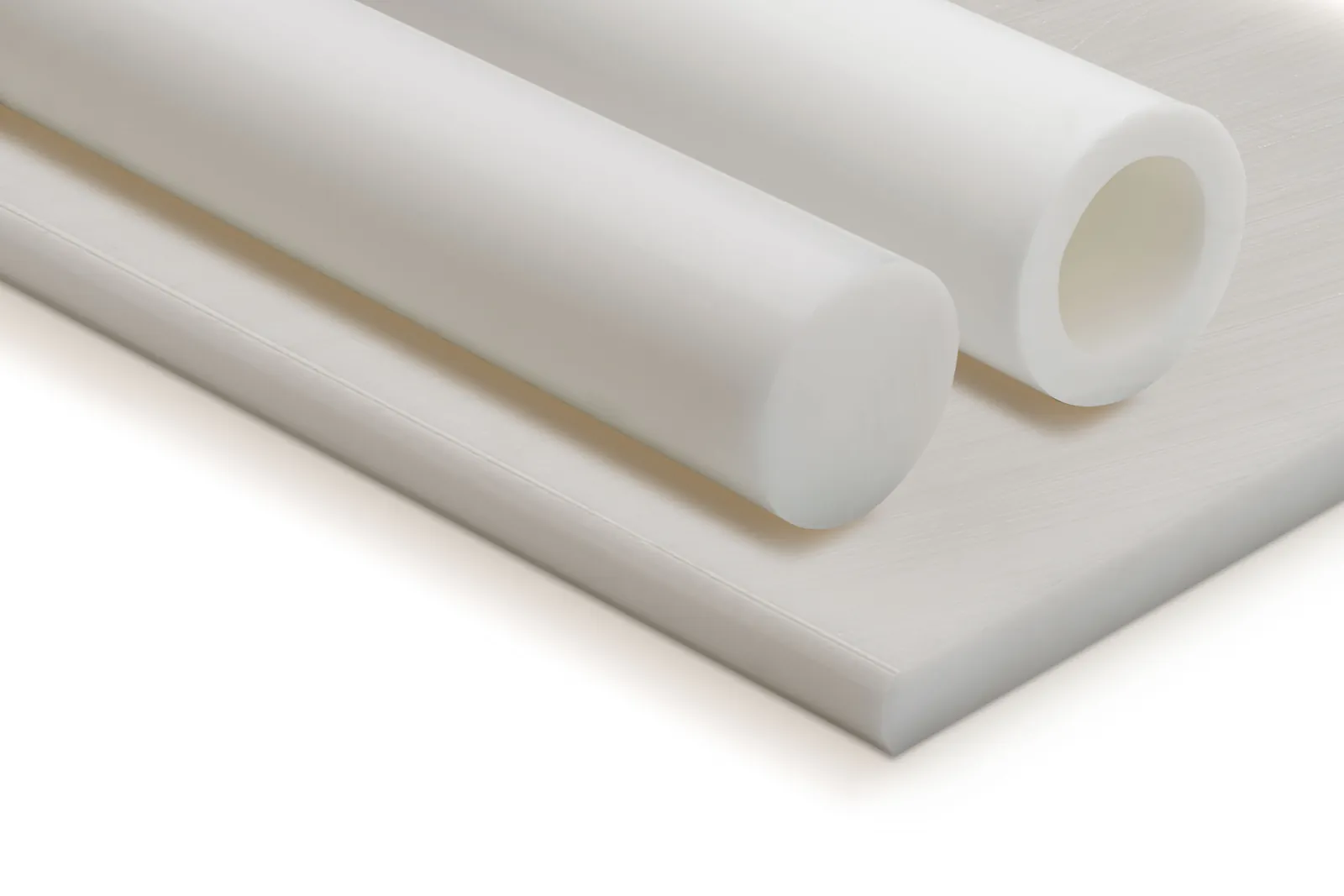
In industrial production, use is usually based on semi-finished products, which are then further processed to precise dimensions. Typical starting forms are sheets, rods or profiles.
An overview of available formats and the further processing of engineering plastics is provided by the section plastic cut-to-size pieces.
Advantages of polyoxymethylene in industrial use
Polyoxymethylene convinces in industrial use through a combination of dimensional accuracy, mechanical stability and good sliding properties. These properties support the reliable operation of moving components over long periods of use.
The low water absorption helps components to maintain their geometry even under changing ambient conditions. As a result, POM is suitable for applications with high requirements for repeatability.
The good wear resistance allows maintenance intervals to be extended and downtime to be reduced. In many applications, POM represents an economical alternative to metallic materials.
For a structured selection of engineering plastics according to application criteria, the overview of engineering plastics is available.
POM types and material variants
Polyoxymethylene is available in various material types, which differ in structure and property profile. In industrial practice, POM-C (copolymer) and POM-H (homopolymer) are primarily used.
POM-C offers a balanced combination of toughness, dimensional accuracy and chemical resistance. This type is preferably used when components are subjected to permanent mechanical load and stable performance is required.
POM-H is characterised by higher rigidity and strength. The material is suitable for applications with increased requirements for mechanical load capacity and precision.
The selection of the suitable POM type is made on an application-specific basis and taking into account load, ambient conditions and production requirements. A basic orientation is provided by the overview of plastics.
Application notes and material limits of POM
Polyoxymethylene is designed for precise, mechanically stressed components and unfolds its strengths above all in sliding and moving applications. The material selection is made in a practical manner on the basis of temperature range, media contact and continuous mechanical load.
For applications with strongly increased continuous temperatures or intensively oxidising media, testing of alternative high-performance plastics with an extended property profile is recommended.
For safety-relevant or heavily regulated fields of application, the material approval is carried out on a project-specific basis. Early coordination supports a stable design and long-term reliable operation.
An orientation for demanding application conditions is provided by the overview of high-performance plastics.
Selection criteria for polyoxymethylene components
The selection of polyoxymethylene is made on the basis of clearly defined technical requirements. Decisive are mechanical load, type of movement, ambient conditions and the required dimensional accuracy of the component.
For sliding or rotating components, the coefficient of friction, wear behaviour and surface quality are the focus. For statically loaded components, rigidity and fatigue strength come more strongly into focus.
Equally relevant are temperature range, media contact and the desired service life. These parameters determine whether POM-C or POM-H represents the suitable material basis.
For an application-specific material selection with comparison options to alternative plastics, the material overview under plastics offers a structured orientation.
Frequently asked questions about polyoxymethylene (POM)
What is polyoxymethylene (POM)?
Polyoxymethylene is a thermoplastic engineering plastic with high dimensional accuracy, low friction and very good sliding properties. The material is suitable for precise, mechanically stressed components in industrial use.
What is POM typically used for?
POM is frequently used in mechanical engineering, in conveyor technology and in automation technology. Typical components are gears, plain bearings, guides and functional precision parts.
What advantages does POM offer compared with other plastics?
POM offers high dimensional stability with low water absorption as well as favourable friction and wear behaviour. These properties support uniform operation of moving components over long periods.
Which POM types are common?
In practice, POM-C and POM-H are primarily used. POM-C stands for a balanced combination of properties, POM-H for higher rigidity and strength. A basic classification of engineering materials can be found in the overview of engineering plastics.