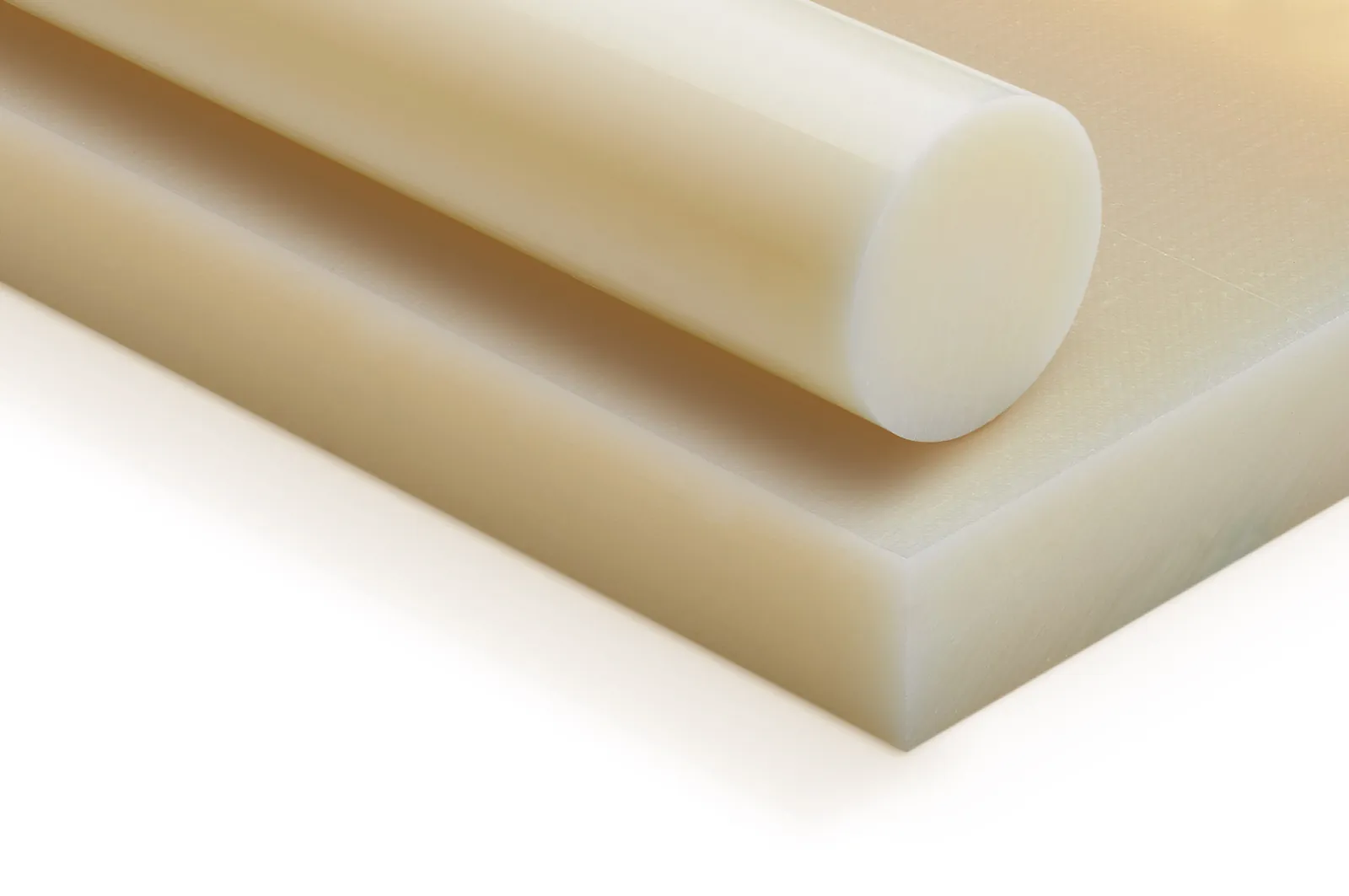
Engineering plastics
Engineering plastics | High-performance plastics as sheet or rod | POM-C, PA6, PA6.6, PA12, PAI, PEEK, PVDF, PTFE, PBT, PPS, PPSU
Your system partner for
plastic sheets and rods
Large selection of engineering plastics
Our strength lies in custom manufacturing of plastic finished parts, including small and large series, and in attractive delivery times. We supply plastic semi-finished products in a wide variety of designs (rods, hollow rods, tubes, sheets, films, discs and also
individual cut pieces to size
according to customer requirements.
Engineering plastics
are among the thermoplastic plastics and differ from standard plastics through their special properties and their price. Engineering plastics are characterised, among other things, by greater impact strength or higher elasticity. In addition to the large group of polyamides, numerous other plastics also count as engineering plastics. We would be happy to present the various materials and their specific properties to you.
STANDARD PLASTICS
PE 300(natural, black, green, blue) PE 500 (natural, black, green, blue) PE 1000(natural, black, green, blue)PP (polypropylene) PVC (polyvinyl chloride) PPE (polyPhenyleneEther) ABS(acryButadieneStyrene) PE1000 REG(PE 1000 REG) PE1000 AST(PE 1000 AST) PE 500 ELS(PE 500 ELS) PE100 natural(PE100 natural, black, blue, yellow)
CONSTRUCTION PLASTICS
PA 6, PA 6.6, PA 12, PA 6 GF 30(polyamide) POM-C, POM-C GF, POM-H, POM-H GF, POM ESD,(polyoxymethylene) PET, TECAPET, TECADUR (polyethylene terephthalate) PBT, PBT GF (polyButhyleneTerephthalate) PCTFE (polyChlorTriFluorEthylene) ECTFE ((ethyleneChlorTriFluorEthylene) ETFE (ethyleneTetraFluorEthylene) POM sheets (cut pieces) PA sheets (PA 6.6, PA G natural) Rods (rod sections)
THERMOSETS
HP 2061(paper laminates) HGW 2082 (cotton fabric laminates) HGW 2372 (epoxy resin laminates) HM 2471 (polyester resin) HGW 2282.5 (melamine resin laminates)
Silicone resin laminates, high-temperature laminates, special materials and much more.
Fabric laminates (HGW) PF CC 201 (HGW 2082) EP GC 201 (HGW 2372) EP GC 202 (HGW 2372.1) Paper laminates (HP) PF CP 201 (HP 2061) PF CP 202 (HP 2061.5) EP GC 203 (HGW 2372.4) Resitex, Vetronit, Carta-M, Umabord, Ferrozel, Celeron, Etronit, Novotex
HIGH-PERFORMANCE PLASTICS
PEEK (PEEK GF30) PTFE (polyTetraFluorEthylene) PVDF (polyVinylDieneFluoride) PCTFE (polyChlorTriFluorEthylene) ECTFE ((ethyleneChlorTriFluorEthylene) ETFE (ethyleneTetraFluorEthylene) PTFE (PTFE natural (virgin) ) PTFE GF 25 (PTFE+25% GLASS MOD. (alternatively TFM® 4105 ) ) PTFE GF 25 with CARBON/GRAPHITE (PTFE+25% CARBON/GRAPHITE)
Impressions from plastic production
Engineering plastics: definition, applications and processing
Engineering plastics (also known as technical plastics or construction materials) form a subgroup of thermoplastic plastics. They are characterised by improved mechanical, thermal and chemical properties compared with standard plastics.
Application areas:
- Mechanical engineering: gears, housings, bearings, sliding elements
- Electrical engineering: insulators, plug housings, circuit boards
- Automotive: body parts, lighting, interior fittings
- Medical technology: implants, prostheses, housings for medical devices
- Packaging industry: films, bottles, containers
- Construction: window frames, pipes, profiles
Processing:
Engineering plastics can be processed by various methods, e.g.:
- Injection moulding: This is the most commonly used method for producing complex moulded parts.
- Extrusion: pipes, profiles and films are produced by extrusion.
- Thermoforming: thermoforming is used to draw flat films into three-dimensional moulded parts.
- Machining: engineering plastics can be machined like metals to produce precise moulded parts.
- Adhesive bonds: engineering plastics can be joined to one another with various adhesives.
Important representatives of engineering plastics:
- Polyamide (PA): high strength, toughness and wear resistance
- Polycarbonate (PC): high transparency, impact strength and heat resistance
- Polyoxymethylene (POM): high rigidity, strength and sliding properties
- Polybutylene terephthalate (PBT): high heat resistance, chemical resistance and dimensional stability
- Polyethylene terephthalate (PET): high strength, rigidity and transparency
Advantages of engineering plastics:
- Good mechanical properties
- High temperature resistance
- Chemical resistance
- Good processability
- Lightweight construction
- Cost-effectiveness
Further information:
- Engineering plastics - Wikipedia: https://de.wikipedia.org/wiki/Technische_Kunststoffe