PEEK vs PTFE – differences, temperature & chemical resistance
PEEK or PTFE? Comparison of temperature resistance, chemical resistance, friction and applications. Decision-making aid for industry and engineering.
Two high-performance plastics compared
Polyetheretherketone (PEEK) and polytetrafluoroethylene (PTFE) are among the most versatile and most frequently used high-performance plastics in modern industry. Both are distinguished by exceptional properties that qualify them for a wide range of demanding applications. While PEEK is valued above all for its high mechanical strength and temperature resistance, PTFE scores with outstanding chemical inertness and excellent sliding properties.
Engineers and designers are often faced with the question: which of these two plastic materials is the better choice for a specific application? This article provides a comprehensive comparison and supports you in making a well-founded decision.
Similarities between PEEK and PTFE
Despite their differences, there are important similarities between PEEK and PTFE that explain why both count as high-performance plastics:
- Both materials offer long-term temperature resistance of up to approx. 260 °C, which qualifies them for applications in high-temperature ranges.
- The chemical resistance to acids, bases and solvents is excellent in both materials.
- Both PEEK and PTFE are approved for medical applications, for example in accordance with FDA or USP Class VI.
- Due to their low water absorption, their dimensions remain largely constant even under humid conditions.
- They exhibit good electrical insulating capability and are widely used in electronic applications.
These shared characteristics make them reliable solutions in safety-critical and highly specialised industries such as medical technology, semiconductor manufacturing or chemical apparatus engineering.
PEEK vs PTFE – the most important differences
PEEK and PTFE are among the most high-performance engineering plastics, but differ significantly in their properties and fields of application. The choice depends above all on temperature, chemical exposure, mechanical stress and friction behaviour.
PEEK (polyetheretherketone) is a high-performance plastic with very high mechanical strength and temperature resistance. The material is suitable for highly loaded components, precision parts, bearings or technical components in mechanical engineering, medical technology and the automotive industry.
PTFE (polytetrafluoroethylene or Teflon), by contrast, stands out above all for its exceptional chemical resistance and very low friction. The material is frequently used for seals, sliding elements or applications involving aggressive chemicals.
| Property | PEEK | PTFE |
|---|---|---|
| Mechanical strength | Very high | Low to medium |
| Chemical resistance | Very good | Outstanding |
| Temperature resistance | Very high | Very high |
| Friction / sliding properties | Good | Excellent |
| Wear resistance | Very high | Medium |
| Electrical insulation | Good | Very good |
| Typical applications | Mechanical engineering, precision parts, bearings | Seals, chemical plant, sliding technology |
PEEK is particularly suitable for applications with high mechanical load and demanding temperature conditions. PTFE offers advantages wherever aggressive media, low friction or high chemical resistance are required.
In short: PEEK stands for stability and load-bearing capacity, PTFE for chemical resistance and sliding properties.
Properties in direct comparison
| Property | PEEK | PTFE |
|---|---|---|
| Temperature resistance | up to approx. 260 °C continuously | up to approx. 260 °C continuously |
| Chemical resistance | very high, also against hydrolysis | virtually inert, excellent |
| Mechanical strength | very high | low, plastically deformable |
| Wear resistance | very good, also under load | good at low load |
| Coefficient of friction | low | extremely low |
| Dimensional stability | high | low |
| Density | approx. 1.3 g/cm³ | approx. 2.2 g/cm³ |
| Processing | injection moulding, extrusion, CNC | machinable only |
| Price level | high | medium |
When is PEEK the better choice?
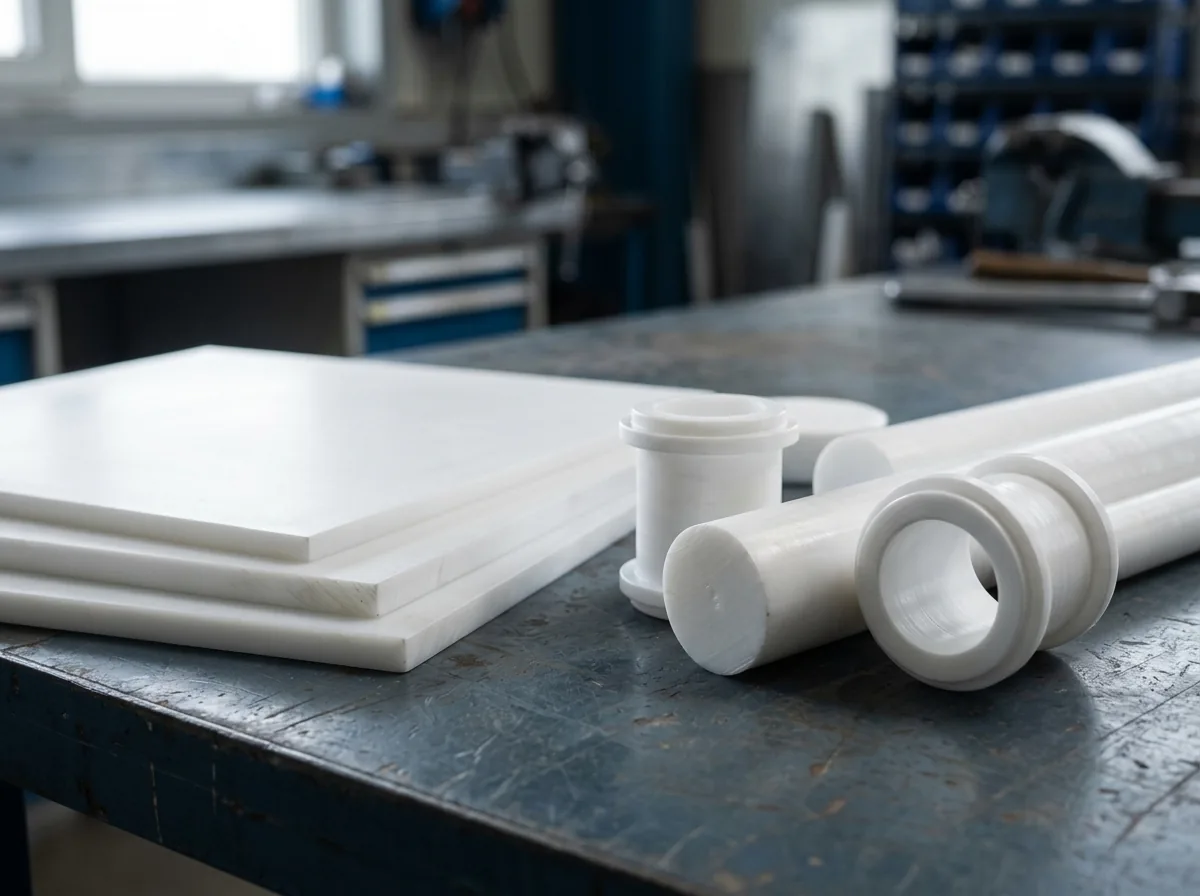
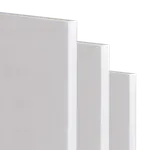
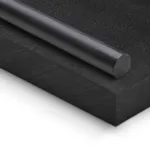
PEEK is available as a semi-finished product in various forms, including rods and sheets. These formats allow flexible further processing – from simple cut pieces to complex CNC machining. PEEK sheets, for example, are frequently used for precise housings, covers or structural components. Rods are outstandingly suitable for rotating components such as bearing bushes or sealing rings.
PEEK offers a unique combination of strength, temperature and chemical resistance as well as excellent dimensional stability. These properties make the material the ideal choice in highly loaded areas. Typical applications are:
- Plain bearings and guides that are both mechanically highly stressed and thermally loaded
- Structural components in aviation, e.g. components in engines or aircraft interiors
- Medical implants such as spinal implants, which require high biocompatibility and load-bearing capacity
- Electronics housings and insulating elements, where both thermal and electrical insulation are crucial
- Pump parts and valves in chemical plant that withstand high pressure and aggressive media
In addition, PEEK can be processed very well into complex geometries. In injection moulding and CNC machining, highly precise components with tight tolerances can be realised.
When is PTFE more suitable?
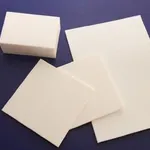
PTFE is likewise available in the form of sheets and rods. Due to the outstanding chemical resistance, PTFE sheets are frequently used for lining plant or as seal carriers. Rods made of PTFE are ideal for turned components such as valve seats or plain bearings, in particular when particularly good sliding properties are required.
PTFE stands out wherever the combination of chemical inertness, temperature resistance and extremely low coefficients of friction is crucial. It is particularly suitable for areas of application in which no high mechanical loads occur but the highest chemical resistance is required:
- Seals, flat gaskets and O-rings in piping systems or reactors
- Plain bearings, slides and conveying aids with a low pressure level
- Pipe linings and valve seats in the process industry
- Coatings for non-stick surfaces in the food and pharmaceutical industry
- Membranes in filtration plant or medical devices
Thanks to its hydrophobic, non-adhesive surface, PTFE is the material of choice in many industries when it comes to media contact or friction reduction.
Limits of the materials
PEEK and PTFE also have limitations that can be critical depending on the application:
| Material | Limitations |
|---|---|
| PEEK | - Reacts sensitively to certain fluorine compounds such as chlorine trifluoride- Higher material price, therefore uneconomical for mass applications- UV resistance only limited without additives |
| PTFE | - Low mechanical load-bearing capacity, tends to cold flow- Dimensional stability under pressure and temperature limited- Not thermoplastically formable – no injection-moulded parts possible |
A deeper understanding of these weaknesses is essential in order to avoid design errors or expensive recalls at an early stage.
Specific application examples from practice
In the semiconductor industry, PEEK spacers are used, for example in plasma etching systems, where high purity, thermal load-bearing capacity and strength are required. PTFE, by contrast, is used in the form of gas lines and linings, since chemical inertness has priority here.
In medical technology, the difference is particularly clear: PEEK is used for screws, spacers or implantable housings – always where stability and biocompatibility are required. PTFE is ideally suited for flexible catheters, pump diaphragms or sealing systems that are designed for tissue compatibility and chemical resistance.
In chemical plant engineering, PTFE shines as a lining in stirred vessels, reactors or pipelines with highly aggressive media. PEEK, by contrast, is used in rotating sealing systems or pressure valves where high mechanical and thermal loads occur.
In mechanical and special-purpose plant engineering, PEEK guide bushes, gears and insulating elements are installed when friction, heat and mechanical load coincide. PTFE films, sliding tapes or expansion joints are used when flexibility and sliding properties matter.
Read more about plastics in the individual industries here
Cost factor and processing
PEEK is a cost-intensive material compared with PTFE. Elaborate production, high material purity and thermoplastic processability have their price. However, this pays off in applications with high requirements for service life, component precision or operational reliability.
PTFE is cheaper to purchase, but more difficult to process. It can only be machined or processed by sintering processes. This limits the geometries and increases the machining costs for complex shapes. In addition, post-processing is made more difficult by its elasticity.
The material decision should therefore not be made on the basis of raw material prices alone, but should also include aspects such as tool costs, service life, maintenance intervals and operational downtime.
Selection aid: which material for which application?
| Application | Recommendation |
|---|---|
| Highly loaded plain bearing | PEEK |
| Seal in an aggressive environment | PTFE |
| Structural component with CNC machining | PEEK |
| Chemical-resistant lining | PTFE |
| Medical implant | PEEK |
| Sliding film at low load | PTFE |
| Non-stick use in pharmaceutical plant | PTFE |
| Insulating element with current & heat | PEEK |
The choice depends on the application
PEEK and PTFE are not in competition but complement each other in their properties. Anyone who depends on high mechanical load-bearing capacity, dimensional stability and long service lives makes a safe choice with PEEK. PTFE stands out where media resistance, sliding capability and non-stick effect dominate.
The choice should always be made on the basis of the entire application context, technical requirements, processing options and economic framework conditions. Only in this way can an optimum material be determined for long-lasting, reliable and economical components.
FAQ
Is PEEK food-safe?
Yes, PEEK is FDA-compliant in special variants and is therefore approved for applications in contact with food or pharmaceutical media.
Is PTFE the same as Teflon?
Teflon is a brand name of the company DuPont for PTFE. In industry, the terms are frequently used synonymously.
How does the processing of PEEK and PTFE differ?
PEEK can be processed thermoplastically, e.g. by injection moulding or extrusion, and is also very well suited to machining. PTFE is not thermoplastically formable and can only be sintered or machined.
Which plastic is more wear-resistant?
PEEK is significantly more wear-resistant than PTFE and is therefore better suited to dynamically loaded applications with contact friction.
Are there glass-fibre-reinforced variants?
Yes. PEEK is available reinforced with glass or carbon fibre, which further increases its strength and rigidity. PTFE can likewise be modified with fillers such as bronze, graphite or glass.
How resistant is PEEK to UV radiation?
PEEK has only limited UV resistance. For permanent outdoor use, UV-stabilised variants should be used.
Can PTFE become toxic?
Under normal conditions, PTFE is physiologically harmless. At temperatures above 300 °C it begins to decompose and can release gases harmful to health. Proper use is therefore crucial.