PEEK machining
How PEEK is precisely machined: CNC milling, turning, drilling, tolerances, semi-finished products and practical tips for dimensionally accurate components. Ideal for industry, design and technical applications.
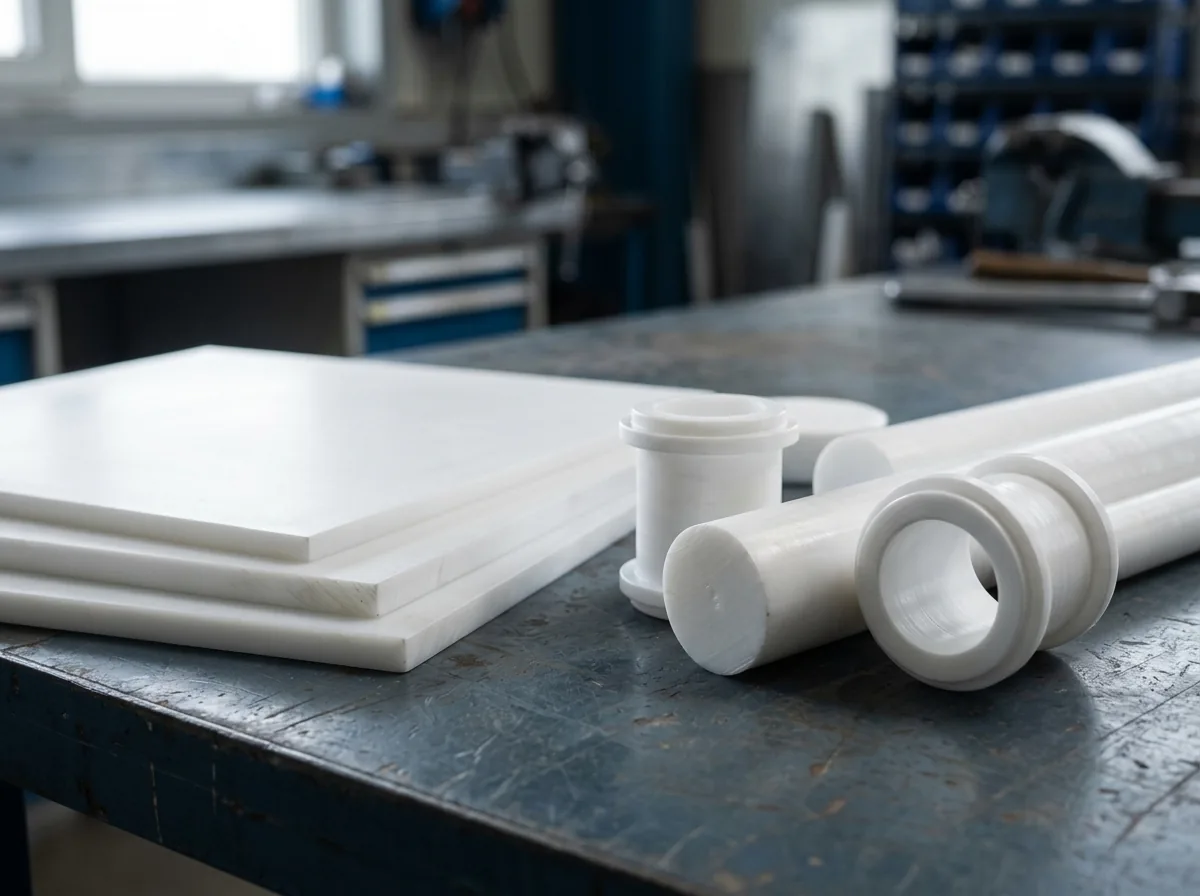
Processing PEEK requires a deep understanding of the material, stable CNC processes and consistent temperature management. As a high-performance plastic with exceptional heat resistance, strength, chemical resistance and dimensional stability, PEEK is one of the most demanding materials in engineering machining. Precise components are only produced when tool selection, cutting parameters, clamping technology and semi-finished product quality are optimally coordinated with one another.
PEEK is used in numerous industries – from mechanical engineering, sensor technology, electronics and fluid technology through to aerospace and security-related applications. Every sector places specific requirements on dimensional accuracy, surface quality and component reliability.
What is PEEK?
Properties of PEEK with an influence on machining
PEEK differs significantly from standard plastics in its thermal and mechanical behaviour. The key properties include: • low thermal conductivity – heat remains in the material for longer, so controlled chip removal is important • high stiffness and strength – increases tool load and requires stable machine technology • pronounced resilience – influences fits and fine functional contours • internal stresses possible – depending on the type of semi-finished product, dimensions and manufacturing process • temperature-dependent dimensional changes – relevant for precise guides, sealing surfaces and functional geometries
Detailed fundamentals on material groups can be found in the Plastics Encyclopaedia.
CNC machining of PEEK
CNC machining demands precise process control. Further information on our manufacturing services can be found under Plastics machining.
Overview of key machining processes
| Process | Advantages | Challenges | Typical applications |
|---|---|---|---|
| Milling | tight tolerances, complex geometries | heat generation, burr formation | housings, functional surfaces, structural components |
| Turning | high concentricity accuracy | controlled chip removal required | bushes, rollers, sealing elements |
| Drilling | precise holes and passages | risk of tear-out, heat generation | mounting points, fluid & sensor openings |
| Grinding | excellent surface quality | material heating | sealing surfaces, guide surfaces |
| Polishing | very low roughness achievable | limited geometries | media-carrying components |
Milling
• use precise carbide tools with polished cutting edges • moderate cutting speeds to avoid local heat • optimised chip removal for consistent dimensional accuracy • cooling as required for delicate or closely toleranced components • high machine stiffness for fine machining
Turning
• defined, constant feed rates • short chips to avoid heat build-up • clamping-friendly fixtures for thin-walled components • rotationally symmetrical components can be produced with high precision
Drilling
• reduced feed rates for clean hole edges • step drilling to prevent tear-out • regular chip removal for consistent temperature control • ideal for sensor, fluid and electronic components
Semi-finished product qualities and their influence
The choice of semi-finished product influences dimensional accuracy, stress behaviour and surface quality.
Extruded semi-finished products
• economical • higher residual stresses • suitable for standard geometries
Compression-moulded semi-finished products
• lower internal stresses • better dimensional stability • ideal for precision components and large wall thicknesses
Modified PEEK variants
• glass-fibre reinforced (GF) – higher stiffness • carbon-fibre reinforced (CF) – very high stiffness & low weight • PTFE-modified – optimised sliding properties
Detailed material overviews can be found in the guide PEEK plastics.
Tolerances in PEEK machining
PEEK allows high precision but requires a process-stable environment. • usual tolerances: ±0.1–0.2 mm • tighter tolerances possible through annealing and climate-stable production • thermal expansion must be taken into account at an early stage • manufacture components in a single setup wherever possible
For particularly demanding functional surfaces – e.g. in sensor or valve technology – post-processing is advisable.
Surface qualities and post-processing
Different requirements apply depending on the application.
Industry requirements
• Mechanical engineering: wear-optimised functional surfaces • Electronics & sensor technology: particle-free and insulating surfaces • Chemical engineering: smooth, media-compatible structures • Aerospace & defence: stable under dynamic load - PEEK in the defence industry
Post-processing techniques
• finishing, fine finishing • grinding for tight sealing and guide fits • polishing for media-carrying components • edge processing for lower notch stresses
Further materials and properties can be found under Materials.
Common problems and causes
• thermal deformation – insufficient cooling or incorrect cutting parameters • burr formation – blunt tools, unsuitable geometries • dimensional drift – internal stresses, temperature gradients • surface scoring – tool wear, vibrations • ovality in round parts – incorrect clamping technology
Design and manufacturing – recommendations
Clamping technology
• large-area, low-force clamping surfaces • vacuum clamping systems for thin sheets • multiple setups for complex geometries • reduced clamping forces for round material
Design
• wall thicknesses as uniform as possible • design functional surfaces for machining in a single setup • take thermal expansion into account • plan reinforcement or relief zones
Cut to size & semi-finished products
Stress-relieved semi-finished product is crucial for precise components: • PEEK sheets • rods • plastic semi-finished products
Further machining fundamentals can be found in the Plastics machining section.
Machining PEEK requires experience
Machining PEEK requires experience, precise tool technology and a deep understanding of the material-related interrelationships. If temperature control, tool selection and tolerance requirements are consistently taken into account, components with high dimensional accuracy, stable performance and many years of reliability are produced – even under extreme industrial operating conditions.