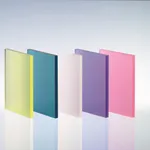
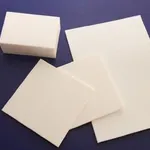
This image was created with artificial intelligence – marked under Art. 50 of the AI Act, Regulation (EU) 2024/1689. It is a placeholder until the company's photos arrive.
PCTFE semi-finished products
PCTFE sheets, rods, cut pieces and finished parts
PCTFE sheets, rods, cut pieces and finished parts
PCTFE (polychlorotrifluoroethylene) is a thermoplastic chlorofluoropolymer with the empirical formula (CF2CCIF) n. It is chemically related to PTFE (polytetrafluoroethylene) and has the lowest water vapour permeability of all plastics. Other names for PCTFE are Kel-F® (a product of 3M) or Neoflon® (a product of Daikin Industries).
Polychlorotrifluoroethylene (PCTFE) is a fully halogenated polymer that contains both fluorine and chlorine as halogens. PCTFE is one of the thermoplastics. It was developed as early as 1934 and is therefore one of the longest-known fluoroplastics. Like other fluoroplastics, PCTFE is very resistant to many chemicals. In addition, PCTFE has the highest hardness, strength and rigidity among the fully halogenated fluoroplastics. PCTFE is dimensionally stable, very easy to machine and can be used over a wide temperature range (about -255° C to +205° C).
The most striking property of PCTFE is its ability to work at extremely low temperatures and retain its elasticity. It also has one of the highest oxygen limits. Because PCTFE is a highly fluorinated resin, it is non-flammable and resists most corrosive chemicals. It exhibits properties such as zero moisture absorption and non-wetting. It does not absorb visible light. PCTFE retains its excellent electrical insulating capability even under thermal cycling and in high-humidity environments.
The high compressive strength and dimensional stability of PCTFE make it a good choice for engineering materials. Its low outgassing rate and permeability is used in instruments, in the laboratory, in aerospace and in flight applications.
Properties of PCTFE (polychlorotrifluoroethylene)
- very large temperature usage range, even at extremely low temperatures from approx. -255°C to +150°C
- non-flammable
- remarkable chemical resistance
- excellent ageing resistance
- impermeability to water and water vapour
- Excellent resistance to creep strain
- Dimensionally stable over a wide temperature range
- Extremely low gas permeability
- FDA approved
- Transparent and coloured compounds
- Working temperature from -240°C to +150°C
We produce finished components to drawings from semi-finished products (rods, tubes, sheet, etc.) for you (seals, valve seats, non-return seals, etc.)