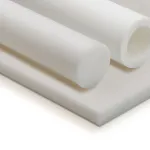
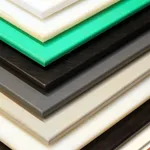
This image was created with artificial intelligence – marked under Art. 50 of the AI Act, Regulation (EU) 2024/1689. It is a placeholder until the company's photos arrive.
Material comparison: elastomers vs thermoplastics in industry
Elastomers or thermoplastics? The direct comparison shows properties, areas of application and helps with the right choice of material.
The choice of the right material directly influences the function, service life and costs of an application. In many industrial sectors the question arises: Elastomer or Thermoplastic? Both material groups fulfil different requirements and show clear strengths depending on the field of application.
In practice, this is rarely a purely technical decision, but rather the interplay of mechanical load, environmental influences and economic framework conditions. Materials that function reliably in one application can fail in another after only a short time.
A detailed comparison is worthwhile already in the planning phase, since wrong decisions later lead to increased wear, unplanned downtime and significantly higher operating costs. A clean material selection therefore forms the basis for stable processes and long-term cost-effectiveness.
Basics: Elastomers and Thermoplastics
What is an elastomer? An elastic material with a cross-linked structure that can be deformed and returns to its original shape.
What is a thermoplastic? A mouldable plastic that becomes soft under heat and can be processed several times.
Elastomers are rubber-like materials with high elasticity. They can be deformed greatly and then return to their original shape. This property arises from their cross-linked molecular structure.
Typical elastomers are:
Thermoplastics, by contrast, consist of non-cross-linked polymer chains. They become soft under heat, can be moulded and solidify again on cooling.
Typical thermoplastics are:
Material properties in direct comparison
| Property | Elastomers | Thermoplastics | Typical classification |
|---|---|---|---|
| Elasticity | very high | low to medium | Elastomers for seals, thermoplastics for construction |
| Shore hardness | 30–90 Shore A | 60–90 Shore D | Elastomers soft, thermoplastics hard |
| Temperature range | approx. -40 °C to +200 °C (depending on type) | approx. -20 °C to +120 °C | FKM and silicone with high reserves |
| Tensile strength | low to medium | high | Thermoplastics for mechanical load |
| Chemical resistance | depends on the elastomer | often very high | PE, PTFE very resistant |
| Wear resistance | medium | high | POM, PA for moving parts |
Elastomers are suitable for sealing and movement, thermoplastics for stability and construction.
Processing and manufacturing differences
Thermoplastics are predominantly processed by injection moulding or extrusion. These processes enable very high dimensional accuracy as well as economical production of large quantities. At the same time, complex geometries can be realised efficiently, which makes thermoplastics particularly interesting for structural components.
A further advantage lies in post-processing: thermoplastics can be machined, welded or thermally formed. This creates high flexibility in further processing and adaptation to specific requirements.
Elastomers, by contrast, are usually produced by vulcanisation. In this process the polymer chains are chemically cross-linked, which creates the typical elastic structure. This process is more complex and less flexible in post-processing, but provides the characteristic resilience and sealing effect.
In practice, dimensionally accurate cut pieces play a central role, particularly for seals, pads or technical components. Here, clean edges, exact dimensions and the right material thickness matter in order to ensure reliable function.
Fields of application in industry
- Elastomers for seals and decoupling
- Thermoplastics for guides and construction
Chemical industry:
- FKM and EPDM for aggressive media
- PE and PTFE for chemically stressed components
- Silicone for hygienic applications
- PE and PP for contact-suitable components
Cost-effectiveness and service life
| Type of use | Better suited | Reason |
|---|---|---|
| Permanent mechanical load | Thermoplastic | high stability |
| Dynamic movement | Elastomer | high elasticity |
| Series production | Thermoplastic | low unit costs |
| Low-maintenance systems | Elastomer | long service life under movement |
The cost-effectiveness of a material results from more than just the material price.
The cost-effectiveness of a material results from more than just the material price. Processing effort, service life, maintenance intervals and the effects on the overall process are also decisive.
Thermoplastics offer clear advantages in series production. Through efficient manufacturing processes and high dimensional stability, components can be produced with consistent quality and low scrap. In addition, many engineering plastics show high wear resistance, which makes them economically attractive for permanently stressed components.
Elastomers unfold their strength above all in dynamic applications. Their ability to compensate for movements and to seal reliably leads to longer service lives in areas such as sealing technology or vibration damping. As a result, maintenance effort and replacement cycles decrease significantly.
In the overall view, the right material choice decides the actual operating costs. A seemingly inexpensive material can become significantly more expensive than a technically more suitable solution due to frequent failures or maintenance.
Decision aid: Which material fits when?
The choice always depends on the specific application.
If sealing is required → Elastomer If mechanical load is the focus → Thermoplastic If vibrations must be compensated → Elastomer If precise components are to be manufactured → Thermoplastic
Decision logic (practical)
| Requirement | Recommended material | Reason |
|---|---|---|
| Sealing function under movement | Elastomer (e.g. NBR, EPDM) | high resilience |
| High surface load / construction | Thermoplastic (e.g. POM, PA) | high strength |
| Chemical stress | FKM / PTFE | high media resistance |
| Wear / friction | POM / PA | good sliding properties |
| Temperature changes | Silicone / FKM | stable properties |
Typical wrong decisions:
- Elastomer under high permanent mechanical load
- Thermoplastic for dynamic sealing requirements
For individual requirements, dimensionally accurate cut pieces offer a precise solution.
Material comparison in detail
EPDM and NBR cover different application focuses. EPDM is suitable for applications with weather influence, ozone exposure and changing temperatures, for example outdoors or in building services. NBR shows its strength in contact with oils, greases and fuels and is therefore frequently used in hydraulics and mechanical engineering. The choice is primarily based on the medium and the environmental load.
POM and PA are among the most widely used thermoplastics in mechanical engineering, but pursue different goals. POM offers very good sliding properties, low friction coefficients and high dimensional stability, which makes it suitable for guides and moving components. PA convinces through high strength and toughness, which is why it is used for stressed structural parts. Here the selection depends above all on friction, load and precision requirement.
Enquiry & implementation
Typical projects from practice
- Industrial sealing systems made of NBR or FKM
- Sliding and guide elements made of POM or PA
- Cut-to-size pieces for machine cladding or pads
Direct implementation of your requirements
You receive a concrete material recommendation based on your application as well as a finished solution as a cut piece or component.
Now define requirements and receive a suitable solution.
For concrete applications, a technical assessment based on your requirements is recommended. This results in tailor-made solutions as a cut piece or finished component.
In conclusion
Elastomers and thermoplastics stand for two different material concepts with clearly defined strengths. While elastomers play out their advantages in flexibility, sealing effect and dynamic loads, thermoplastics convince through dimensional stability, mechanical load capacity and precise manufacturing options.
In industrial applications, the optimal solution arises from the combination of mechanical requirements, environmental conditions and economic goals. A clean analysis of these factors leads to a robust material decision.
Companies benefit from more stable processes, lower downtime and higher efficiency along the entire value chain.
For a concrete application, an individual assessment is worthwhile. Based on your requirements, suitable materials can be selected and implemented as finished components or cut pieces.
FAQ
What is the most important difference between elastomers and thermoplastics?
Elastomers are elastic and return to their original shape after deformation. Thermoplastics are dimensionally stable, deformable under heat and are frequently used for structural components.
When are elastomers the better choice?
Elastomers are particularly suitable for seals, vibration damping, pads and applications with movement or changing load.
When are thermoplastics used?
Thermoplastics are preferred for dimensionally stable components, guides, housings, sliding components and mechanically stressed constructions.
Which materials are suitable for chemical stress?
For elastomers, FKM or EPDM come into question depending on the medium. For thermoplastics, PE, PP or PTFE are frequently used for chemically stressed applications.
How do I find the right material for my application?
Temperature, media contact, mechanical load, movement, desired service life and the type of processing are important. From this it follows whether an elastomer or thermoplastic is better suited.
Our rubber sheets
For industry and trade we offer a wide variety of rubber sheets.
SBR rubber sheet
Our high-quality SBR rubber sheet (styrene-butadiene rubber) is the solution for numerous industrial and commercial applications. This rubber sheet is manufactured from first-class styrene-butadiene rubber and is characterised by its outstanding physical properties.
EPDM rubber sheet
Discover the versatility and reliability of our EPDM rubber sheet, which is manufactured from ethylene-propylene-diene monomer (EPDM). This high-quality elastomer solution has been specially developed to meet the most demanding industrial and commercial applications.
NBR rubber sheet
The NBR rubber sheet is a high-quality industrial product that has been specially developed for applications where excellent resistance to oils, greases and various chemicals is required.
Viton rubber sheet
The Viton rubber sheet is a high-quality technical product that is used for a wide range of industrial applications. Manufactured from fluoro rubber (FKM), it offers outstanding properties that make it the ideal choice for extreme conditions.
FKM rubber sheet
The FKM rubber sheet is a high-quality technical product that is ideal for use in demanding industrial applications. Made from fluoro rubber (FKM), it is characterised by a wide range of outstanding properties that make it the optimal choice for extreme operating conditions.
Silicone rubber sheet
The silicone rubber sheet is a first-class technical product that has been specially developed for applications that place high demands on temperature resistance and flexibility.
PUR rubber sheet
The PUR rubber sheet, made from high-quality polyurethane, is a technically advanced product that has been developed for applications that place the highest demands on abrasion resistance and mechanical load capacity.
Neoprene rubber sheet
The neoprene rubber sheet, manufactured from high-quality chloroprene rubber (CR), is a versatile technical product that is ideal for a wide range of industrial and commercial applications.