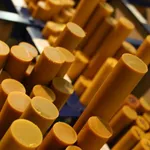
This image was created with artificial intelligence – marked under Art. 50 of the AI Act, Regulation (EU) 2024/1689. It is a placeholder until the company's photos arrive.
Coated aluminium – surfaces with precision, protection and variety
Coated aluminium reliably protects against corrosion and weathering. More about processes, advantages and applications of coated aluminium sheets.
Painted aluminium stands for technical excellence, lasting durability and design freedom. It combines functionality with aesthetics and is used in numerous industries – from industry to architecture. Painting allows aluminium surfaces to be adapted precisely to the respective requirements: in colour, structure and function. The coating protects against external influences, gives the material colour, gloss and structure and at the same time increases its service life.
The combination of low weight, high stability and a weather-resistant paint layer makes painted aluminium one of the most versatile semi-finished products in modern lightweight construction. Whether for façade elements, machine housings, furniture or design objects – the surface can be matched precisely to the planned application. Aspects such as the chemical resistance of aluminium, reflection behaviour, electrical insulation or hygiene requirements can also be specifically influenced by the choice of paint type.
Painted aluminium also impresses with its environmental friendliness: modern coating systems do without solvents, are recyclable and enable an almost closed material cycle. Painted aluminium thus combines technical innovation with ecological responsibility.
What is painted aluminium?
Painted aluminium describes aluminium surfaces that are permanently finished with one or more coats of paint. The aim is not only visual enhancement, but above all protection of the metal against corrosion, UV radiation on aluminium, moisture and chemical influences.
During painting, the natural oxide layer that aluminium automatically forms is specifically treated or removed. This pre-treatment creates the basis for optimum adhesion of the paint. A system of primer, colour coat and clear coat is then applied in several steps, which can be adapted depending on the area of application. This produces coating systems with different functions – from decorative to highly functional.
Depending on the area of use, paint layer thicknesses can be between 20 and 120 micrometres. While thin systems are sufficient for decorative interior applications, thicker, weather-resistant layers are usually used outdoors. Modern industrial paints are also scratch-resistant, chemical-resistant and UV-stable. This makes aluminium a material that is both technically demanding and flexible in design.
Painted aluminium refers to metal surfaces that have been finished with one or more coats of paint. This is not merely a colour design, but a functional protective layer. The paint prevents corrosion, protects against UV radiation, chemicals and moisture and at the same time improves the appearance.
Aluminium naturally forms a thin oxide layer, which must first be removed or chemically activated as a basis for coating. Only after this pre-treatment can the paint adhere permanently and develop its protective function. Modern coating systems combine primers, colour coats and clear coats into multi-layer, resilient surfaces – adapted to the respective load.
Painting processes for aluminium
1. Wet painting
Classic wet painting is flexible in use and enables a large selection of colour tones, effects and gloss levels. The paint is applied in liquid form, usually by spraying, rolling or dipping. Drying or stoving then follows. This process offers particular advantages when small batches, special colours or repairs are required.
High-gloss and metallic effects can also be realised precisely. In industrial wet painting, multi-component paints with an epoxy or polyurethane base are often used, which ensure high adhesion and chemical resistance.
2. Powder coating
Powder coating is today the most widespread form of aluminium painting in the industrial sector. An electrostatically charged powder coating is applied to the conductive aluminium and stoved at around 180 to 200 °C. The paint melts, cross-links and forms an extremely resistant surface.
The advantages lie in the high impact and scratch resistance, the excellent weather resistance of aluminium sheets and the solvent-free nature of the process. Powder-coated aluminium sheets are used in façades, machine housings, railings and vehicle bodies. Different gloss levels, structures and metallic effects can be realised using adapted powder types.
3. Coil coating (strip painting)
In coil coating, aluminium in roll form is painted continuously. The material runs through several coating stations in which pre-treatment, priming and top coating take place. The strip is then stoved and wound up. This process guarantees consistent quality over large areas and is frequently used for façade elements, ceiling panels and composite materials.
Coil coating produces particularly uniform, smooth and weather-resistant surfaces that can be processed further extremely well. The paint layer is usually thinner than with powder coatings, but extremely homogeneous and economical at high unit volumes.
Properties and advantages of painted aluminium surfaces
An additional aspect concerns the electrical properties: the paint layer largely electrically insulates the surface of aluminium. This insulating effect can be advantageous for housings, electronic components or mounting elements, as it prevents short circuits or unwanted contact currents. Depending on the paint type and layer thickness, however, a low residual conductivity may remain, which is why technical requirements should be checked on a case-by-case basis.
Painted aluminium impresses with a combination of technical robustness, design freedom and ease of care.
| Property | Advantage and benefit |
|---|---|
| Corrosion protection | Protection against oxidation, moisture and chemical media. |
| UV resistance | Colours remain stable even after years, no fading. |
| Visual variety | RAL, NCS or special colours, metallic and textured effects. |
| Mechanical resilience | High impact, scratch and abrasion resistance. |
| Ease of cleaning | Smooth surfaces prevent dirt deposits. |
| Processing compatibility | Cut pieces, drill holes and edge processing possible without problems. |
| Temperature resistance | Resistant to heat and cold, including outdoors. |
| Recyclability | Despite the coating, aluminium remains almost fully recyclable. |
Applications of painted aluminium
Painted aluminium is used in numerous industrial sectors and design areas. It combines lightweight construction, design and durability – and is therefore ideal for a wide range of applications:
Architecture and façade construction
Façade elements made of painted aluminium shape modern architecture through clear structures, brilliant colour tones and durability. The combination of lightweight construction and corrosion resistance enables large areas with minimal weight. In high-rise buildings, industrial halls and office buildings, painted aluminium composite panels are used for cladding, window reveals, parapets and ceilings.
Particularly in coastal regions or heavily weathered locations, powder coating offers protection against salty air and moisture. Visually sophisticated effects can also be achieved, such as textured surfaces, metallic finishes or matt design variants that blend harmoniously into the building architecture. Interiors also benefit from colour-painted ceiling panels, light strips and wall claddings that set accents and are easy to care for.
Mechanical and plant engineering
In the industrial environment, painted aluminium is a central material for housings, covers, frame constructions and machine components. The coating protects components against oils, coolants, cleaners and moisture, thereby minimising corrosion and wear. Coloured finishes also help with the visual structuring of complex plants: safety areas, control panels or maintenance zones can be marked in colour.
The coating also allows easy cleaning and contributes to a well-maintained appearance of the plants. In the food, chemical or packaging industry, special chemical-resistant paint systems are often used in order to meet the high hygiene and safety standards. Thanks to the exact dimensional accuracy and the uniform layer thicknesses, the precision and fit of the components are retained even after coating.
Vehicle construction and transport engineering
In the vehicle and transport sector, the ratio of weight, stability and weather resistance plays a decisive role. Painted aluminium offers an optimum balance here. In body and vehicle engineering, it is used for interior claddings, roof systems, doors, steps and trailer bodies.
Commercial vehicles, buses and rail vehicles also benefit from painted aluminium sheets, as they form a durable, visually high-quality outer skin that is resistant to road salt, solar radiation and mechanical load. The variety of colours also enables precise brand adaptation or safety marking. In aviation, painted aluminium is used for interior panels and cabin elements because of its low weight and high reflectivity.
Advertising technology and design
In advertising technology, in exhibition stand construction and in the design sector, painted aluminium is a preferred material for durable and visually precise applications. The uniform, smooth surface provides an excellent base for films, printing and engravings. The use of high-gloss or textured paints can achieve special lighting effects that highlight lettering or logos. In outdoor advertising, UV-resistant finishes ensure that colours remain intense for many years.
Painted aluminium is also used in interior fitting and furniture design – for example for kitchen fronts, panels, luminaires or design elements. The combination of lightness, stability and colour variety makes it a versatile material for architects, designers and manufacturers of individual objects. Painted aluminium sheets serve as a base for signs, displays or advertising boards. The uniform surface enables brilliant printing results and exact edge processing. Painted aluminium surfaces are also increasingly used in interior fitting, furniture or exhibition stand construction – as a stable, lightweight and visually variable alternative to plastic or wood.
Preparation, adhesion and processing
Good adhesion requires careful surface preparation. Before painting, aluminium must be degreased, cleaned and, if necessary, chemically pre-treated. Pickling processes or chromating create a microscopically rough structure in which the paint can anchor itself.
After application, curing or stoving takes place, whereby the paint layer cross-links. For subsequent processing – such as aluminium sheet cut to size or drilling – uncoated edges should be re-sealed in order to avoid corrosion. In industrial practice, special edge-protection paints or transparent sealants are used for this.
Painted, anodised or powder-coated?
Depending on the area of use, the question arises as to the optimum surface treatment for aluminium. The following overview shows the most important differences:
| Process | Appearance | Protective effect | Costs | Typical application |
|---|---|---|---|---|
| Painted (wet paint) | High colour variety, individual design | Good, depending on layer thickness | Medium | Design, interior fitting, special colours |
| Powder-coated | Uniform, robust | Very high | Medium to high | Façades, machines, vehicles |
| Anodised | Metallic glossy, technical | Very high, permanent | High | Architecture, high-end components |
Recommendation: Anyone who needs the greatest colour variety and flexibility chooses painted aluminium. For extreme weather or high mechanical load, powder-coated is usually the better choice. If a metallic, technically refined surface is the priority, anodised offers the greatest long-term protection.
Quality, standards and test criteria
The quality of painted aluminium surfaces is assured by a large number of standards, test methods and certifications. The European standards DIN EN 12206 (powder coating) and DIN EN 13523 (coil coating) are central here, defining requirements for pre-treatment, coating structure, layer thickness, gloss level, colour accuracy and resistance. International standards such as ISO 2813 (gloss measurement) or ISO 2409 (cross-cut test) are also regularly applied.
Various test methods are used for quality control:
- Cross-cut test: Assessment of the adhesion of the paint layer by scoring and pulling off.
- Salt spray test (DIN EN ISO 9227): Simulation of aggressive environmental conditions to test corrosion resistance.
- Bending and impact test: Evaluation of the elasticity and mechanical resilience of the coating.
- Condensation and UV ageing tests: Determination of weather and light resistance over defined periods.
- Colour measurement (ΔE value): Detection of the smallest colour deviations from the reference tone.
For architectural and industrial coatings, compliance with the Qualicoat and GSB standards is also of great importance. These certificates guarantee that all process steps – from pre-treatment through application to stoving – are documented and regularly monitored by independent testing institutes. Only coated products that meet these requirements may carry the respective quality seal. This gives planners, architects and buyers a reliable quality promise for durable and colour-stable surfaces.
Particularly in the industrial environment, where machine housings or façade elements are permanently exposed to weather, temperature changes and chemicals, these standards form the basis for reproducible and verifiable quality. Regular internal and external audits ensure that production processes are continuously improved and adapted to new technical standards.
Sustainability and recycling of aluminium sheets
Certifications and quality standards
In industrial practice, test certificates such as Qualicoat, GSB Standard or GSB International play a central role. These certifications confirm that the coating processes meet strict requirements for layer thickness, adhesion, gloss level and weather resistance. Companies certified to Qualicoat or GSB guarantee consistently high quality of the paint finish – particularly relevant for architectural, façade and mechanical engineering projects. These standards create trust among planners, building owners and technical buyers, as they represent verifiable and internationally recognised quality guidelines.
Energy consumption and CO₂ saving potential
Modern painting facilities are increasingly designed for energy efficiency. Heat recovery systems, optimised oven technology and precise controls significantly reduce the energy required for stoving or drying the paints. Compared with older facilities, up to 30–40 % of process energy can be saved in this way. Water-based paint systems and powder coatings also enable almost emission-free production. These advances reduce both the operating costs and the CO₂ footprint of the coating, which makes painted aluminium particularly attractive also with regard to sustainability and climate protection. Recycling
Aluminium is almost infinitely recyclable – even when it is coated. In the recycling process, the paint layer is removed thermally, the metal is melted down and returned to the cycle. This process saves around 95 % of the energy compared with primary production.
Modern painting companies also rely on solvent-free systems, powder coatings and closed cycles in order to avoid emissions. The combination of durability, recyclability and environmentally friendly coating processes makes painted aluminium a sustainable material solution.
In summary
Painted aluminium combines protection, design and functionality at the highest level and has established itself as an indispensable material in many industrial sectors. Its versatility allows aesthetic requirements to be combined with technical performance. The surfaces are not only visually appealing, but also resistant to corrosion, mechanical load and UV radiation. The precise selection of the paint type allows the material to be adapted exactly to specific operating conditions – whether in architecture, mechanical engineering or product design.
Painted aluminium also offers clear advantages with regard to sustainability. Advanced coating technologies enable environmentally friendly, solvent-free processes with low energy consumption and minimal emissions. Thanks to its recyclability, aluminium remains in the material cycle in the long term and thus contributes to resource conservation.
For industrial applications in which durability, colour variety and quality are decisive, painted aluminium is regarded as a future-proof material. Anyone who requires dimensionally accurate cut pieces, precise surfaces and individual colours will find in painted aluminium sheets an economical, sustainable and visually convincing solution with high technical and aesthetic standards.
FAQ – Painted aluminium
How long does a paint finish last on aluminium? With high-quality industrial processes, 15 to 25 years, with powder coating sometimes considerably longer – depending on the environment and care.
Can you paint aluminium yourself? With thorough cleaning, suitable primers and 2K paints, this is possible. Nevertheless, a professional paint finish is more durable and more uniform.
Which paints are best suited? Epoxy, polyurethane and acrylic systems offer the highest adhesion, chemical resistance and UV stability.
How does painting differ from powder coating? Powder coating uses powder particles and stoving, is solvent-free and particularly robust. Wet painting, by contrast, allows finer colour tones and lower layer thicknesses.
Is painted aluminium available in RAL colours and special tones? Yes, almost the entire RAL spectrum as well as special colour tones to NCS or customer requirements can be realised.
How is the quality checked? Durability is regularly monitored by cross-cut testing, salt spray testing and layer thickness measurement.