Plastic rods
We supply plastic rods of your choice quickly, cheaply and punctually
Plastic Rods
POM-C | PE1000 (PE-UHMW) | PA6 GF 30 | PA6 CAST | PA6.6 | PEEK
PLASTIC RODS
Engineering plastics
PEEK sheets and rods
PE semi-finished products
POM-C FG balz
POM-H sheets
PA6 cast with oil
PA6 GF30 sheets
PEEK blue
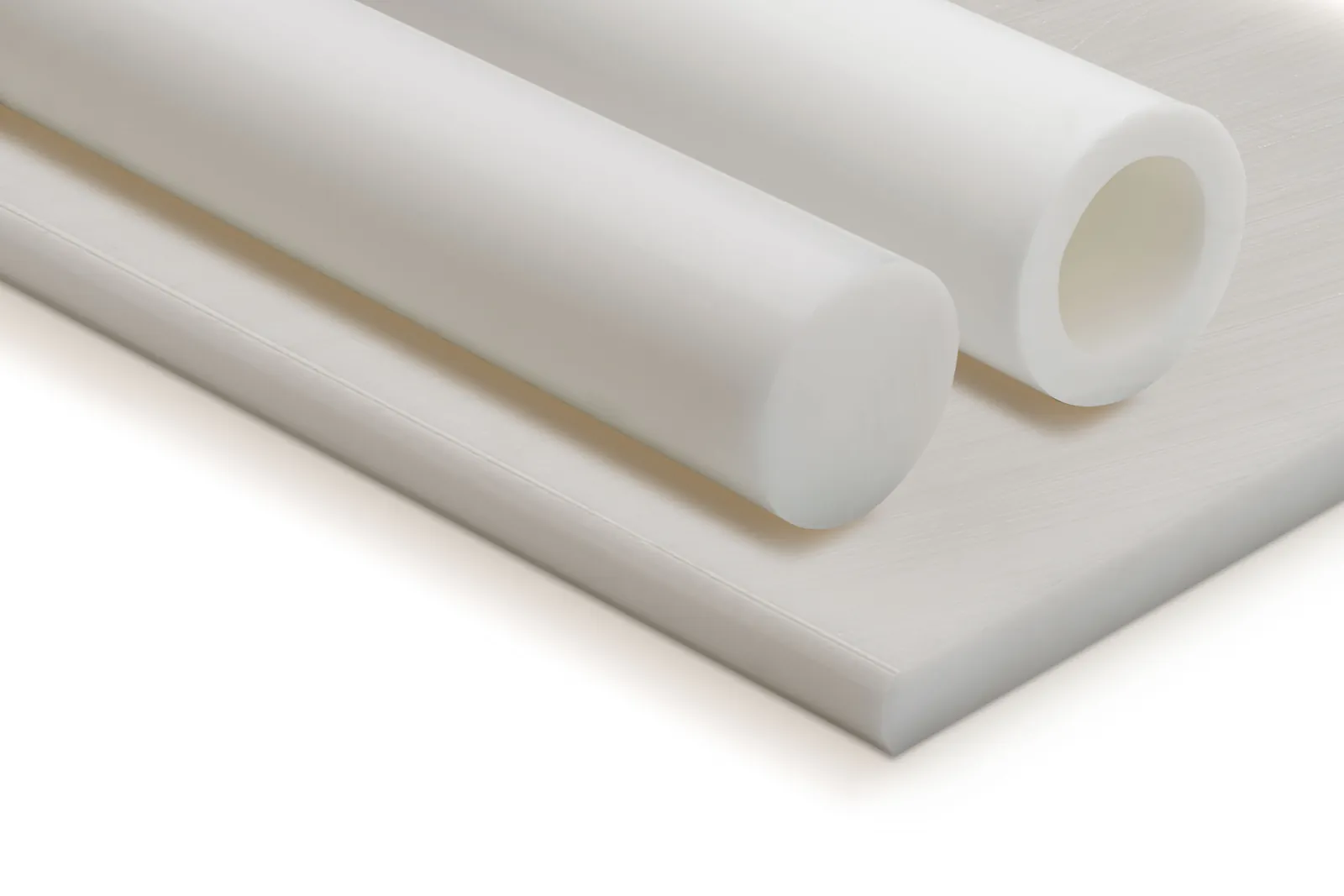
Plastic rods are among the most important semi-finished products in plastics engineering. In industry, mechanical engineering, construction and the trades they serve as a versatile starting material for numerous technical components. Different materials allow mechanical, chemical and thermal requirements to be met in a targeted way.
Plastic rods are frequently used as the starting material for turned or milled parts. They can be machined precisely and therefore enable economical production of individual parts, small batches or series components. At the same time, many plastics offer advantages over metallic materials, such as lower weight, corrosion resistance or very good electrical insulation.
Properties of plastic rods
The properties of a plastic rod depend largely on the material used. Engineering plastics have very different mechanical and chemical properties, which means rods can be selected specifically for particular areas of application.
Typical properties of many plastic rods are low weight, high resistance to moisture and good chemical resistance. Many materials also show good impact strength and high abrasion resistance. This makes them particularly suitable for moving or mechanically loaded components.
Electrical properties also play a role in many applications. Numerous plastics have very good insulating properties and are therefore used in electrotechnical designs. In addition, many materials have good temperature resistance. Depending on the plastic, the typical service range is between about −40 °C and +100 °C, and for high-performance engineering plastics considerably above that.
Another important advantage is good machinability. In many cases, plastic rods can be sawn, turned, milled or drilled without difficulty. This makes them particularly well suited as semi-finished products for individual components.
Materials for plastic rods
Plastic rods are made from various thermoplastics. Each material has specific properties and is therefore suitable for different applications.
Polyethylene (PE)
Polyethylene is one of the most commonly used plastics for rods. The material has very good chemical resistance and excellent sliding properties. At the same time, PE is very impact-resistant and resistant to moisture.
Because of these properties, polyethylene is frequently used for plain bearings, guide elements or rollers. The material is also often used in plant construction or in food technology.
Polypropylene (PP)
Polypropylene has high chemical resistance and good rigidity at comparatively low weight. In addition, PP has a higher temperature resistance than many other standard plastics.
Polypropylene rods are frequently used in apparatus and plant construction. PP is a frequently chosen material especially where components come into contact with chemicals.
Polyvinyl chloride (PVC)
PVC is characterised by high dimensional stability and good resistance to many chemicals. At the same time, the material is easy to machine and has high dimensional accuracy.
PVC rods are frequently used in tank construction, plant construction and technical designs.
Polyamide (PA)
Polyamide is one of the most important engineering plastics in mechanical engineering. The material has high mechanical strength and very good abrasion and wear resistance. This makes it particularly suitable for mechanically stressed components.
Typical applications are bearing bushes, rollers, gears or guide elements in machines and plants.
Polycarbonate (PC)
Polycarbonate is characterised by exceptionally high impact strength. At the same time, the material has good temperature resistance and high strength.
Polycarbonate rods are frequently used in technical designs, for example in components that require high mechanical load capacity.
Dimensions and delivery forms
Plastic rods are available in numerous dimensions. The diameter ranges from a few millimetres to several centimetres. Standard lengths are usually between one and three metres.
For many applications, the rods are supplied as raw material and then further processed. Alternatively, cut pieces to exact dimensions are also possible when specific lengths or dimensions are required.
Besides diameter and length, colour also plays a role. Many plastics are available in different colour variants, which vary depending on the material.
Advantages over metallic materials
- Low weight: Plastic rods are considerably lighter than comparable components made of steel or aluminium. This makes it easier to realise designs, and moving components cause lower loads on machines or bearings.
- Corrosion resistance: Many plastics barely react to moisture, salts or numerous chemicals. This makes plastic rods particularly suitable for use in damp environments, in plant construction or in the chemical industry.
- Good machinability: In many cases, plastic rods can be sawn, turned or milled more easily than metallic materials. This reduces machining times and enables economical production of components.
- Electrical insulation: Many plastics have very good insulating properties. This means plastic rods are frequently used in electrotechnical designs or for insulating components.
- Good sliding properties: Certain plastics such as PE or PA have low friction and are therefore particularly suitable for plain bearings, guides or moving machine elements.
Typical areas of application
- Mechanical engineering: Production of rollers, bearing bushes, spacers, guides or technical machine parts.
- Plant construction: Use in chemical plants, tank constructions or technical components with contact to liquids or chemicals.
- Construction industry: Use as spacers, structural connecting elements or technical auxiliary parts in construction.
- Electrical engineering: Use as insulators, spacers or support elements in electrical designs.
- Furniture and interior fitting: Use as functional components or structural elements in furniture and interior fittings.
- Trades and model making: Production of individual designs, prototypes or small batches.
Machining of plastic rods
Plastic rods are used in many industries. They are particularly often used in mechanical engineering. There they serve, for example, as the starting material for rollers, bearing bushes, spacers or guide parts.
Plastic rods are also used in the construction industry. There they are used, for example, as spacers, connecting elements or structural auxiliary elements.
In electrical engineering, plastic rods are frequently used as insulators or spacers. Their insulating properties make them outstandingly suitable for electrical designs.
In addition, there are numerous applications in furniture and interior fitting as well as in model making or in the trades. Here plastic rods frequently serve as structural or decorative elements.
Machining of plastic rods
A major advantage of many engineering plastics is their good machinability. As a rule, rods can be sawn, turned or milled without difficulty. This makes them outstandingly suitable as a starting material for individual components.
During machining, it is important to take account of the properties of the respective material. Different plastics produce different chips and heat generation. Cutting speed, tool selection and cooling should therefore be adjusted accordingly.
For complex components or flat geometries, a cut piece from plastic sheets can alternatively also make sense.
Selecting the right plastic rod
The selection of the right material depends strongly on the later area of application. Mechanical loads, temperature ranges or chemical influences play a central role in material selection.
A rod used in a machine must meet different properties from a component in plant construction or outdoors. The specific requirements of the application should therefore always be taken into account when selecting.
Further processing is also an important factor. If a rod is used, for example, as the starting material for turned parts, the diameter and tolerances must be selected accordingly.
Ordering and specification
So that plastic rods can be further processed efficiently, the order should be as precise as possible. This includes details of the material, the diameter and the desired length. Requirements for temperature resistance or chemical resistance can also play a role.
A clear specification makes it easier to select the right material and ensures that the rod is optimally suited to the respective application.
Plastic rods as a versatile technical semi-finished product
Plastic rods are among the most important semi-finished products in plastics processing. The large selection of different materials means their properties can be specifically adapted to technical requirements. Depending on the material, the focus can be on high mechanical load capacity, good sliding properties, chemical resistance or electrical insulation.
Particularly in mechanical and plant engineering, rods frequently serve as the starting material for turned or milled components. They enable precise production of technical components and can be further processed economically. At the same time, many plastics offer advantages such as low weight, corrosion resistance and easy machining.
Through this combination of versatile materials, good machinability and broad possible applications, plastic rods are among the most important materials for technical designs in industry, the trades and engineering.
Frequently asked questions about plastic rods
Which plastic rods are suitable for mechanically loaded components?
Polyamide (PA) and polycarbonate (PC) are suitable for mechanically stressed applications. These materials offer high strength, good abrasion values and stable dimensional accuracy.
Which plastics offer high chemical resistance?
Polyethylene (PE), polypropylene (PP) and polyvinyl chloride (PVC) have high resistance to many acids, alkalis and cleaning media. Suitability depends on the medium, temperature and concentration.
In which dimensions are plastic rods available?
Plastic rods are available in numerous diameters, from small precision sizes to larger technical cross-sections. Delivery is usually in lengths of 1 to 3 metres; cut pieces to size can be realised.
Are plastic rods suitable for turning and milling work?
Many plastic rods are very well suited to machining. Material, tool selection and cutting parameters influence surface quality and dimensional accuracy.
When is a rod preferable to a plastic sheet?
Rods are particularly suitable for rotationally symmetrical components such as bushes, rollers or spacers. For flat or contour-milled components, the use of plastic sheets as a semi-finished product is advisable.
Advantages you can expect from Martan Gummi
Large selection of rubber sheets, sealing material and O-rings
Individual solutions on site
Rubber machining and sealing technology
Designing, drafting and drawing your parts
The highest degree of precision
XXL machine park, plotting, punching, CO2 laser cutting, bending, bonding
Contact us
REQUEST YOUR NON-BINDING QUOTE NOW
Submit an individual enquiry
Industries we supply
Mechanical & plant engineering
Conveyor technology
Food industry
Automotive industry
Packaging industry
Medical / laboratory technology
Vehicle engineering
Water technology
Aerospace industry
Rail technology
Shopfitting
Aviation industry
Mechanical & plant engineering
Conveyor technology
Food industry
Automotive industry
Packaging industry
Medical / laboratory technology
Vehicle engineering
Water technology
Aerospace industry
Rail technology
Shopfitting
Aviation industry
Contact us