Plastic profiles cut to size – advantages and areas of application
Discover the advantages of custom-made plastic profiles for industry & engineering. Precisely fitting, economical and versatile.
Plastic profiles cut to size are used wherever standard profiles reach their limits constructively, visually or functionally. In many projects, a few millimetres decide fit accuracy, assembly effort and long-term stability. Made-to-measure profiles make it possible to match the cross-section, wall thicknesses, webs, grooves and functional areas exactly to the respective application. This creates solutions that meet mechanical requirements, can be assembled cleanly and function reproducibly over their entire service life.
In contrast to stock profiles, with plastic profiles cut to size the geometry is consistently thought through from the application onwards. This applies both to the profile type and to the material, the tolerances and subsequent series production. Anyone who plans these points systematically reduces rework, minimises assembly times and achieves a technically clean, economical solution.
The following provides a structured presentation of profile types, material options, realistic tolerances and typical projects. In addition, you will receive concrete decision-making aids on when a custom plastic profile is worthwhile, how to have a plastic profile manufactured to drawing and which steps are relevant for an economical implementation.
Plastic profiles cut to size – profile types in detail
Anyone who wants to have a plastic profile manufactured cut to size should understand the profile geometry as a central design element. The cross-section defines stability, assembly path, load capacity and subsequent functional integration. Particularly with a custom plastic profile, the geometry decides economy and suitability for series production.
Presenting profile types systematically
Made-to-measure plastic profiles are frequently produced by extrusion. The profile type determines function, stability and assembly.
Standard cross-sections (common profile shapes)
| Profile type | Brief description | Typical function | Example application |
|---|---|---|---|
| U-profile | U-shaped, open groove | Grip, guide, protect edges | Edge protection, guiding, edging |
| L-profile (angle profile) | 90° angle | Protect corners, covers | Frames, corner protection, cladding |
| T-profile | T cross-section | Separate, clip in, connect | Plug-in systems, cover strips |
| H-profile | Double web / H | Connect sheets | Sheet joints, partition walls |
| Flat profile | rectangular, solid | Cover, shim | Cover strip, spacer |
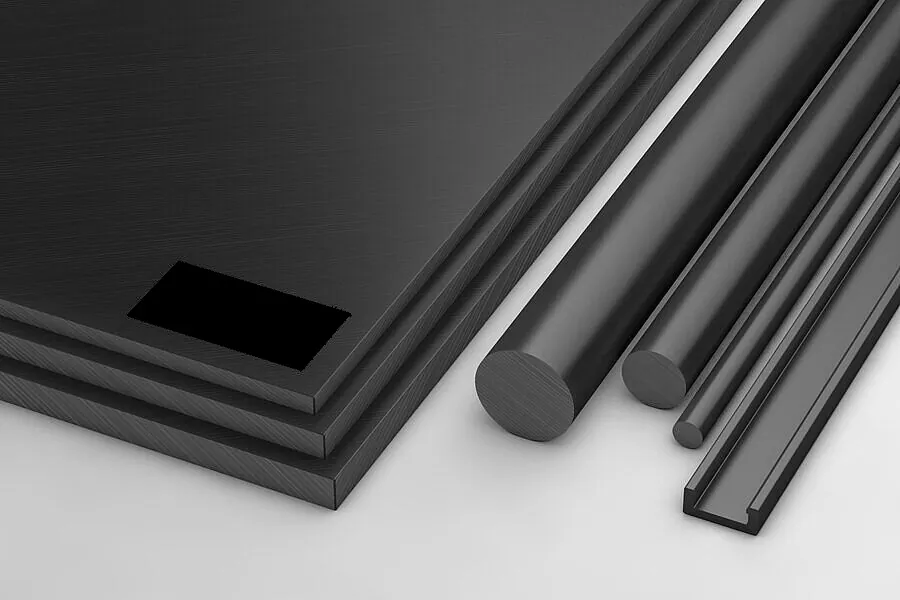
| Round profile | round, solid | Spacing, guiding | Spacers, technical inserts |
| Multiwall profile | several chambers | Lightweight construction, rigidity | Claddings, covers |
PVC profiles cut to size
PVC is particularly suitable for individually manufactured plastic profiles when dimensional stability, economical series production and a versatile profile geometry are required. Depending on the application, rigid PVC or flexible PVC versions are used.
PVC profiles cut to size can, for example, be manufactured as cover profiles, guide profiles, edge protection, mounting profiles or complex technical custom profiles. During design, grooves, webs, detents and other functional areas can be integrated directly into the profile cross-section.
Custom profiles (individual geometries)
Custom profiles are chosen when requirements go beyond standard shapes:
- clip and detent geometries (snap connection)
- seal seats (groove-and-tongue-like contours)
- multi-stage plug-in profiles
- profiles with functional webs, stops, screw-on surfaces
- co-extrusion (two materials in one profile, e.g. carrier + soft sealing lip)
Goal: functional integration in the profile reduces assembly effort, number of parts and sources of error.
Manufacturing plastic profiles individually – material options at a glance
The material influences dimensional stability, temperature behaviour, chemical resistance, UV resistance and mechanical load capacity. For plastic profiles cut to size, a clear selection according to operating conditions is worthwhile.
| Material | Strengths | Limits | Suitable for |
|---|---|---|---|
| PVC (rigid) | dimensionally stable, economical, easy to extrude | limited temperature range | construction profiles, covers, edges |
| PVC (flexible) | flexible, damping | lower rigidity | sealing lips, protective strips |
| PE (HDPE) | chemical-resistant, robust | lower rigidity than POM/PA | industrial environment, outdoor area |
| PP | light, chemical-resistant | more cold-sensitive than PE | tank construction, technical applications |
| ABS | impact-resistant, easy to machine | UV depends on quality | housings, cover profiles |
| PC (polycarbonate) | impact-resistant, transparent possible | more expensive, stress cracks depending on medium | protective covers, visible parts |
| POM | high dimensional stability, good sliding properties | limited UV stability | guides, slide strips, precision |
| PA (nylon) | load-bearing, tough | absorbs moisture | mechanically stressed profiles |
Optional treatments (as required)
- UV-stabilised (for outdoor applications)
- antistatic / conductive
- flame-retardant
- food-compliant (depending on material/quality)
- glass-fibre reinforced (higher rigidity)
Practical rule: choose the material not by "stronger", but by environment, load case and service life.
Tolerances for plastic profiles cut to size
Tolerances can be realistically planned for extruded profiles – however, they depend heavily on profile geometry, wall thickness, material and cooling.
Factors that influence tolerances
- shrinkage and temperature curve
- wall thickness distribution and profile width
- tool design and calibration
- haul-off speed and cooling
- subsequent cutting
Typical tolerance ranges (guide values)
| Feature | Typical range |
|---|---|
| Width/height up to approx. 50 mm | ± 0.2 to ± 0.5 mm |
| larger cross-sections | ± 0.5 to ± 1.0 mm |
| Wall thickness | ± 0.1 to ± 0.3 mm |
| Length when cut to size | ± 1 to ± 2 mm |
When it has to be more precise
- design the profile geometry to be tolerance-friendly (uniform wall thicknesses, stable webs)
- plan for sampling and fine-tuning of the tool
- rework critical surfaces (e.g. milling, drilling)
Important: exact fits are created by a combination of sensible design, sample approval and reproducible series production.
Typical projects
- Finishing and cover profiles in construction: they ensure clean transitions, defined edges and a long-lasting visual solution.
- Edge and corner protection in interior fitting: profiles protect sensitive areas against impact loads and increase the service life of components.
- Sheet connections with H or plug-in profiles: they enable stable and assembly-friendly connections between surface elements.
- Guide and slide strips in mechanical engineering: made-to-measure profiles ensure defined movement sequences and uniform force transmission.
- Protective and deflector profiles on systems: they serve as mechanical protection against impact, abrasion or contamination.
- Cable and line protection profiles: they bundle and secure cables in industrial or technical environments.
- Design and decorative profiles in furniture and shopfitting: individual geometries support a clear line and a high-quality appearance.
- Lightweight and cover profiles in vehicle or caravan construction: they combine low weight with sufficient stability.
- Profiles with integrated seal seat: they combine carrier and sealing function in one component and reduce the number of parts.
- Co-extrusion profiles with several materials: they combine different properties such as rigidity and elasticity within one profile.
Having plastic profiles manufactured cut to size – decision-making basics
When is a custom profile worthwhile?
A custom plastic profile offers economic advantages as soon as several functions are combined in the cross-section, assembly time is to be reduced or high quantities are planned over a longer period. By integrating detents, seal seats or stops, the number of parts falls and process reliability rises.
When is a standard profile with cut to size sufficient?
For one-off projects, low quantities or simple geometries, a stock profile with individual cut to size offers a fast and flexible solution. The effort for tooling and sampling is eliminated, which speeds up implementation.
Extrusion profiles cut to size – economy, minimum quantities and tool costs
The economy of an individual extrusion profile depends on geometry, material and annual quantity. Typical influencing factors are:
- tool costs depending on complexity and calibration effort
- planned annual quantity or project duration
- savings potential in assembly, rework and number of parts
For medium to higher series, a tool often pays for itself within a short time through reduced assembly times and reproducible quality. Minimum quantities depend on the profile cross-section and material and, for series projects, are often in the range of several hundred to a thousand metres.
Delivery times and project phases
For an individual plastic profile cut to size, the process is divided into several phases:
- design coordination and technical approval
- toolmaking and calibration
- sampling and dimensional inspection
- start of series production and defined cut to size
The period from project start to series delivery is usually in the range of several weeks, depending on complexity. Clean technical preparation shortens coordination times and increases planning reliability.
Design rules for wall thicknesses in extrusion profiles
Uniform wall thicknesses support dimensional accuracy and dimensional stability. The following principles have proven themselves:
- wall thicknesses as constant as possible within a cross-section
- soft transitions instead of abrupt material changes
- adequately dimensioned webs to stabilise wide profiles
- define function-relevant dimensions as a reference
A tolerance-friendly design improves repeat accuracy and reduces distortion during the cooling process.
How a made-to-measure project typically proceeds
- Clarify the requirement: geometry, application, quantity, environment
- Provide a drawing or sample
- Select the material
- Tool concept (for extrusion) and sampling
- Sample approval based on defined dimensions/tolerances
- Series production, cut to size, delivery
Note on economy: for series or recurring projects, a tool pays for itself quickly, as assembly effort falls and fits are reproducible.
Common mistakes in projects – and how to avoid them
- profile shape planned without an assembly path: check detent and plug-in geometries early
- strongly varying wall thicknesses: leads to distortion, poor repeat accuracy
- tolerances without reference to function: better to define functional dimensions
- material chosen without considering media/UV: later damage due to environmental conditions
Requesting plastic profiles cut to size – how to proceed
If you want to have a plastic profile manufactured individually, clear information speeds up the entire process. For a reliable assessment, the following steps are recommended:
- Provide a technical drawing with functional dimensions
- Define the material or operating conditions
- State the planned annual quantity or project duration
- Add information on assembly, temperature, UV or media exposure
- Describe tolerance requirements functionally
On this basis, it is possible to assess whether an extrusion profile cut to size is sensible or whether a standard profile with cut to size is economically sufficient.
Practical examples from real projects
A mechanical engineering company replaced a bolted aluminium guide with a custom POM profile with an integrated sliding zone. Result: reduced assembly time, lower noise development and reproducible fit across the series.
In interior fitting, a multi-part edge system was replaced by a co-extrusion profile made of a rigid carrier and a soft sealing lip. Result: fewer parts, clean appearance and simplified assembly.
A construction project had previously used standard H profiles with adjustments on site. A customised plastic profile to drawing eliminated the rework, and assembly times fell significantly.
Decision-making aid: custom profile or standard solution?
A custom plastic profile is particularly suitable for:
- recurring series projects
- high assembly time per component
- complex functions in the cross-section
- defined technical requirements
A standard profile with cut to size is particularly suitable for:
- one-off projects or prototypes
- simple geometries
- very low quantities
- short-term requirements without tool lead time
Project checklist: having a plastic profile manufactured to drawing
| Checkpoints | Significance for the project |
|---|---|
| Functional dimensions defined | Ensures fit accuracy in the application |
| Operating environment described | Basis for the right material choice |
| Annual quantity calculated | Assesses the economy of a tool |
| Assembly path checked | Prevents later adjustments |
| Tolerances defined in relation to function | Increases process reliability |
Planning plastic profiles cut to size strategically
Plastic profiles cut to size unfold their economic and technical advantage when profile type, material and tolerances are coordinated with one another at an early stage. A well-thought-out geometry reduces assembly times, increases functional reliability and ensures reproducible quality over the entire service life of the component.
Anyone who takes operating conditions, quantities and assembly processes into account from the outset creates a solution that is technically clean in design and economically viable in the long term. Made-to-measure profiles are therefore a strategic design tool for demanding projects in construction, industry and mechanical engineering.
Why plastic profiles cut to size are superior in the long term
Individual plastic profiles reduce component complexity, save assembly time and improve functional integration. While standard profiles frequently require adjustments, a made-to-measure solution produces a cross-section precisely matched to the project. This increases efficiency, repeat accuracy and technical safety.
For companies with recurring projects or clearly defined requirements for load capacity, media resistance or dimensional accuracy, an extrusion profile cut to size offers a stable basis for long-term series quality.
Summary for decision-makers
Plastic profiles cut to size enable a constructively clean, assembly-optimised and economically scalable solution for construction, industrial and mechanical engineering projects. What is decisive is the coordination of profile geometry, material choice and realistic tolerances with the actual operating environment. Custom plastic profiles are particularly worthwhile for series applications, functional integration in the cross-section and clearly defined technical requirements.
Anyone who observes design rules at an early stage, weighs tool costs against assembly savings and prepares the project parameters in a structured way creates a reproducible series solution with long-term cost certainty. Having plastic profiles manufactured individually is therefore a strategic means of optimising components, assembly processes and service life.
FAQ
Which profile types are most frequently suitable for made-to-measure projects? U, L, T and H profiles cover many applications. Custom profiles offer advantages when several functions such as detents, seal seats or stops are to be combined in one component.
Which materials are suitable for outdoor applications? UV-stabilised materials come into consideration for outdoor applications. The choice depends on the temperature range, mechanical load and possible media contact.
Which tolerances are realistic for plastic profiles cut to size? The achievable tolerances depend on geometry and material. For smaller cross-sections, typical values are often in the range of ±0.2 to ±0.5 mm, and correspondingly higher for larger profiles.
From what quantity is an extrusion custom profile worthwhile? As soon as a profile is needed regularly or saves significant assembly and adjustment times, an individual tool solution pays for itself even at medium quantities.
What information do I need for an enquiry? Required are a technical drawing or sketch with functional dimensions, information on the desired material, the length and quantity, as well as information on the operating environment and type of assembly.