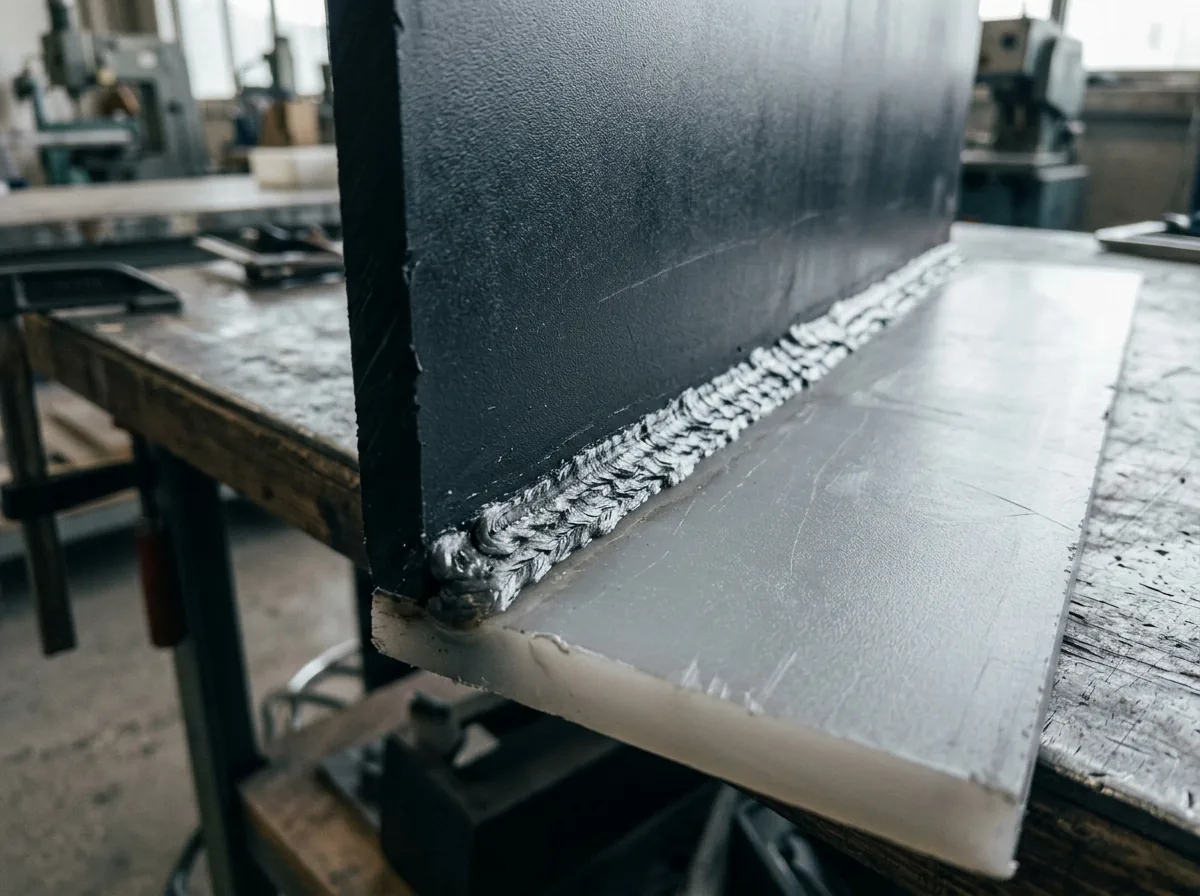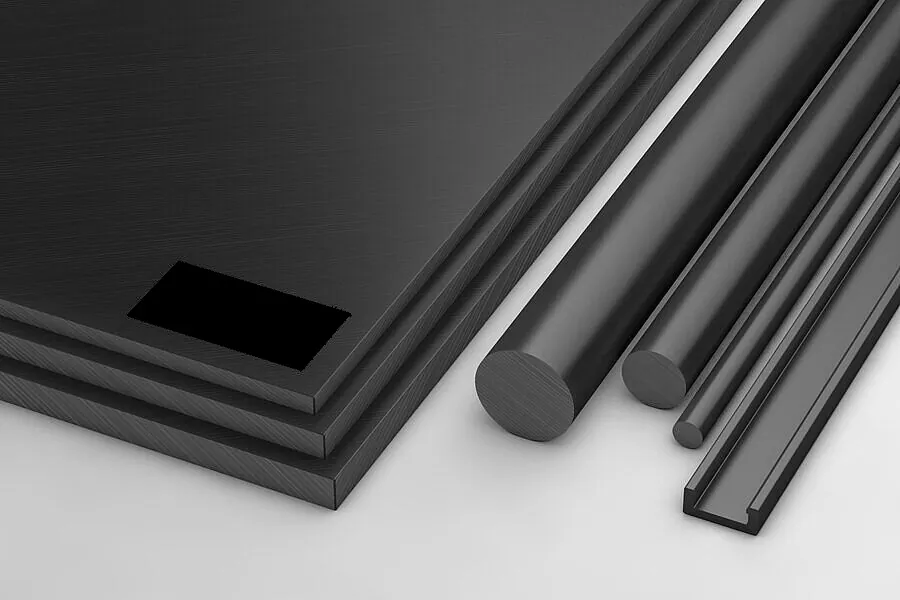
Plastics for guides, slide rails and wear parts
PE 1000, POM-C, PA6, PET, PTFE or PEEK: find the right plastic for slide rails, guides and wear parts.
Plastics for slide rails must meet several requirements at once: they should slide well, wear little, absorb loads and maintain their dimensions as reliably as possible during operation. Different materials are therefore suitable for guides, chain rails, slide plates and replaceable wear parts.
PE 1000 is particularly suitable for abrasion-resistant slide rails and conveyor systems. POM-C is often the better choice for precise guide elements. PA6 offers advantages under impact and high mechanical loads, while PET combines high dimensional stability with good wear properties. For high temperatures, aggressive media or extreme loads, PTFE, PEEK or specially modified slide materials may be necessary.
Which plastic is suitable for slide rails and guides?
For many slide rails made of plastic, PE 1000 is the first material option. The plastic has high abrasion resistance, good sliding properties and low moisture absorption. It is frequently used in conveyor systems, chain guides, chutes and wear-resistant linings.
However, PE 1000 is not automatically the best solution for every guide. Where tolerances are tighter, stiffness higher or compressive load greater, POM-C, PET or PA6 may be more suitable.
As a first guide:
| Operating condition | Frequently suitable material |
|---|---|
| Chain guides and conveyor technology | PE 1000 |
| Precise guide rails | POM-C |
| High impact load | PA6 |
| High dimensional stability under moisture | POM-C or PET |
| Slide plates with good compressive strength | PET or POM-C |
| Very low friction | PTFE or modified slide material |
| High temperature and load | PEEK |
| Low temperatures | PE 1000 or PTFE |
| Food processing systems | suitable PE, POM, PET or PEEK grade |
For individually manufactured components, different plastic sheets can be used as starting material, cut to size.
What tasks do guides, slide rails and wear parts perform?
The terms are often used together, but they describe different component functions.
Guides
A plastic guide holds a moving component in a defined position or path of motion. These include, for example:
- linear guides
- chain guides
- belt guides
- rail guides
- side guides in conveyor systems
- guide rings and guide elements
With guides, dimensional stability, stiffness and controlled clearance are particularly important.
Slide rails
Slide rails reduce direct contact between moving metal parts. They form a low-wear sliding surface and protect the actual machine structure.
Typical examples are:
- chain slide rails
- conveyor rails
- slide pads
- guide rails
- support rails
- side guides
With slide rails, sliding properties, abrasion resistance and low noise generation are the priority.
Slide plates
Slide plates made of plastic distribute loads over larger areas and enable relative movement between components. They are used under machine components, carriages, guides or moving system components.
Compared with narrow slide rails, compressive strength, flatness and thermal expansion are often particularly relevant for slide plates.
Wear parts
Wear parts are intended to absorb abrasion in a targeted way so that expensive machine components are not damaged. They are designed so that they can be easily replaced when necessary.
These include:
- wear rails
- impact plates
- scrapers
- linings
- guide jaws
- slide shoes
- rollers
- slide bushes
The best plastic for wear parts is therefore not necessarily the hardest material. What matters is which material wears in a controlled way under the specific loads and damages the mating surface as little as possible.
PE 1000, POM-C, PA6, PET, PTFE and PEEK compared
| Property | PE 1000 | POM-C | PA6 | PET | PTFE | PEEK |
|---|---|---|---|---|---|---|
| Sliding properties | Very good | Good | Good | Good | Very good | Good |
| Abrasion resistance | Very high | Good | Good to very good | Very good | Limited with pure PTFE | Very good |
| Compressive strength | Medium | High | High | High | Rather low | Very high |
| Stiffness | Low to medium | High | Medium to high | High | Low | Very high |
| Dimensional stability | Medium | Very good | Dependent on moisture | Very good | Limited under load | Very good |
| Water absorption | Very low | Low | High | Low | Very low | Very low |
| Impact strength | Very high | Good | Very high | Medium | Medium | Good |
| Temperature resistance | Rather limited | Medium | Medium | Medium | Very high | Very high |
| Machinability | Good | Very good | Good | Very good | More demanding | Very good |
| Cost | Low to medium | Medium | Medium | Medium | Higher | Very high |
The table shows why pure wear resistance alone is not enough. A material can be very abrasion-resistant but yield too much under high surface pressure. Another plastic can be precise and pressure-resistant but break more quickly under impact loads.
When is PE 1000 suitable for slide rails?
PE 1000, also referred to as PE-UHMW, is one of the most important materials for slide rails and chain guides. The plastic has very good sliding properties, high wear resistance and low moisture absorption.
Typical areas of application are:
- chain guides
- belt guides
- conveyor systems
- chutes
- side guides
- wear plates
- silo walls
- linings
- scrapers
- slide pads
For such applications, PE 1000 sheets for slide rails and wear parts are suitable. Further technical basics can be found in the material overview on PE 1000 as an abrasion-resistant slide material.
Why PE 1000 is suitable for chain guides
A chain guide must remain in permanent contact with moving chain links. The material should therefore:
- generate little friction
- resist wear
- dampen impacts
- reduce noise
- be corrosion-free
- absorb little moisture
PE 1000 meets these requirements particularly well in many conveyor systems. The plastic can also significantly reduce running noise compared with metal guides.
Limits of PE 1000
PE 1000 has lower stiffness than POM-C, PET or PEEK. Under high compressive load, the material can deform more. Thermal expansion is also comparatively high.
PE 1000 is therefore less suitable when:
- very tight tolerances are necessary
- high surface pressures occur
- the guide requires high stiffness
- higher temperatures prevail
- large unsupported spans must be bridged
For a precise guide, POM-C may be more suitable, even though PE 1000 has the better abrasion value.
When is POM-C the better choice?
POM-C combines good sliding properties with high strength, stiffness and dimensional stability. The material is particularly suitable for precise POM guide rails, rollers, slide shoes and guide elements.
Typical applications are:
- precise machine guides
- guide rings
- slide jaws
- rollers
- sliders
- small slide rails
- guide elements with tight fits
- machined series parts
For these components, POM-C sheets for precise guide elements can be used. The material page on the properties and areas of application of POM-C offers additional information.
POM-C or PE 1000?
The decision PE 1000 or POM depends primarily on the priority.
PE 1000 is often better when:
- high abrasion resistance is decisive
- impact loads occur
- low friction is important
- the guide must tolerate large dirt particles
- tight tolerances are not required
POM-C is often better when:
- dimensional stability is decisive
- tight fits are required
- higher stiffness is necessary
- the guide must be manufactured precisely
- lower thermal expansion is desired
For a wear-prone conveyor chain, PE 1000 is often the more economical solution. For a precisely guided machine carriage, POM-C can be considerably more suitable.
When is PA6 suitable for guides and wear parts?
PA6 has high toughness, good wear resistance and higher mechanical load capacity than PE 1000. The material is particularly suitable for larger components subject to impact loads.
Typical PA6 wear parts are:
- large guide rails
- slide shoes
- rollers
- guide jaws
- bearing parts
- impact plates
- mechanically loaded wear inserts
For such applications, PA6 sheets for mechanically loaded slide rails are available.
When is PA6 better than PE 1000?
PA6 can be more suitable when:
- high compressive loads occur
- higher stiffness is required
- components must absorb greater loads
- the design is subject to impact loads
- greater component thicknesses are required
PE 1000, by contrast, often remains superior when abrasion, sliding properties and low moisture absorption are the priority.
Note the moisture absorption of PA6
PA6 absorbs significantly more moisture than PE 1000, POM-C or PET. As a result, dimensions and mechanical properties can change.
In a guide, this can lead to:
- the guide clearance becoming smaller
- a rail swelling
- hole spacings no longer fitting exactly
- stiffness decreasing
- the component becoming softer
PA6 should therefore not be designed on the basis of dry datasheet values alone. Where moisture varies, sufficient clearance and suitable fastening points must be allowed for.
The comparison PA6, POM-C or PE-HD explains the differences in water absorption and dimensional stability in more detail.
When does PET make sense for slide plates?
PET has high strength, stiffness and dimensional stability. At the same time, the material absorbs only little moisture and has good wear properties.
PET is particularly suitable for:
- precise slide plates
- guide rails with tight tolerances
- wear-prone machine parts
- guide rings
- rollers
- components with high compressive load
- applications with varying air humidity
For such components, PET sheets for dimensionally stable slide plates can be used.
PET or POM-C?
PET and POM-C overlap in many applications. Both materials are dimensionally stable, easy to machine and absorb little moisture.
PET can offer advantages when:
- higher stiffness is required
- the compressive load is high
- wear resistance is the priority
- precise sliding surfaces are required
POM-C is often more suitable when:
- high impact strength is important
- good machinability for complex parts is required
- the component is exposed to varying loads
- an economical general-purpose material is sought
The specific material grade is decisive. Slide-modified PET can behave very differently from a standard grade.
When are PTFE slide rails suitable?
PTFE has a very low coefficient of friction and high chemical resistance. The material is suitable for sliding surfaces where low friction, media contact or high temperatures are decisive.
Possible applications are:
- chemically exposed guides
- slide pads
- sealing and sliding elements
- temperature-exposed guide plates
- dry-running applications
- applications with low breakaway forces
However, pure PTFE is comparatively soft and tends to creep under sustained load. For highly loaded PTFE slide rails, filled or mechanically supported materials are therefore often used.
PTFE is less suitable when:
- high surface pressure occurs
- tight tolerances must be maintained permanently
- thin components are heavily loaded
- high structural stiffness is required
When are PEEK guide elements required?
PEEK is a high-performance plastic for high temperatures, high compressive load and demanding chemical conditions. The material has high strength, stiffness and creep resistance.
Typical applications for PEEK guide elements are:
- high-temperature systems
- pumps and compressors
- chemical plants
- semiconductor technology
- high-pressure systems
- precision guides
- wear-prone components with high temperature
For such applications, PEEK sheets for highly loaded guide elements can be used.
PEEK is technically high-performing, but considerably more expensive than PE 1000, POM-C, PA6 or PET. The material should therefore only be used when standard plastics do not reliably meet the requirements.
The article Standard plastic or high-performance plastic helps with the economic assessment. Further areas of application are described in the article on PEEK plastics for slide guides and bearing components.
Which plastic is suitable for chain guides?
PE 1000 is frequently used for chain guides. The material combines high abrasion resistance with good impact damping and low frictional resistance.
A plastic for chain guides must cope with the following loads:
- continuous sliding contact
- vibrations
- varying chain forces
- lubricants
- dirt
- temperature changes
- possible moisture
PE 1000 is particularly suitable when the chain runs continuously and no extremely high surface pressures occur.
For more precise or more heavily loaded guides, POM-C, PET or PA6 may be more suitable. For high temperatures, PEEK may be required.
Which plastic is suitable for belt guides?
With belt guides, low friction, good surface quality and dimensional stability are important. The guide must not unnecessarily heat or damage the belt.
Suitable materials are often:
- PE 1000 for robust, low-wear guides
- POM-C for precise belt guides
- PET for pressure-loaded, dimensionally stable guide elements
- PTFE for particularly low friction
The edges of the guide must be cleanly rounded. Sharp transitions can damage the belt and shorten its service life.
Which plastic is suitable for high surface pressure?
A plastic for high surface pressure must absorb pressure without deforming permanently to a great extent.
Among the standard plastics compared, the following are often suitable:
- POM-C
- PA6
- PET
At particularly high temperatures or loads, PEEK may be required.
PE 1000 does have very high abrasion resistance, but it deforms more under high compressive load than POM-C, PET or PEEK. Pure PTFE is also only suitable to a limited extent due to its creep behaviour.
Surface pressure must not be considered in isolation. Simultaneous movement generates frictional heat and can significantly reduce the permissible load.
Wear resistance and sliding properties are not the same
A common mistake is to automatically classify the plastic with the lowest coefficient of friction as the most wear-resistant material.
The coefficient of friction of a plastic describes how strongly two surfaces brake against each other. The wear rate, by contrast, describes how much material is removed during movement.
A material can:
- have a low coefficient of friction and still wear heavily
- have a higher coefficient of friction and nevertheless last a long time
- protect its own surface but damage the mating surface
- function well under clean loads but fail quickly with dirt
The material pairing is therefore more important than a single table value.
Which mating surface is suitable for plastic guides?
The surface of the mating part significantly influences the service life of a plastic guide.
The following must be taken into account:
- material
- hardness
- roughness
- coating
- corrosion resistance
- edges
- weld seams
- dirt particles
A surface that is too rough acts like sandpaper and increases abrasion. An unsuitable, very smooth surface can also be unfavourable with certain material pairings.
Particular caution is required with fibre-reinforced plastics. Hard fillers can wear the metal mating surface more heavily.
Can plastic slide rails be used without lubrication?
Many plastics can be operated dry or with little lubrication. However, this does not mean that every plastic slide rail without lubrication works maintenance-free in the long term.
Lubrication can:
- reduce friction
- reduce wear
- dissipate heat
- lower noise
- extend service life
But it can also cause disadvantages:
- dirt binds to grease or oil
- food or products can be contaminated
- the lubricant can attack the plastic
- maintenance becomes necessary
- lubricant can be washed out
PE 1000, POM-C and special slide modifications are often suitable for dry running. At high speeds or loads, however, suitability must be technically verified.
The term self-lubricating plastic should be used critically. Standard materials do not automatically release lubricant. What is usually meant is that the material can be operated without external lubrication due to its low coefficient of friction, or that it contains special solid lubricants.
When are modified slide materials suitable?
Standard plastics are not sufficient for every guide. Additives can improve sliding properties, wear resistance or compressive load capacity.
Typical modifications are:
- oil additives
- PTFE
- molybdenum disulphide
- silicone
- graphite
- fibres
- special solid lubricants
Modified materials can be suitable when:
- operation is permanently dry
- high running performance is required
- stick-slip must be avoided
- a low breakaway force is important
- high load and movement occur together
However, the modification can also cause disadvantages. Fibres can wear mating surfaces, additives can reduce impact strength and special formulations can restrict food conformity.
How do temperature and moisture influence dimensional stability?
Plastics change their dimensions more than metals. With long slide rails or large-area slide plates, thermal expansion can amount to several millimetres.
Particularly relevant are:
- component length
- temperature difference
- material
- installation situation
- fastening
- moisture absorption
PE 1000 has comparatively high thermal expansion. PA6 also changes due to moisture absorption. POM-C and PET are more dimensionally stable, while PEEK offers high dimensional stability even at higher temperatures.
For applications in cold environments, the properties of plastics at low temperatures should be taken into account.
How are plastic slide rails fastened correctly?
A slide rail must not be fastened as if it were a metal profile. Thermal expansion must be accommodated in the design.
Suitable measures are:
- slotted holes in the longitudinal direction
- one defined fixed point
- sliding additional fastenings
- sufficient screw spacings
- large contact surfaces
- suitable countersinks
- avoidance of notches
- sufficient edge distance
- division into shorter segments
With a long rail, often only one fastening point should define the exact position. The remaining fastenings must allow a change in length.
Screws must not be tightened so much that the plastic deforms or tears. Particularly with countersunk screws, high local stresses can occur.
Information on the correct handling of mechanical stresses can be found in the article Avoiding stress cracks in engineering plastics. Typical processing errors and warpage in plastics should also be taken into account during design and production.
What role does component thickness play?
The thickness of a slide rail influences:
- stiffness
- deformation
- wear reserve
- thermal expansion
- screw spacings
- replaceability
A thicker rail has a greater wear reserve, but can expand more when temperatures change. A very thin rail can adapt to an uneven substructure, but at the same time be locally overloaded.
The base should be as flat as possible. Voids lead to bending and local stress peaks.
Plastics for conveyor technology
In conveyor technology, plastic guides are used to guide chains, belts, products and containers safely.
Common components are:
- chain guides
- side guides
- curve guides
- belt guides
- slide rails
- product guides
- scrapers
- wear plates
PE 1000 is particularly widespread due to its abrasion resistance and damping. POM-C is used when precision and stiffness are more important. PET is suitable for more heavily loaded, dimensionally stable guide elements.
In food processing systems, it must additionally be checked whether the specific material grade is suitable for contact with food.
Typical mistakes in material selection
Always preferring the most abrasion-resistant plastic
High abrasion resistance is not enough if the material yields greatly under pressure or does not hold the required tolerances.
Using PE 1000 for every guide
PE 1000 is excellently suited to many slide rails, but not automatically to precise or highly loaded guides.
Ignoring the moisture absorption of PA6
Dimensional changes can cause guides to jam or fastening points to come under stress.
Not taking thermal expansion into account
Long slide rails that are firmly bolted can bulge, distort or tear at the screws.
Choosing a standard material instead of a slide modification
For permanent dry running, a modified material can achieve a significantly longer service life.
Considering only the plastic part
Mating surface, dirt, edges, assembly and load distribution influence wear at least as strongly.
Decision matrix for guides and wear parts
| Application | Frequently suitable material |
|---|---|
| Chain guide | PE 1000 |
| Precise guide rail | POM-C |
| Impact-loaded guide | PA6 |
| Dimensionally stable slide plate | PET |
| Chemically exposed sliding surface | PTFE |
| High-temperature guide | PEEK |
| Abrasion-prone lining | PE 1000 |
| Precise guide ring | POM-C or PET |
| Large mechanical wear parts | PA6 |
| Dry running with high running performance | modified slide material |
| Low-temperature application | PE 1000 or PTFE |
| High surface pressure | PET, POM-C or PEEK |
Select material by load, not just by abrasion value
PE 1000 is the most economical solution for many slide rails, chain guides and wear plates. The material combines high abrasion resistance with good sliding properties and low moisture absorption.
POM-C is better suited to precise guide elements with tight tolerances. PA6 offers advantages under high mechanical and impact loads, but requires careful consideration of moisture absorption. PET is particularly interesting when dimensional stability, compressive strength and wear resistance are required together.
PTFE should be used when friction, chemical resistance or temperature are the deciding factors. PEEK is the solution for applications in which standard plastics are no longer mechanically or thermally sufficient.
A reliable material selection only emerges from the interaction of surface pressure, speed, temperature, moisture, mating surface, fastening and desired service life.
Which plastic is best suited to slide rails?
PE 1000 is particularly well suited to many slide rails because the material is abrasion-resistant, has good sliding properties and absorbs little moisture. For precise guides or those subject to higher compressive loads, POM-C, PET or PA6 may be more suitable.
Is PE 1000 or POM better for guides?
PE 1000 is often better suited to abrasion-prone chain and conveyor guides. POM-C, by contrast, offers higher stiffness and dimensional stability and is therefore often the better choice for precise guide elements with tight tolerances.
Which plastic is suitable for high surface pressure?
POM-C, PET or PA6 are often considered for high surface pressures. At simultaneously high temperatures or extreme mechanical requirements, PEEK may be required. PE 1000 and pure PTFE deform comparatively more under high sustained load.
Can plastic slide rails be used without lubrication?
Many plastic slide rails can be operated dry. Whether additional lubrication is necessary depends on load, speed, temperature, mating surface and running time. For permanently high running performance, modified slide materials with solid lubricants can be useful.
How are plastic slide rails fastened correctly?
Slide rails should be fastened in such a way that they can expand when temperatures change. A defined fixed point, slotted holes in the longitudinal direction, sufficient screw spacings and a flat contact surface have proven effective. The screws must not excessively stress the plastic locally.