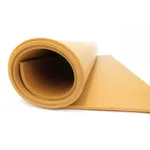
This image was created with artificial intelligence – marked under Art. 50 of the AI Act, Regulation (EU) 2024/1689. It is a placeholder until the company's photos arrive.
Using rubber sheets in the outdoor sector of industry
Which rubber sheets are suitable for outdoor use? Materials, applications and selection guide for industrial applications.
Rubber sheets in outdoor areas must withstand extreme conditions permanently. In an industrial environment, sun, rain, frost and mechanical loads act on the material simultaneously. In addition, chemical influences, changing loads and high stress from machines or vehicles are often added. While indoor applications usually have clearly defined conditions, outdoor areas give rise to complex load situations that are constantly changing.
In this context, the choice of material directly determines the service life, safety and functionality of the entire application. Unsuitable rubber compounds quickly lose their elasticity, become brittle or deform under load. High-quality solutions, by contrast, remain stable, resilient and functional even after years. This is precisely where the difference lies between a short-term solution and permanently reliable use.
Requirements for rubber sheets in outdoor areas
In industrial use, resistance and function are above all what count. Rubber sheets must permanently withstand UV radiation and ozone without changing their structure. At the same time, moisture in the form of rain, snow or standing wetness acts on the material, which makes high weather resistance necessary.
Temperature fluctuations between summer and winter represent an additional challenge, since the material must retain its elasticity both in heat and in frost. Added to this is mechanical load from machines, vehicles or pedestrian traffic, which requires sufficient pressure and abrasion resistance.
Depending on the area of use, the focus shifts. While machine mounts above all require stability and damping, safety and slip resistance are the focus on walkways.
Suitable materials in comparison
The choice of material determines the service life.
| Material | Properties | Suitability for outdoor areas |
|---|---|---|
| EPDM | UV-, ozone- and weather-resistant | Very good |
| SBR | robust, inexpensive, limited weather resistance | Limited |
| NBR | oil- and chemical-resistant | Only conditionally |
EPDM is regarded as the standard for outdoor applications. The material remains stable and elastic even under long-term solar radiation.
Typical areas of use in industry
Rubber sheets are used outdoors in many areas:
- Machine mounts in outdoor areas
- Protective pads on metal surfaces
- Walkways and work paths
- Loading zones and ramps
- Vibration damping on installations
- Seals in outdoor areas
Particularly common: combination of protection + damping + slip resistance.
Practical examples
An outdoor compressor is installed on an EPDM rubber sheet to reduce vibrations and protect the substrate. On a loading ramp, structured rubber sheets ensure secure grip underfoot when wet. Between steel components, rubber sheets prevent direct contact and reduce wear as well as noise.
Rubber sheets are used outdoors in many areas:
- Machine mounts in outdoor areas
- Protective pads on metal surfaces
- Walkways and work paths
- Loading zones and ramps
- Vibration damping on installations
- Seals in outdoor areas
Particularly common: combination of protection + damping + slip resistance.
Important properties for outdoor use
Alongside the material, specific technical properties count:
- Weather resistance Rubber must be able to permanently absorb moisture and release it again without becoming brittle.
- UV stability Sunlight directly attacks many rubber compounds and quickly leads to material degradation.
- Elasticity in cold Even at sub-zero temperatures, high-quality material remains flexible and resilient.
- Abrasion resistance Resistance plays a central role, especially on walkways and transport surfaces.
Selection criteria for the right rubber sheet
Selection is always based on the application:
- Load: point load or area load
- Environment: sun, rain, chemicals
- Thickness: depending on damping requirement
- Surface: smooth, structured or slip-resistant
Practical rule: The stronger the environmental influences, the clearer the decision in favour of EPDM.
Selection aid by application
| Application | Material | Thickness | Surface |
|---|---|---|---|
| Machine foundation | EPDM | 10–20 mm | smooth / lightly structured |
| Walkways | EPDM / SBR | 6–10 mm | heavily structured |
| Ramps | EPDM | 8–15 mm | slip-resistant |
| Protective pads | SBR / EPDM | 3–5 mm | smooth |
Typical material characteristics
- Shore hardness: 60–80 Shore A depending on application
- Temperature range: approx. -30 °C to +120 °C for EPDM
- Density: approx. 1.1–1.5 g/cm³
- Resistances: UV, ozone, weather depending on material
Thickness recommendations
- 3–5 mm for light protective applications
- 6–10 mm for walkways and medium load
- 10–20 mm for machines and high loads
Selection is always based on the application:
- Load: point load or area load
- Environment: sun, rain, chemicals
- Thickness: depending on damping requirement
- Surface: smooth, structured or slip-resistant
Practical rule: The stronger the environmental influences, the clearer the decision in favour of EPDM.
Processing and installation in outdoor areas
Installation directly influences durability. Depending on the area of use, laying is done loose, bonded or mechanically fixed. Flexible applications benefit from loose laying, while permanently used surfaces require a firm connection to the substrate. Under high loads, additional mechanical fixing provides stability.
The substrate plays a central role for function. It must be level, clean and load-bearing so that the rubber sheet lies evenly. In addition, water drainage should be taken into account in order to avoid standing water and the resulting material loads.
Common mistakes and practical problems
Typical mistakes quickly lead to damage:
- Use of SBR in outdoor areas → solution: use EPDM
- Underestimated UV exposure → solution: use UV-resistant materials
- Insufficient material thickness → solution: calculate load correctly
- Missing fixing where there is movement → solution: bond or secure mechanically
- Wrong combination with chemicals → solution: check material resistance
These points usually lead to premature replacement.
Rubber sheets cut to size in outdoor areas
In industrial use, a precisely dimensioned cut offers clear advantages. Rubber sheets can be adapted exactly to the respective application, which reduces installation times and avoids fit problems. At the same time, function improves, since no transitions or overhangs occur.
Individual cut pieces are particularly suitable for complex installations, machine foundations or specific protective solutions in outdoor areas.
Industrial requirements vs. standard applications
In an industrial environment, significantly higher loads act than in the private sector. Permanent UV radiation, high weights, changing weather influences and continuous use lead to permanent stress on the material. While short-term solutions are often sufficient in private use, long-term stability, safety and function are the priority in industry.
Industrial rubber sheets are specifically matched to the respective application. Material, thickness and surface must fit the load and environment exactly. High-quality rubber compounds such as EPDM offer significantly higher resistance to UV radiation, ozone and weather.
In contrast to standard applications, every technical property counts here. A wrong choice quickly leads to wear, loss of function or safety risks. Precisely fitting dimensioning and a suitable choice of material, by contrast, ensure permanently stable use and significantly reduce maintenance effort as well as replacement intervals.
Frequently asked questions about rubber sheets in outdoor areas
Which rubber sheets are suitable for outdoor areas?
EPDM rubber sheets offer the best resistance to UV radiation, ozone and weather and are regarded as the standard solution for industrial outdoor applications.
How long do rubber sheets last in outdoor areas?
With a suitable choice of material and correct installation, high-quality rubber sheets achieve a service life of several years, often well over 10 years.
Are rubber sheets slip-resistant when wet?
Structured or specially coated surfaces offer high slip resistance even when damp and increase safety on walkways.
Can rubber sheets be bonded in outdoor areas?
Bonding is possible and makes sense for permanent use. The prerequisite is a suitable adhesive and a prepared substrate.
Which thickness makes sense for industrial applications?
Depending on the load, thicknesses between 3 mm and 20 mm are usually used. Higher loads require correspondingly thicker sheets.
Our rubber sheets
For industry and trade, we offer a wide variety of rubber sheets.
SBR rubber sheet
Our high-quality SBR rubber sheet (styrene-butadiene rubber) is the solution for numerous industrial and commercial applications. This rubber sheet is manufactured from first-class styrene-butadiene rubber and is distinguished by its outstanding physical properties.
EPDM rubber sheet
Discover the versatility and reliability of our EPDM rubber sheet, which is manufactured from ethylene-propylene-diene monomer (EPDM). This high-quality elastomer solution has been specially developed to meet the most demanding industrial and commercial applications.
NBR rubber sheet
The NBR rubber sheet is a high-quality industrial product that has been specially developed for applications where excellent resistance to oils, greases and various chemicals is required.
Viton rubber sheet
The Viton rubber sheet is a high-quality technical product that is used for a wide range of industrial applications. Manufactured from fluoro rubber (FKM), it offers outstanding properties that make it the ideal choice for extreme conditions.
FKM rubber sheet
The FKM rubber sheet is a high-quality technical product that is ideal for use in demanding industrial applications. Made from fluoro rubber (FKM), it is distinguished by a wide range of outstanding properties that make it the optimum choice for extreme operating conditions.
Silicone rubber sheet
The silicone rubber sheet is a first-class technical product that has been specially developed for applications that place high demands on temperature resistance and flexibility.
PUR rubber sheet
The PUR rubber sheet, manufactured from high-quality polyurethane, is a technically advanced product that has been developed for applications that place the highest demands on abrasion resistance and mechanical load capacity.
Neoprene rubber sheet
The Neoprene rubber sheet, manufactured from high-quality chloroprene rubber (CR), is a versatile technical product that is ideal for a wide range of industrial and commercial applications.