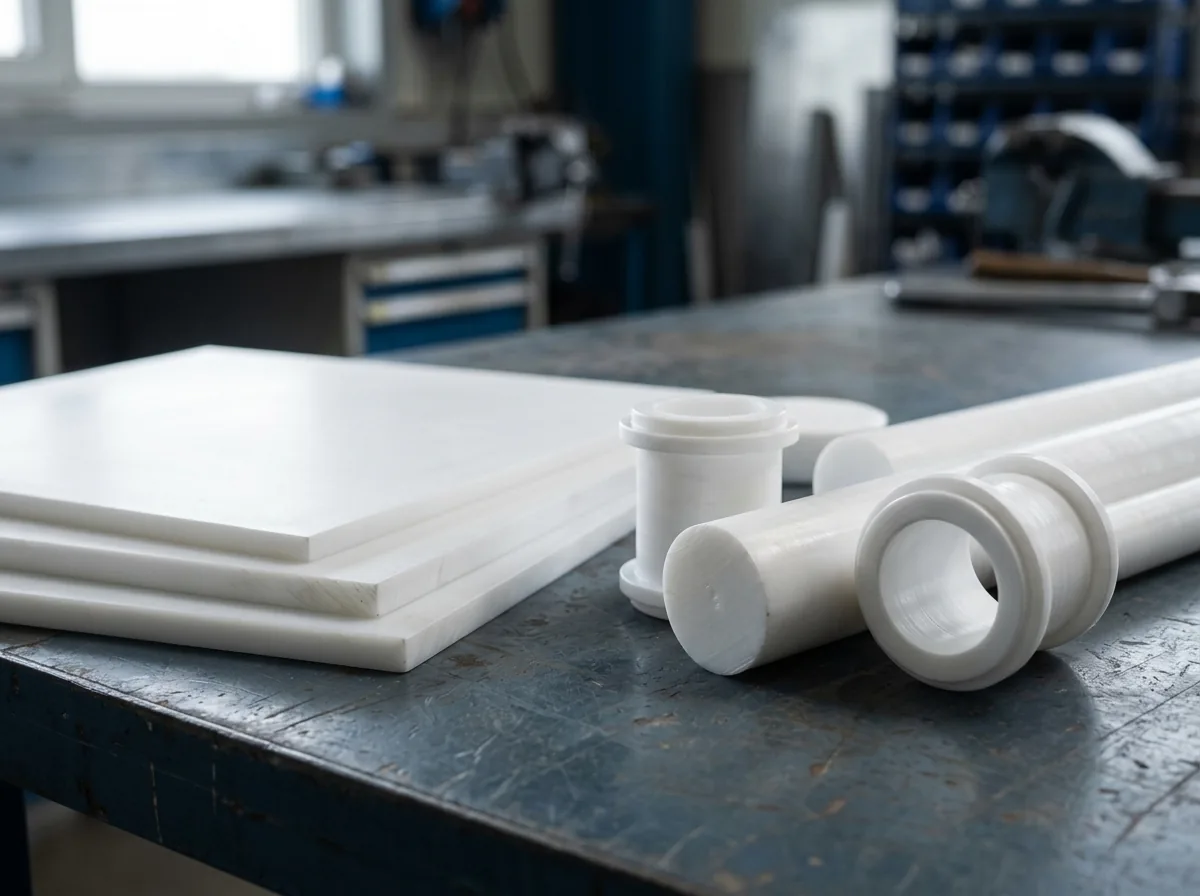
 This image was created with artificial intelligence – marked under Art. 50 of the AI Act, Regulation (EU) 2024/1689. It is a placeholder until the company's photos arrive.
FDA-compliant seals for the food industry
FDA-compliant seals for the food industry: materials, regulations and selection criteria explained. Find out more and choose now.
FDA-compliant seals safeguard production processes, product quality and legal compliance in the food industry. Even small material deviations lead to contamination, production downtime or legal risks. The requirements for materials, processing and documentation are correspondingly high.
Seals perform a central function here: they separate media, prevent leaks and ensure hygienic conditions – often under extreme conditions such as high temperatures, aggressive cleaning processes or mechanical stress.
What does FDA compliance mean for seals?
FDA compliance describes adherence to the requirements of the US Food and Drug Administration for materials that come into contact with food. Particularly relevant is the regulation 21 CFR (Code of Federal Regulations), which defines which substances and materials may be used.
For seals, this means specifically:
- Use of approved raw materials
- Migration of substances within defined limits
- No impairment of taste, odour or safety
- Verification through testing and documentation
Important: FDA compliance refers to the material, not automatically to the finished component. Processing, formulation and operating conditions influence the actual suitability.
Relevant regulations and standards
In addition to the FDA, other sets of rules play a role in Europe. For companies with an international focus, this results in a combined set of requirements.
Key regulations at a glance
| Regulation | Meaning |
|---|---|
| FDA 21 CFR | US requirements for food contact materials |
| EU 1935/2004 | Framework regulation for materials in contact with food |
| EU 10/2011 | Plastics regulation with migration limits |
| BfR recommendations | German guidelines for materials |
For many applications, pure FDA compliance is not enough. Parallel verification for EU regulations is often required.
Materials for FDA-compliant seals
The choice of material largely determines performance and approval. Different materials bring specific properties.
Typical materials
EPDM (ethylene propylene diene rubber) Very good resistance to water, steam and many cleaning media. Frequently used in CIP and SIP processes.
Silicone (VMQ) Temperature-resistant, flexible and taste-neutral. Ideal for applications with high temperature requirements.
PTFE (polytetrafluoroethylene) Extremely chemically resistant and virtually inert. Used with aggressive media or high purity requirements.
NBR (nitrile rubber) Good resistance to fats and oils. Use depends on the specific formulation.
FKM (fluoro rubber) High temperature and chemical resistance, but limited suitability depending on food contact.
Material comparison
| Material | Temperature | Resistance | Typical application |
|---|---|---|---|
| EPDM | high | water, steam | beverages, cleaning |
| Silicone | very high | neutral | direct food contact |
| PTFE | extremely high | chemicals | pharma, aggressive media |
| NBR | medium | oils, fats | mechanical engineering |
Selection criteria in practice
FDA-compliant seals are selected on the basis of specific operating conditions. Blanket solutions frequently lead to problems in operation.
Key influencing factors
- Temperature range (operation and cleaning)
- Media contact (acids, alkalis, fats, water)
- Pressure conditions
- Cleaning procedures (CIP/SIP)
- Mechanical stress
- Type of food (dry, fatty, alcohol-containing)
Only the combination of these factors enables a well-founded material decision.
Typical applications in the food industry
FDA-compliant seals are used in virtually all areas of food production:
- Filling systems
- Piping systems
- Pumps and valves
- Mixing and stirring systems
- Packaging machines
Applications with direct food contact and areas with frequent cleaning cycles are particularly critical.
Common mistakes in selection and use
In practice, recurring mistakes emerge that lead to failures or complaints:
- Selection based on price instead of operating conditions
- Failure to take cleaning processes into account
- Confusion of FDA compliance with actual approval for use
- Inadequate documentation
- Use of unsuitable material mixtures
These mistakes have a direct effect on production reliability and product quality.
Quality assurance and documentation
For use in the food industry, documentation is a central component.
Typical verification documents
- FDA declaration of compliance
- Material data sheets
- Test reports (migration, resistance)
- Traceability of batches
Without complete documentation, risks arise during audits or certifications.
Dimensionally accurate seals for industrial applications
Standard solutions cover many requirements, but quickly reach their limits in complex applications. Dimensionally accurate seals offer clear advantages:
- exact adaptation to components
- optimised sealing effect
- longer service life
- reduced maintenance costs
Particularly in mechanical and plant engineering, custom solutions are often more economical than standard products.
In conclusion
FDA-compliant seals are a safety-relevant component of every food production operation. The right choice of material, adherence to regulatory requirements and clean documentation determine process reliability in the long term.
Companies that proceed in a structured way here secure stable processes, avoid risks and at the same time meet all regulatory requirements.
Frequently asked questions
What does FDA-compliant mean for seals?
FDA-compliant describes materials that meet the requirements of the US food authority and are approved for contact with food. The basis is in particular 21 CFR.
Which materials are FDA-compliant?
Typical materials are EPDM, silicone, PTFE as well as special NBR and FKM formulations. The actual suitability depends on the formulation, operating conditions and processing.
Is FDA compliance sufficient for Europe?
Additional regulations such as EU 1935/2004 or EU 10/2011 apply to the European market. In many projects, both verifications are required in parallel.
What role do cleaning processes such as CIP and SIP play?
Cleaning processes strongly influence the choice of material. High temperatures, steam and chemicals require particularly resistant materials such as EPDM or PTFE.
How do I choose the right seal for my application?
Important factors are temperature, media contact, pressure, mechanical stress and the type of food. Only the combination of these parameters enables a suitable selection.
Why are custom-made seals often worthwhile?
Custom-made seals offer better fit, longer service life and reduce maintenance effort, particularly in complex systems.
Which verification documents should a supplier provide?
Important documents are FDA declarations of compliance, material data sheets, test reports as well as full traceability of the materials used.
Our rubber sheets
For industry and trade we offer a wide variety of rubber sheets.
SBR rubber sheet
Our high-quality SBR rubber sheet (styrene-butadiene rubber) is the solution for numerous industrial and commercial applications. This rubber sheet is manufactured from first-class styrene-butadiene rubber and stands out thanks to its excellent physical properties.
EPDM rubber sheet
Discover the versatility and reliability of our EPDM rubber sheet, which is made from ethylene propylene diene monomer (EPDM). This high-quality elastomer solution has been specially developed to meet the most demanding industrial and commercial applications.
NBR rubber sheet
The NBR rubber sheet is a high-quality industrial product that has been specially developed for applications where excellent resistance to oils, fats and various chemicals is required.
Viton rubber sheet
The Viton rubber sheet is a high-quality technical product that is used for a wide range of industrial applications. Made from fluoro rubber (FKM), it offers outstanding properties that make it the ideal choice for extreme conditions.
FKM rubber sheet
The FKM rubber sheet is a high-quality technical product that is ideal for use in demanding industrial applications. Manufactured from fluoro rubber (FKM), it stands out thanks to a wide range of outstanding properties that make it the optimal choice for extreme operating conditions.
Silicone rubber sheet
The silicone rubber sheet is a first-class technical product that has been specially developed for applications that place high demands on temperature resistance and flexibility.
PUR rubber sheet
The PUR rubber sheet, manufactured from high-quality polyurethane, is a technically advanced product that has been developed for applications that place the highest demands on abrasion resistance and mechanical load capacity.
Neoprene rubber sheet
The neoprene rubber sheet, produced from high-quality chloroprene rubber (CR), is a versatile technical product that is ideal for a wide range of industrial and commercial applications.