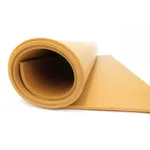
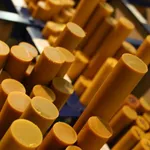
This image was created with artificial intelligence – marked under Art. 50 of the AI Act, Regulation (EU) 2024/1689. It is a placeholder until the company's photos arrive.
Sealing materials for the food industry
Sealing materials for the food industry. Requirements, suitable materials, standards and applications for seals.
Seals perform a safety-relevant function in the food industry. They prevent the escape of media, protect products from contamination and safeguard hygienic production processes over many operating cycles. Food-safe seals must do considerably more than pure sealing tasks. They operate in the field of tension between hygiene requirements, chemical exposure, thermal cycling and mechanical stress.
Particularly in sensitive areas such as the meat, dairy, beverage or bakery industry, suitable sealing materials determine process reliability, product quality and regulatory conformity.
Requirements for sealing materials in the food industry
The requirements for seals in food-processing operations are high and clearly regulated. Every product-contact component must be designed so that it can be operated in a hygienically flawless manner and no risks arise for consumers.
Central criteria are food safety, resistance to cleaning media, temperature resistance, mechanical stability as well as a permanently smooth surface. In addition, aspects such as ageing resistance, traceability of materials and reproducible quality play an important role.
Hygienic safety and material purity
Food-safe seals must not release plasticisers, colourants or fillers in relevant quantities into the food. Odour and taste neutrality are considered a basic prerequisite. Equally important is a closed, low-porosity surface, as fewer residues can accumulate there.
In hygiene-critical production areas, seals must withstand repeated cleaning and disinfection cycles without becoming brittle, swelling or losing their sealing function.
Temperature, pressure and media resistance
Production processes in the food industry frequently operate with strongly fluctuating temperatures. From cooling processes to hot filling or steam sterilisation, high thermal loads occur. In addition, fats, oils, sugar, acids, alkalis and cleaning chemicals act on the sealing material.
The material used must remain dimensionally stable under these conditions and retain its elastic properties permanently.
Mechanical load and service life
Seals are frequently exposed to permanent pressure, vibrations or dynamic movements. Valves, pumps or moving machine parts place particular demands on abrasion resistance and recovery behaviour. A long service life reduces maintenance intervals and minimises unplanned downtime.
Common sealing materials for food-safe applications
Depending on the application, different elastomers and plastics are used. The material choice is based on temperature range, contact media, cleaning processes and mechanical stress.
- EPDM: Very well suited for hot water, steam and alkaline cleaning media, frequently used in CIP and SIP processes.
- NBR: Proven in contact with fats and oils, a typical material in meat and dairy processing with the appropriate approval.
- FKM: High temperature and chemical resistance for demanding processes with aggressive media.
- Silicone: High flexibility and temperature stability, suitable for hygienic applications with low mechanical load.
Standards and approvals for food-safe seals
The use of sealing materials in the food industry is subject to clear legal requirements. Among the most important regulations is EU Regulation 1935/2004, which governs the contact of materials with food.
In addition, FDA approvals and other international standards are used. For operators, complete documentation of material approvals is essential, as this is regularly part of audits and certification procedures.
Typical areas of application in the food industry
Food-safe seals are found in virtually all production stages:
- Filling and packaging systems
- Pumps, valves and fittings
- Piping and conveying systems
- Mixing, stirring and kneading units
- Cleaning and CIP systems
Depending on the place of use, the requirements vary considerably, which is why a blanket material choice is rarely sensible.
Selecting the right sealing material
The selection of suitable seals should always be based on a sound analysis of the operating conditions. Decisive factors are temperature range, pressure conditions, media contact, cleaning cycles and mechanical stress.
In addition, the geometric design plays an important role. Dimensionally accurate seals contribute significantly to process reliability and extend the service life of the systems.
Economic aspects and operational safety
High-quality, food-safe seals help to reduce maintenance costs and production downtime. A longer service life lowers replacement requirements and improves planning reliability.
Especially in continuously operated systems, reliable sealing has a direct effect on overall equipment effectiveness.
Summary and classification
Food-safe sealing materials form a supporting foundation for safe, hygienic and economical production processes in the food industry. They have a direct influence on product quality, system safety and regulatory conformity and thus have an effect far beyond their actual sealing function.
Selecting the right material requires a precise examination of the real operating conditions. Temperature ranges, contact media, cleaning processes and mechanical loads largely determine whether a seal works reliably in the long term or fails prematurely. Materials such as EPDM, NBR, FKM or silicone each offer specific advantages that should be used in a targeted manner.
By using standard-compliant, documented and dimensionally accurate seals, downtime can be reduced, maintenance intervals extended and hygiene risks minimised. A sound material decision thus contributes directly to process reliability, cost-effectiveness and the long-term stability of food-processing systems.
Frequently asked questions about food-safe seals
What does food-safe mean for seals?
Food-safe describes sealing materials that are approved for direct or indirect contact with food. They do not release any health-relevant substances, remain taste- and odour-neutral and meet the legal requirements for hygienic production processes.
Which sealing materials are considered food-safe?
Frequently used materials are EPDM, NBR, FKM and silicone. Suitability always depends on the specific approval, the medium used, the temperature range and the cleaning requirements.
Which standards and approvals are relevant for food-safe seals?
Among the most important regulations are EU Regulation 1935/2004 and FDA approvals. Depending on the industry, further hygiene and quality standards may be relevant, requiring documented material approval.
Are food-safe seals suitable for all cleaning procedures?
Suitability depends on the material. Particularly in CIP and SIP processes, seals must be resistant to high temperatures, steam and cleaning chemicals. The material selection should always be matched to the cleaning cycles.
How often should seals in the food industry be replaced?
A fixed replacement interval cannot be specified as a blanket rule. The decisive factors are operating conditions, mechanical load, cleaning frequency and material quality. Regular visual inspections and maintenance plans increase operational safety.
Why is dimensionally accurate manufacturing of seals important?
Dimensionally accurate seals ensure even contact pressure, reduce leakage risks and extend service life. This contributes directly to process reliability and to reducing maintenance and downtime costs.
Our rubber sheets
For industry and trade we offer a wide variety of rubber sheets.
SBR rubber sheet
Our high-quality SBR rubber sheet (styrene-butadiene rubber) is the solution for numerous industrial and commercial applications. This rubber sheet is manufactured from first-class styrene-butadiene rubber and is distinguished by its outstanding physical properties.
EPDM rubber sheet
Discover the versatility and reliability of our EPDM rubber sheet, which is manufactured from ethylene-propylene-diene monomer (EPDM). This high-quality elastomer solution has been specially developed to meet the most demanding industrial and commercial applications.
NBR rubber sheet
The NBR rubber sheet is a high-quality industrial product that has been specially developed for applications requiring excellent resistance to oils, fats and various chemicals.
Viton rubber sheet
The Viton rubber sheet is a high-quality technical product that is used for a wide range of industrial applications. Manufactured from fluoro rubber (FKM), it offers outstanding properties that make it the ideal choice for extreme conditions.
FKM rubber sheet
The FKM rubber sheet is a high-quality technical product that is ideal for use in demanding industrial applications. Made from fluoro rubber (FKM), it is distinguished by a wide range of outstanding properties that make it the optimum choice for extreme operating conditions.
Silicone rubber sheet
The silicone rubber sheet is a first-class technical product that has been specially developed for applications placing high demands on temperature resistance and flexibility.
PUR rubber sheet
The PUR rubber sheet, made from high-quality polyurethane, is a technically advanced product that has been developed for applications placing the highest demands on abrasion resistance and mechanical load capacity.
Neoprene rubber sheet
The neoprene rubber sheet, manufactured from high-quality chloroprene rubber (CR), is a versatile technical product that is ideal for a wide range of industrial and commercial applications.