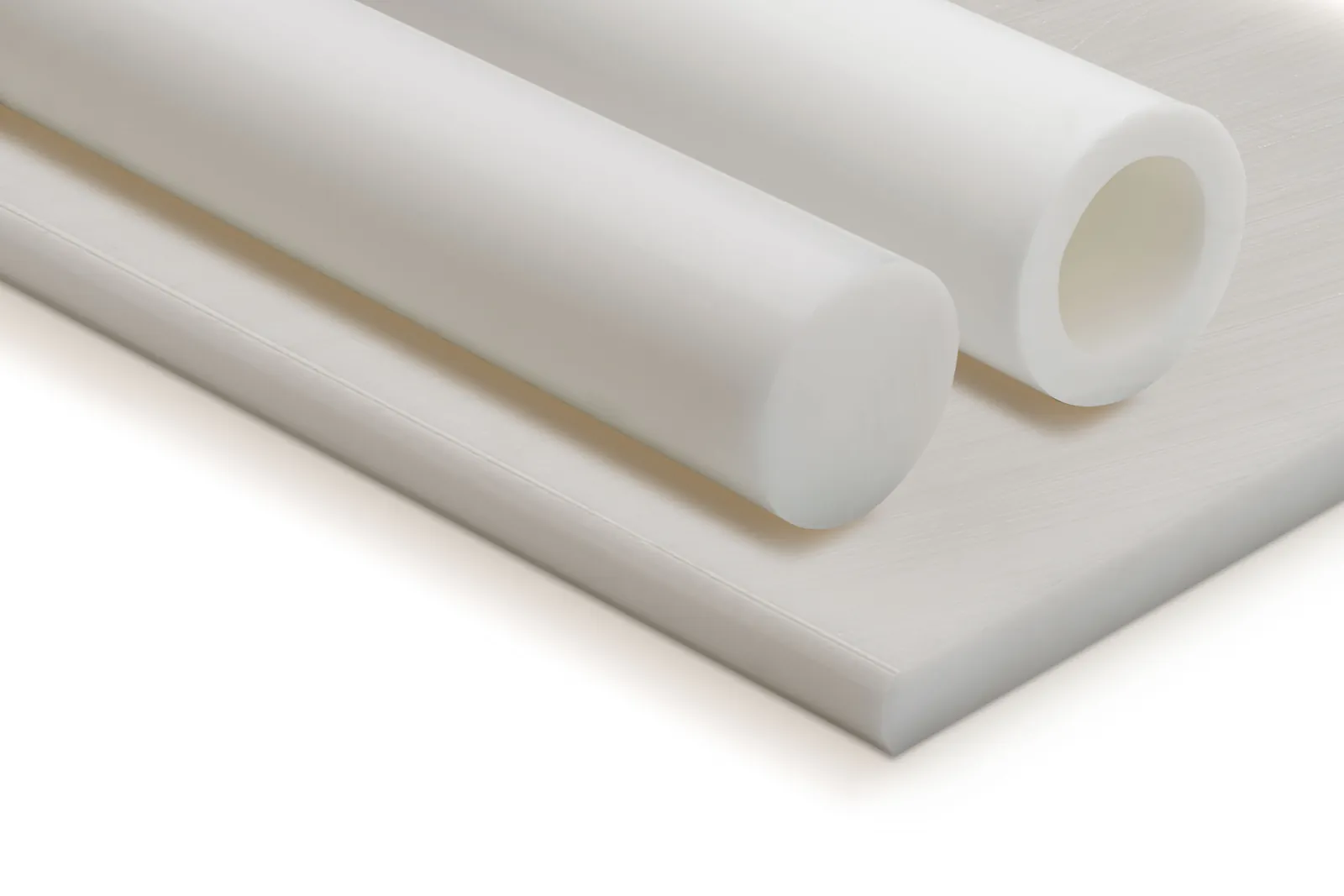
What is POM? Thermoplastic high-performance plastic
POM, or polyoxymethylene, is a high-performance engineering thermoplastic, often also referred to as acetal. Find out more in the guide.
What is POM?
This material is characterised by its outstanding mechanical properties and offers excellent rigidity, strength and wear resistance. Thanks to these properties, POM is frequently used in industrial applications where precise and durable solutions are required.
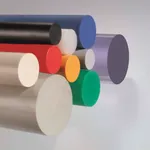
Polyoxymethylene, POM for short or also known as polyacetal, is a semi-crystalline plastic. It is a colourless polymer. The POM plastic can be coloured in any desired colour. POM belongs to the group of thermoplastics.
The POM plastic also belongs to the subcategory of engineering plastics. By cooling and reheating, the plastic can be brought to a liquid molten state and reshaped again and again. As long as it is not overheated and reverts to its decomposition state. This ensures good processing of the POM cut pieces.
History
Polyoxymethylene was discovered by chance in 1859. In 1920, research was again carried out on the plastic, but here too no sufficient production was achieved. It was not until 1940 that the plastic was researched further. The production of POM-H was achieved by the company DuPont, so that they received the patent for it in 1956. The plastic is marketed under the trade name Delrin.
Polyoxymethylene C was researched in the United States. From 1961, the plastic was marketed under the trade name Celcon. In Germany, POM-C is known under the trade name Hostaform. Furthermore, POM-C is also known under the trade names Ultraform, Kocetal, Ramtal, Duracon, Kepital and Polypenco.
POM plastic is produced in the injection moulding process. Through hollow body blowing, the plastic can be further processed, so that you can obtain it in different sizes and lengths as cut pieces. The plastic is gladly used as a material because of its high density of 1.39 - 1.42 g/cm³. POM is successfully used for precision parts, turned and milled parts. Polyoxymethylene is readily sold as cut pieces.
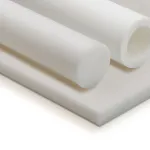
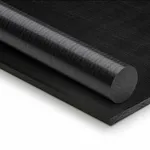
These POM-C cut pieces are also called semi-finished products. The semi-finished products are produced as cut pieces, sheets, hollow rods, rods or panels. And only with other semi-finished products does a finished product come about.