Polyoxymethylene (POM): properties, variants and applications
Learn more about polyoxymethylene (POM), its POM-C and POM-H variants, and the applications and special properties of this engineering plastic.
POM plastic is an engineering thermoplastic that combines high strength and rigidity with low moisture absorption and good sliding and wear properties. Under the full name polyoxymethylene, the material is used above all for precise mechanical components that must reliably maintain their dimensions even under changing operating conditions.
Typical applications are gears, plain bearings, guides, rollers, valve components, housing parts and other machined functional parts. Thanks to its good machinability, POM can be economically processed from sheets and rods into individual parts, spare parts or series components.
Martan Plastics supplies engineering plastics and materials for industrial applications and supports you in selecting suitable semi-finished products and material grades.
What is POM?
POM is the abbreviation for polyoxymethylene. The semi-crystalline engineering plastic is also referred to as polyacetal or acetal plastic. Its molecular structure provides a combination of high mechanical load capacity, good elastic recovery, low friction and comparatively low water absorption.
POM is therefore particularly suitable for components where repeatable movements, tight fits and a permanently stable geometry matter. In mechanical and plant engineering, POM is therefore frequently used as a structural material and, in suitable applications, as an alternative to aluminium, steel or brass.
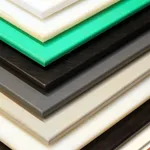
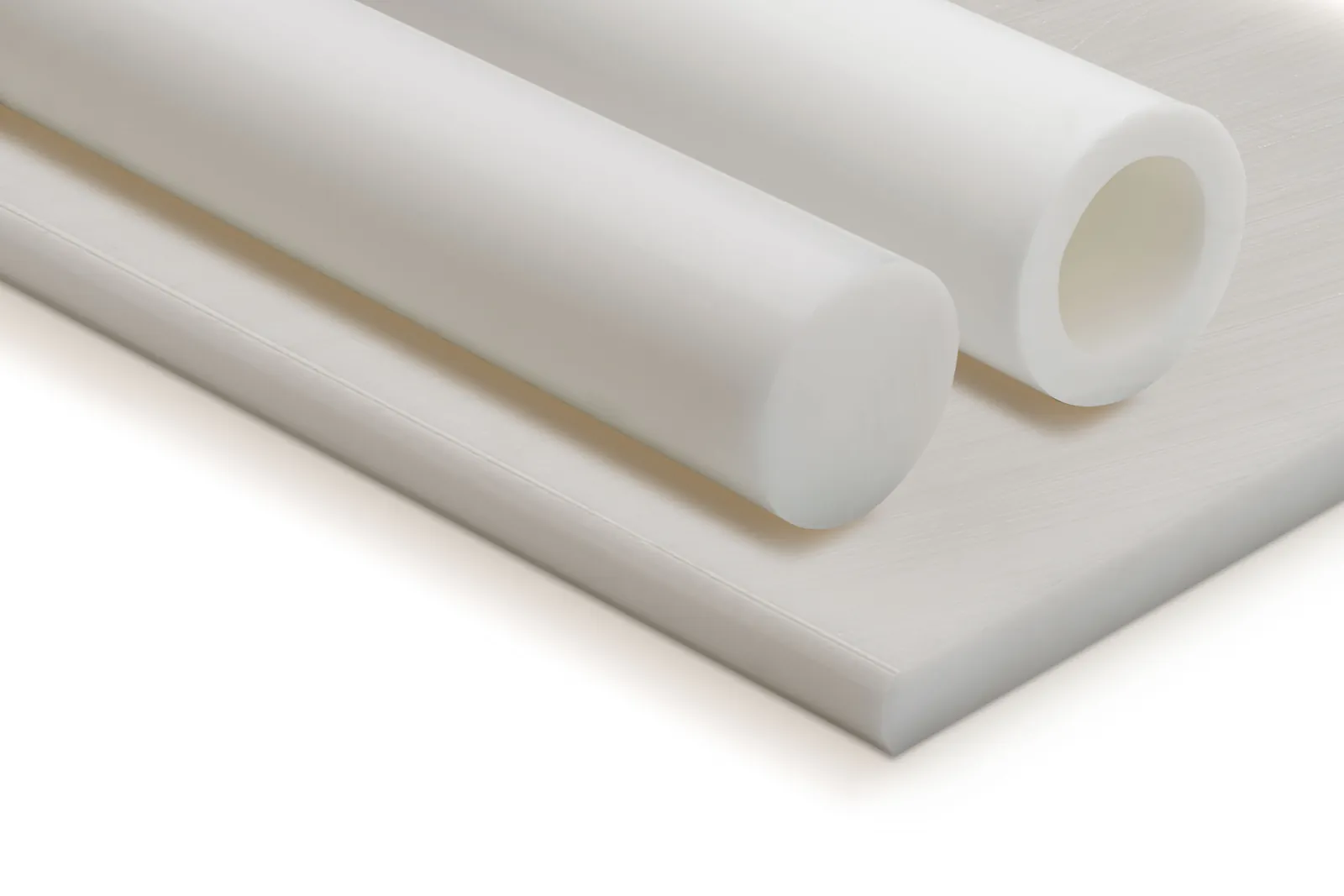
POM is available among other things as sheet, rod and cut piece. From these plastic semi-finished products, precise components can be produced by sawing, turning, milling or drilling.
Key properties of POM plastic
The property profile of POM depends on the respective type, the manufacturing process, possible additives and the test conditions. The following values therefore serve as typical guidance for unreinforced standard grades and do not replace a material-specific data sheet.
| Property | Typical guidance range |
|---|---|
| Density | approximately 1.41 to 1.43 g/cm³ |
| Tensile strength | approximately 60 to 75 MPa |
| Modulus of elasticity | approximately 2,500 to 3,200 MPa |
| Moisture absorption | low |
| Friction and sliding behaviour | good to very good |
| Continuous service temperature | depending on type and load, often up to approximately 100 °C |
| Short-term temperature load | possible above the continuous service range depending on grade |
Density of POM
Depending on the material type, POM typically has a density of approximately 1.41 to 1.43 g/cm³. POM is therefore among the comparatively dense engineering thermoplastics. The exact density can differ depending on POM-C, POM-H, fillers and other modifications. For the design and weight calculation of a component, the value of the specific material grade used should therefore be applied.
High strength and rigidity
POM has high mechanical strength and remains comparatively dimensionally stable even under recurring loads. The material is therefore suitable for components that must transmit forces or permanently maintain a defined position.
Under long-lasting static load, the creep behaviour must be taken into account, as with all thermoplastic plastics. Load, temperature, component geometry and duration of use should therefore be assessed together.
Low moisture absorption
Compared with polyamide, POM absorbs only little moisture. As a result, dimensions and mechanical properties change significantly less under humid ambient conditions. This advantage is particularly relevant for precision parts, guides, fits and components with tight tolerance requirements.
Good dimensional stability
The low moisture absorption and high rigidity support good dimensional stability. Nevertheless, POM also expands more than metal when temperatures change. For long components, tight fits or larger temperature differences, thermal expansion must be taken into account in the design.
Good sliding and wear properties
POM has a low coefficient of friction and is suitable for numerous moving components. Plain bearings, guides, rollers or gears can, with a suitable design, be operated quietly and partly without additional lubrication.
The actual service life depends among other things on surface pressure, speed, counterface partner, temperature, lubrication and ambient conditions. Modified POM grades are also available for heavily stressed sliding pairs.
Good electrical insulation
POM generally has good electrically insulating properties. The material can therefore be used for holders, housing components and mechanical components in electrical devices, provided that temperature, fire protection and other application-specific requirements are met.
Resistance to many operating media
POM is resistant to numerous oils, greases, fuels and organic solvents. The material also shows good behaviour towards many weak alkalis. Strong acids, strong oxidising agents and certain chlorine-containing media, on the other hand, can be critical.
Since resistance depends on concentration, temperature, exposure time, mechanical stress and the specific POM grade, a media-related test should be carried out for components exposed to chemicals.
POM-C and POM-H: what is the difference?
POM is mainly offered in two material groups: as copolymer POM-C and as homopolymer POM-H. Both belong to the polyoxymethylenes, but differ in their molecular structure and therefore in individual technical properties.
| Criterion | POM-C | POM-H |
|---|---|---|
| Material structure | Copolymer | Homopolymer |
| Strength and rigidity | high | usually somewhat higher |
| Dimensional stability | very good | very good |
| Chemical resistance | often somewhat more balanced | good, but more dependent on media |
| Resistance to hydrolysis and hot water | generally more favourable | more dependent on the conditions |
| Typical use | versatile precision and functional parts | components subject to particularly high mechanical loads |
POM-C: balanced properties for industrial components
POM-C is the variant frequently used in the industrial semi-finished product sector. The material combines high strength with good toughness, low moisture absorption, good chemical resistance and reliable machinability.
POM-C is suitable among other things for guides, rollers, bushes, housing parts, valve components and precise CNC components. For production, for example, POM-C sheets and cut pieces are available.
POM-H: higher mechanical values
In direct comparison, POM-H often has somewhat higher strength, rigidity, hardness and creep resistance. The material can therefore offer advantages for gears, coupling parts or precision components subject to particularly high mechanical stress.
Whether POM-H is actually the better choice, however, does not depend on mechanical load alone. Chemical influences, temperature, moisture, production conditions and the specific geometry must also be taken into account.
Which POM type suits the application?
POM-C is the balanced solution for many industrial standard applications. POM-H is primarily an option when the highest possible rigidity or mechanical load capacity is required. A blanket decision is nevertheless not sensible, since available material types and modifications can differ considerably.
For the selection, at least the following factors should be known:
- type, magnitude and duration of mechanical load
- permissible deformation and required tolerances
- continuous and peak temperature
- contact with chemicals, cleaning agents or operating media
- sliding speed and surface pressure
- counterface partner and possible lubrication
- requirements regarding food contact, colour or electrical conductivity
Typical applications of POM
The combination of dimensional stability, mechanical strength and good sliding behaviour makes POM a versatile engineering material.
Gears and sprockets
POM is used for gears, sprockets and other power-transmitting elements. Compared with metal, lower weight, quieter running and reduced susceptibility to corrosion can result. However, load, tooth geometry, speed and operating temperature must be designed to suit the material.
Plain bearings and bearing bushes
Due to its low friction and good wear resistance, POM is suitable for bearing bushes and other sliding components. Depending on the operating conditions, low-maintenance or dry-running use is possible.
Guides and slide rails
Guide elements made of POM enable precise linear movements. They are used among other things in production machines, assembly systems, packaging systems and conveyor systems.
Rollers and conveyor elements
Rollers, deflection elements, spacers and components for conveyor systems benefit from the strength, dimensional stability and good machinability of the material.
Valves, pumps and dosing technology
POM can be used for valve components, dosing components, pump elements and media-carrying functional parts. Before use, resistance to the specific medium and the intended temperature must be tested.
Housings and precision parts
Housing components, spacers, snap-fit connections, holders and other dimensionally accurate components can also be produced from POM. Its good elastic recovery can be advantageous in resilient or latching design elements.
Components for food technology
Appropriately approved POM grades are available for conveyor elements, guides and machine parts in food processing. However, POM is not automatically food-compliant. The decisive factors are the specific material type, colour, additives and the associated conformity certificates.
POM as a metal replacement
POM can replace metallic materials when high dimensional stability and mechanical load capacity are required, but the service temperature remains within the permissible range. The material can offer advantages particularly for moving components.
Possible advantages over metal are:
- lower component weight
- no corrosion
- good sliding and damping properties
- quieter operation of moving components
- electrical insulation
- economical machining
POM is nevertheless not a direct replacement for metal in every design. Plastics have lower rigidity, higher thermal expansion and more pronounced time-dependent deformation behaviour. The design must therefore be adapted to the material.
Machining of POM
POM is one of the easily machined engineering plastics. With suitable tools and material-appropriate machining parameters, clean surfaces and precise contours can be produced. Martan Plastics offers various methods of plastic machining for industrial semi-finished products and components.
Milling
During plastic milling, contours, pockets, grooves, hole patterns and complex geometries can be produced. Sharp tools and sufficient chip removal reduce heat generation and improve surface quality.
Turning
POM rods can be processed into rollers, bushes, rings, bolts and rotationally symmetrical precision parts. Suitable cutting edge geometries help to achieve clean surfaces and avoid unwanted heating.
Drilling and thread production
POM can be drilled and provided with internal or external threads. For deep holes, heat must be reliably dissipated. Threads should be dimensioned according to the load, since plastic threads cannot absorb the same forces as comparable metal threads.
Sawing and cutting to size
Sheets and rods can first be cut to an economical rough dimension and then finished by machining. Suitable plastic sheets and plastic rods form the starting basis for this.
Bonding and welding
Due to its low surface energy, POM can only be bonded to a limited extent. Load-bearing bonded joints require suitable pre-treatment and specially matched adhesive systems. Thermal joining processes are also more demanding than with many other thermoplastics and must be matched to the material type and component geometry.
In many designs, mechanical connections, positive-locking joints, screw connections or structurally integrated snap-fit connections are more reliable.
Notes for the design of POM components
Take thermal expansion into account
POM expands more than steel or aluminium when heated. For long components, tight guides, press fits and strongly fluctuating temperatures, sufficient clearance for movement must be provided.
Allow for creep under continuous load
Under a permanently acting load, POM can deform over time. This effect increases at higher temperatures. Components under continuous load should therefore not be designed solely on the basis of strength values determined in the short term.
Avoid notches and sharp transitions
Unnecessarily sharp internal edges, notches and abrupt changes in cross-section can cause local stress peaks. Radii and uniform wall thicknesses improve the load capacity of the component.
Note machining stresses
With heavy or one-sided material removal, internal stresses can be released and lead to distortion. For highly precise components, stepped machining with intermediate storage or additional stress relief can be sensible.
Design fits to suit the plastic
Tolerances from metal construction should not be transferred to POM without checking. The achievable accuracy depends on dimensions, geometry, semi-finished product, temperature, machining sequence and measuring conditions. Binding tolerances should therefore be agreed on a component-specific basis.
Limits of POM plastic
For POM to be used reliably, the material limits must be taken into account alongside the advantages:
- only limited resistance to strong acids and oxidising agents
- higher thermal expansion than metallic materials
- time-dependent deformation under high continuous load
- limited use at permanently high temperatures
- only limited weather and UV resistance without suitable stabilisation
- difficult bonding due to low surface energy
- not every grade is approved for food contact or sensitive applications
For applications with significantly higher temperatures or exceptionally aggressive media, high-performance plastics may be more suitable. The guide POM, PA or PEEK – which material for mechanical engineering? supports an initial assessment of various material groups.
POM compared with other engineering plastics
POM or PA?
POM absorbs significantly less moisture and therefore usually offers higher dimensional stability. Depending on the grade, polyamide can have advantages in impact strength, wear behaviour or dynamic load. Which solution is more suitable depends on moisture, type of load, temperature and counterface partner.
POM or PET?
POM has very good sliding and friction properties and can be used versatilely for mechanical functional parts. PET plastic offers, depending on the grade, high rigidity, good dimensional stability and favourable creep behaviour. For heavily loaded precision parts, a direct comparison based on the specific operating conditions should be carried out.
POM or PE?
POM is stronger, more rigid and more dimensionally stable than most PE grades. Polyethylene, on the other hand, often offers higher toughness and very good chemical resistance. PE-UHMW in particular is used for wear-stressed sliding and conveyor elements where impact strength and abrasion behaviour are the focus rather than precision.
POM or PEEK?
PEEK is suitable for considerably higher temperatures and particularly demanding chemical or mechanical conditions. POM, on the other hand, is the more economical solution for many applications in the usual industrial temperature range. The use of PEEK is primarily justified when POM reaches its thermal or chemical limits.
Modified POM grades
In addition to unreinforced POM-C and POM-H, special material variants are available for particular requirements. Depending on the manufacturer and product range, these can include:
- sliding-modified grades with reduced friction
- wear-optimised POM types
- antistatic or electrically conductive variants
- glass fibre reinforced grades with higher rigidity
- detectable materials for sensitive production areas
- food-compliant grades with corresponding certificates
- UV-stabilised variants or variants optimised for outdoor use
Additives improve certain properties, but can at the same time change other characteristics. A glass fibre reinforced grade, for example, is more rigid, but can exhibit different sliding and machining behaviour than unreinforced POM.
When is POM the right material?
POM is a suitable choice when a component is to combine high dimensional stability, good mechanical strength and reliable sliding properties. The material is particularly sensible for machined precision parts, guides, gears, rollers, bearing bushes and other moving functional elements.
Before deciding on the material, temperature, load, chemical contact, tolerances and possible approval requirements should be assessed together. This makes it possible to decide whether standard POM-C, POM-H or a modified grade represents the technically and economically best solution.
Frequently asked questions about POM plastic
What does the abbreviation POM stand for?
POM stands for polyoxymethylene. The engineering thermoplastic is also referred to as polyacetal or acetal plastic.
What is the difference between POM-C and POM-H?
POM-C is a copolymer with a balanced property profile and is frequently used for industrial standard applications. POM-H is a homopolymer and typically achieves somewhat higher values in strength, rigidity and hardness. The selection must nevertheless be made on the basis of the overall load situation.
Is POM suitable for gears?
Yes. POM is frequently used for gears because the material is strong, wear-resistant, dimensionally stable and comparatively quiet. Load, speed, temperature and tooth geometry must be designed to suit the material.
Is POM food-safe?
Not every POM grade is automatically suitable for food contact. For corresponding applications, expressly approved material types with the required conformity certificates must be used.
Is POM UV-resistant?
Unmodified POM is only of limited suitability for permanent weathering. For outdoor applications, UV-stabilised grades should be selected or alternative materials considered.
Up to what temperature can POM be used?
Many standard grades are used continuously up to approximately 100 °C. The permissible temperature, however, depends on the material type, mechanical load, duration of use and ambient medium. The data sheet of the specific grade is decisive.
Can POM be milled and turned well?
Yes. POM is one of the easily machined engineering plastics. Sharp tools, suitable cutting parameters and reliable heat and chip removal enable precise components with good surfaces.
Can POM replace metal?
POM can replace metal in many guides, rollers, gears, bushes and precision parts. However, the design must take into account the lower rigidity, higher thermal expansion and creep behaviour of the plastic.