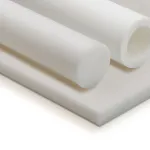
This image was created with artificial intelligence – marked under Art. 50 of the AI Act, Regulation (EU) 2024/1689. It is a placeholder until the company's photos arrive.
Polyethylene (PE)
Why is polyethylene (PE) one of the most widely used plastics worldwide? Properties, advantages & applications clearly explained.
Polyethylene (PE) – Overview and classification
Polyethylene (PE) is a thermoplastic material used in a wide variety of industrial and technical applications. The material is characterised by low density, good chemical resistance and high cost-effectiveness. Depending on structure and density, a distinction is made between various PE types with clearly defined properties.
PE is preferably used where components are permanently in contact with moisture, chemicals or mechanical stress. The material exhibits low water absorption and remains dimensionally stable even during prolonged use. At the same time, polyethylene is easy to process, cut and weld.
In industrial practice, polyethylene is used primarily as sheet material, semi-finished product or cut piece. Typical applications are found in apparatus engineering, mechanical engineering, conveyor technology and in chemical environments.
A systematic overview of variants, properties and distinctions can be found in the category Polyethylene plastics.
PE types and differences
Polyethylene is not a uniform material. Depending on density, molecular structure and manufacturing process, different mechanical and chemical properties result. For industrial applications, LDPE, HDPE and UHMW-PE are particularly relevant.
LDPE – Low Density Polyethylene
LDPE has a low density and a soft, flexible structure. The material exhibits good chemical resistance, but limited mechanical load capacity. LDPE is suitable for applications where flexibility, damping or deformability are the priority.
HDPE – High Density Polyethylene
HDPE is denser, harder and more mechanically resilient than LDPE. The material offers high resistance to chemicals and moisture as well as good dimensional stability. HDPE is frequently used in mechanical engineering, in conveyor technology and for technical components.
UHMW-PE – Ultra-high molecular weight polyethylene
UHMW-PE is characterised by extremely long molecular chains. This results in very high abrasion resistance, excellent sliding properties and exceptional impact strength. This PE type is preferably used for heavily stressed components and sliding surfaces.
A detailed overview of the available variants and delivery forms can be found on the page Polyethylene materials.
Properties of polyethylene
Polyethylene has a balanced property profile that makes the material suitable for numerous industrial fields of application. The specific values vary depending on the PE type, but follow clear material principles.
Mechanical properties
PE exhibits good impact strength and high resistance to impact loads. HDPE and UHMW-PE in particular are suitable for components with permanent mechanical stress. Stiffness remains moderate compared with high-performance engineering plastics.
Chemical resistance
Polyethylene is resistant to many acids, alkalis and aqueous media. The material is suitable for use in chemical environments as well as in damp operating conditions. Organic solvents can limit the resistance.
Thermal properties
PE has limited temperature resistance compared with high-temperature engineering plastics. The continuous service temperature lies in the lower to medium temperature range depending on the type. Short-term temperature peaks can be absorbed depending on the material.
Physical properties
The material exhibits low density, low water absorption and good electrical insulating properties. This combination favours use in conveyor technology, apparatus engineering and electrical engineering.
A comparison of properties and delivery forms can be found in the overview of Polyethylene properties.
Areas of application for polyethylene
Polyethylene is used in numerous industrial areas where resistance, low weight and cost-effectiveness are required. The selection of the suitable PE type depends on the mechanical stress, the chemical environment and the operational requirements.
Mechanical and plant engineering
In mechanical engineering, polyethylene serves as a material for guides, sliding surfaces, protective covers and spacer elements. HDPE and UHMW-PE in particular are used where wear resistance and low-noise operation are required.
Conveyor technology and logistics
In conveyor technology, PE is used for sliding profiles, chain guides and supports. The good sliding properties and high abrasion resistance reduce friction and material wear during continuous operation.
Chemical and apparatus engineering
Polyethylene is suitable for containers, linings and technical components with contact to chemical media. The low water absorption and chemical resistance support stable long-term use.
Electrical engineering and assemblies
Due to the good electrical insulating properties, PE is used for spacers, support elements and protective components in electrical assemblies.
Further information on available designs and cut pieces can be found under Polyethylene applications.
Processing and delivery forms of polyethylene
Polyethylene can be processed economically using common plastics processing methods. Depending on the PE type and the component geometry, various delivery forms and processing options are available.
Delivery forms
In industrial applications, polyethylene is used predominantly as sheet material, rods or semi-finished products. These forms are suitable for machining further processing as well as for use as a structural component.
PE sheets are frequently used for sliding surfaces, linings or covers. Semi-finished products and rods are used for individually manufactured components and technical parts.
Mechanical processing
Polyethylene can be sawn, milled, drilled and turned. The material exhibits forgiving machining behaviour. UHMW-PE in particular requires adapted cutting parameters due to its high toughness.
Joining and connecting
PE can be thermally welded. Adhesive bonds are only suitable to a limited extent and depend on pre-treatment and application. In practice, mechanical connection solutions are frequently used.
Information on available dimensions and cut pieces can be found in the section Polyethylene cut pieces.
Selection criteria and distinction of polyethylene
Polyethylene is selected on the basis of clear technical requirements. The material is particularly suitable for applications with mechanical stress, chemical contact and moderate temperature requirements.
When polyethylene is suitable
PE offers advantages in applications with high moisture exposure, contact with acids or alkalis as well as for sliding or impact-loaded components. The material combines cost-effectiveness with reliable service properties.
Limits of polyethylene
At permanently elevated temperatures or high requirements for stiffness and dimensional accuracy, polyethylene reaches its material limits. In such cases, engineering plastics with higher temperature resistance are advisable.
Distinction from other plastics
Compared with polyamide, PE exhibits lower water absorption and better chemical resistance. Compared with POM, polyethylene offers higher impact strength, but lower dimensional accuracy. The choice of material should always be application-related.
A comparative classification of other materials can be found in the overview Engineering plastics.
Frequently asked questions about polyethylene (PE)
What is polyethylene?
Polyethylene is a thermoplastic material with low density, good chemical resistance and versatile industrial application possibilities.
What polyethylene types are there?
Common types are LDPE, HDPE and UHMW-PE. They differ in density, mechanical load capacity and wear resistance.
Is polyethylene chemically resistant?
Polyethylene exhibits high resistance to many acids, alkalis and aqueous media and is suitable for chemically stressed applications.
Up to what temperatures can polyethylene be used?
The temperature resistance of polyethylene lies in the lower to medium range and depends on the respective PE type.
Can polyethylene be machined?
Polyethylene can be sawn, milled, drilled and turned. UHMW-PE requires adapted machining parameters due to its high toughness.
What is polyethylene used for in industry?
PE is used in mechanical engineering, in conveyor technology, in apparatus engineering as well as for components with mechanical or chemical stress.
Where can I find an overview of polyethylene?
A structured overview of variants and application possibilities can be found in the section Polyethylene overview.