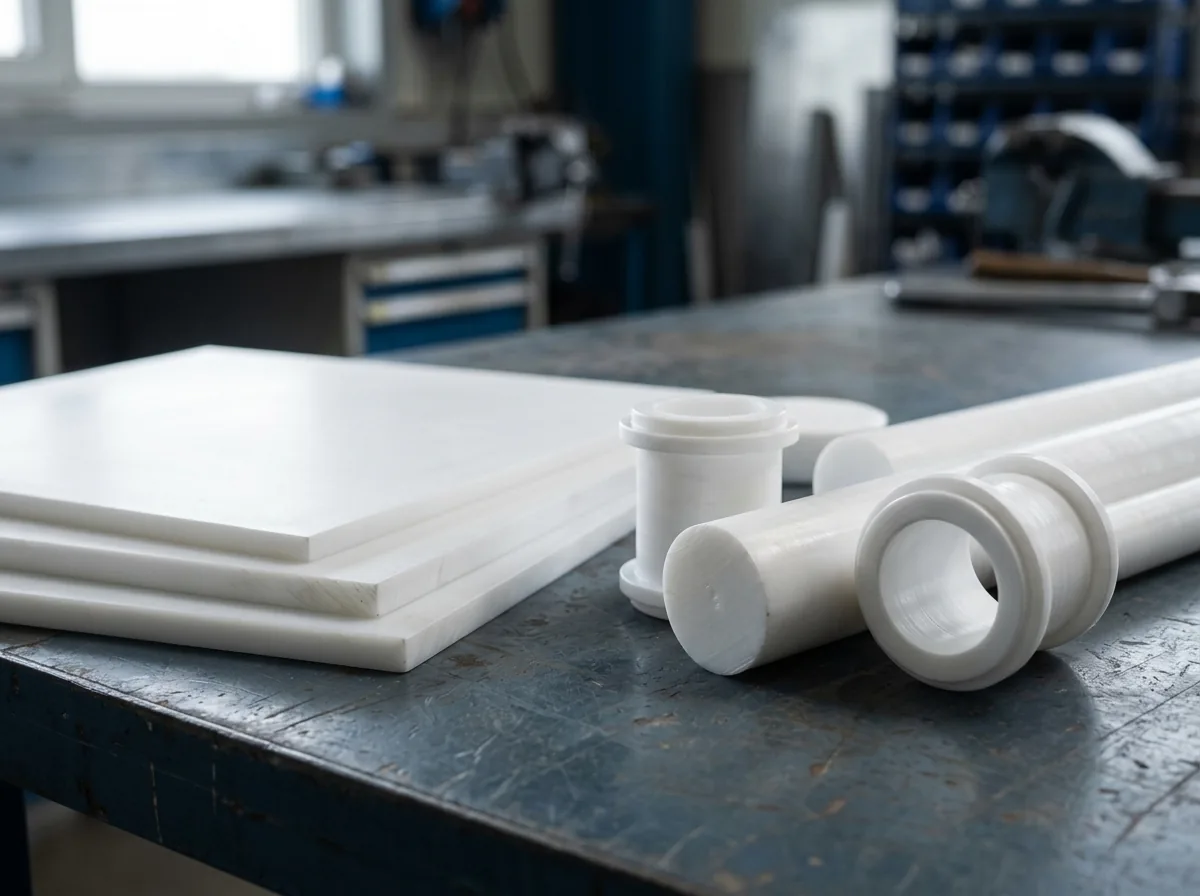
 This image was created with artificial intelligence – marked under Art. 50 of the AI Act, Regulation (EU) 2024/1689. It is a placeholder until the company's photos arrive.
Food-safe plastics compared – FDA approval and EU 10/2011
Which plastics are food-safe? Find out how FDA approval and EU 10/2011 apply – with a comparison of PE, PP, POM, PTFE & PEEK for food contact.
Whether chopping board, pipeline or screw conveyor – food-safe plastics are indispensable in food processing. But not every plastic is automatically suitable. Which materials count as food-compliant? And what exactly does FDA or EU approval mean?
In this article you will get a well-founded overview – with comparison, practical relevance and legal framework. In addition, you will learn which properties are important in detail, how the individual plastics compare and what matters in conformity assessment.
This article is aimed at engineers, quality managers and buyers who have to make safe and legally sound decisions when selecting materials.
What does "food-safe" mean?
Plastics count as food-safe if, when used as intended, they do not release any constituents into food in quantities harmful to health. What is decisive here are so-called migration limits. These define how many substances may pass from the material into the food. The values apply both to the totality of all released substances (overall migration) and to individual potentially critical constituents (specific migration).
Important: food safety is not a blanket property of a material, but always also depends on the end product, the application and the contact medium. A material that is suitable for dry foods can be problematic with oily or acidic products. The duration and temperature of contact also play an essential role. Only realistic statements can be made through practice-oriented simulations.
FDA vs. EU 10/2011 – the most important differences
FDA stands for the US American "Food and Drug Administration". The regulation there is based on so-called "positive lists" – that is: only certain materials, additives and processing aids are approved for food contact. FDA approval is granted on a material basis, irrespective of the specific component. The focus is on the chemical safety of the substances used. An FDA list entry is a quality feature for many internationally active companies.
EU Regulation 10/2011 is considerably more differentiated. In addition to the chemical composition, it also considers the specific applications (e.g. temperature, duration, food type). It also prescribes comprehensive declarations of conformity, migration tests and traceable documentation. Unlike with the FDA, every individual case of application must be tested and documented separately here.
An important aspect of EU 10/2011 is the mandatory simulation of real contact conditions. For this purpose, standardised food simulants (e.g. ethanol, acetate, oil) are used, which represent typical food groups. The tests must be carried out taking into account contact time and temperature. In addition, Regulation (EC) No. 2023/2006 on good manufacturing practice (GMP) applies – that is, clear requirements for production processes, hygiene and traceability.
| Criterion | FDA (USA) | EU 10/2011 (Europe) |
|---|---|---|
| Scope | Material-based | Component- and application-based |
| Test procedure | Standardised (no component reference) | Simulation of applications |
| Declaration of conformity | Not mandatory | Mandatory with specific details |
| Additives | Approval lists | Approval lists + overall migration values |
| International acceptance | High (recognised worldwide) | Mandatory within the EU |
Requirements for plastics with food contact
Food-safe plastics must meet strict criteria. Only a combination of material purity, documented manufacturing and successfully completed migration testing guarantees legal and hygienic safety. In detail, this includes:
- Low migration: The limits for overall (total quantity) and specific (individual substances) migration must be complied with.
- Purity of the formulation: All substances used – including colour pigments, stabilisers or plasticisers – must be approved for food contact.
- Traceability: Seamless documentation from raw material to component, including batch tracking and manufacturer details.
- Cleanability: Particularly relevant for reusable packaging, machine components and open processes. The surfaces must not absorb residues or encourage biofilms.
- Temperature behaviour: Materials must remain dimensionally and functionally stable even during steam sterilisation, pasteurisation or cooling.
These plastics are suitable for food
PE (polyethylene)
PE-HD and PE-LD are widely used in the food sector, particularly for packaging, cutting boards or pipes. They are characterised by good chemical resistance, low density and a favourable price-performance ratio. FDA- and EU-compliant variants are available. Popular e.g. for milk lines, flexible hoses, storage containers and chopping boards. PE is particularly suitable for cold and dry foods, but should be carefully checked with fatty or hot media.
PP (polypropylene)
PP is more heat-resistant than PE and is well suited for microwave-safe containers, hot filling and reusable boxes. It is tasteless, light, chemical-resistant and very dimensionally stable. PP is also a common choice for reusable food containers. Used e.g. for delicatessen packaging, clip-lid tins, dispenser boxes or portion cups. Thanks to its favourable processing, PP is also attractive for large series.
POM (polyoxymethylene)
POM is an engineering plastic with high rigidity, dimensional accuracy and excellent sliding properties. It is used in food technology for slide guides, gears and pump parts. Not every POM type is food-safe, so a targeted selection based on the declaration of conformity and migration testing is necessary. Frequently used in cutting machines, dosing units, conveyor technology and other dynamic components where friction is to be minimised.
PTFE (polytetrafluoroethylene)
Due to its non-stick properties and high temperature resistance, PTFE is ideal for seals, coatings and dosing valves. It is available both FDA- and EU-compliant, but requires careful processing and verification of the additives. Typical in filling systems, non-stick surfaces, sliding elements or bellows. Due to its high inertness, PTFE is suitable for aggressive cleaning processes and extremely temperature-sensitive media.
PEEK (polyetheretherketone)
PEEK is a high-performance plastic for extreme requirements. In the food industry it is used where high temperatures, aggressive media and mechanical stress come together. Certified variants are expensive, but efficient and durable. Used e.g. in thermally stressed valves, sterilisers, high-performance mixing systems or sensor housings. PEEK can also be used with repeated sterilisation cycles and meets the highest requirements for process reliability.
Comparison of food-safe plastics
| Plastic | Temperature resistance | Chemical resistance | FDA-compliant | EU 10/2011-compliant | Typical applications |
|---|---|---|---|---|---|
| PE | up to approx. 80 °C | good | Yes | Yes | Packaging, pipes, cutting boards |
| PP | up to approx. 120 °C | good | Yes | Yes | Cups, tins, microwave containers |
| POM | up to approx. 100 °C | very good | Type-dependent | Type-dependent | Gears, guides, pump parts |
| PTFE | up to approx. 260 °C | excellent | Yes | Yes | Seals, non-stick components |
| PEEK | up to approx. 250 °C | excellent | Yes | Yes | High-temperature parts, valves, sensor technology |
What to consider when selecting materials
- Not every material type is automatically food-safe. Look out for specified types with a corresponding declaration of conformity.
- Define the intended use precisely: Temperature, contact time, food type – cleaning cycles should also be taken into account.
- Request documentation: Manufacturers should be able to supply migration data, material certificates and EU/FDA certificates.
- Check legal evidence: The declaration of conformity must be complete and product-related – ideally with reference to specific test conditions and the simulants used.
- Take GMP criteria into account: The production processes must also be documented as hygienic and traceable.
Typical mistakes in material selection
- Confusing FDA approval with EU conformity: The requirements are not identical. FDA approval is not sufficient in the EU.
- Focusing only on the base material: Additives or processing aids are often not tested or approved.
- Missing evidence: Migration values, GMP certificates or raw material data are often missing or incomplete.
- Wrong simulants in the test procedure: This can invalidate the results – check whether suitable conditions were simulated.
- Unsuitable cleanability: In practice it becomes apparent that some materials do not permanently meet the hygiene requirements.
- Unclear batch labelling: Without clear traceability, certification cannot be proven in the event of an emergency.
- Lack of coordination with the processor: Changes in the process (temperature, cleaning agents, contact time) can affect suitability.
Outlook: development and trends
With the growing focus on sustainability, bio-based and recyclable materials are also gaining in importance. In the EU, the use of recycled plastics in the food sector is only permitted in strictly regulated exceptional cases – for example following an EFSA opinion. In the long term, combined materials are conceivable that meet both functional and ecological requirements.
Digital traceability through QR codes or blockchain technologies could also become the norm in future, in order to further increase transparency with food-safe materials.