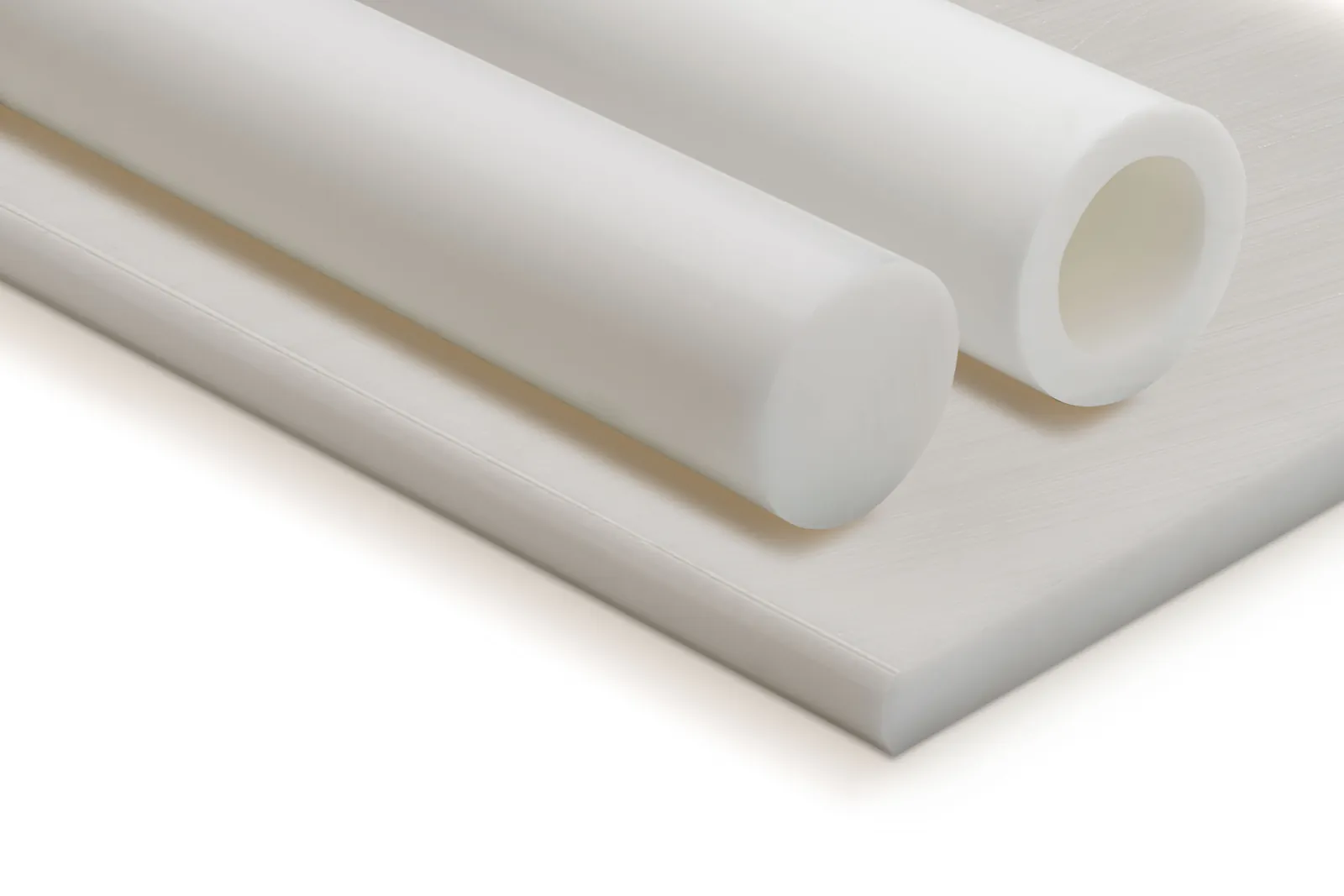
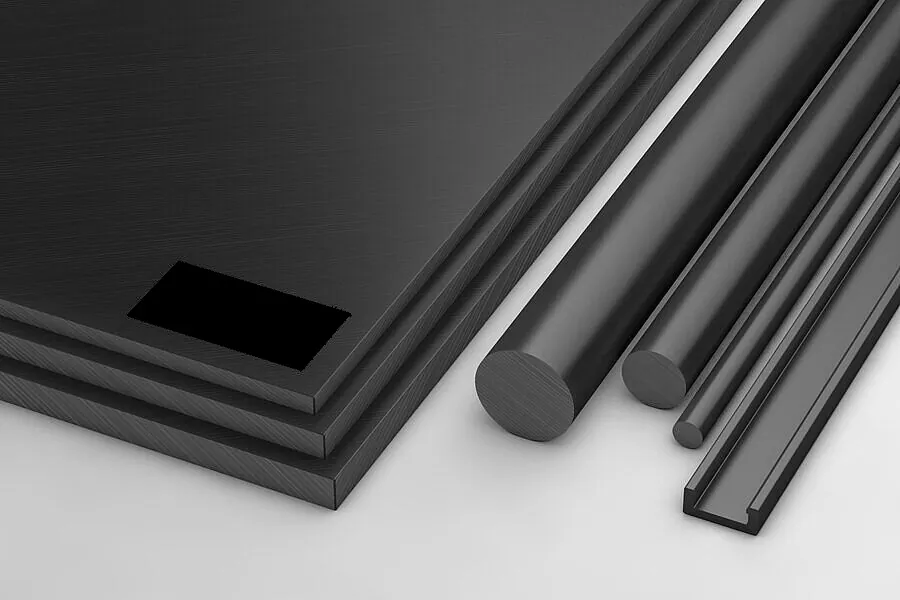
 This image was created with artificial intelligence – marked under Art. 50 of the AI Act, Regulation (EU) 2024/1689. It is a placeholder until the company's photos arrive.
HDPE, PE300 or PE1000 – differences, areas of application, advantages
PE300, PE1000 or HDPE? Learn the key differences in sliding properties, wear, processing & price – with practical application tips.
Polyethylene is not the same as polyethylene: behind the designations HDPE, PE300 and PE1000 are different material types with properties that sometimes differ considerably. Anyone who designs, selects or purchases components should know the differences in order to choose the suitable material with regard to cost, service life and functionality.
In this article you will learn how the three types differ, which applications they are suitable for and what to look out for when selecting.
Overview table of polyethylene types
| Designation | Abbreviation | Molecular weight | Typical application |
|---|---|---|---|
| PE-HD | HDPE | < 500,000 g/mol | Standard plastic, packaging, simple components |
| PE300 | HDPE, PE-HD | approx. 300,000 g/mol | Machine covers, support parts |
| PE500 | HMW-PE | approx. 500,000 g/mol | Technical components with increased abrasion stress |
| PE1000 | UHMW-PE, PE-UHMW | > 1,000,000 g/mol | Slide guides, chutes, heavily stressed parts |
Classification by molecular weight
Depending on the molecular structure, polyethylene is divided into different types. Above all, the molecular weight determines the mechanical properties such as sliding properties, wear resistance and machinability. The following table shows an overview of the most important PE classes in technical use.
What do HDPE, PE300 and PE1000 mean?
HDPE, PE300 and PE1000 are trade names for different polyethylene types, which differ in their density, molecular structure and therefore in their technical properties. The abbreviations stand for:
- HDPE (High Density Polyethylene): a high-density polyethylene with good rigidity, dimensional stability and chemical resistance. It is often used for technical components, packaging or pipe systems, for example in the form of PE300 sheets cut to size for machine covers and technical applications.
- PE300: a type of HDPE with a defined molecular weight of about 300,000 g/mol. Under this trade name it is often offered as a machinable standard material in plastics engineering.
- PE1000: an ultra-high-molecular-weight polyethylene (UHMW-PE) with a molecular weight of over 1 million g/mol. The extremely long polymer chains lead to outstanding mechanical properties, especially in the areas of sliding properties and wear. PE1000 sheets made of UHMW-PE are used particularly in heavily stressed areas – for example in slideways or as slide strips.
- PE500: For many applications with medium load, PE500 (High Molecular Weight Polyethylene, HMW-PE) is a sensible alternative. It combines better sliding and wear properties than PE300 with easier machinability and a more favourable price structure compared with PE1000. PE500 is often used in conveyor technology, mechanical engineering and for chutes, covers or technical parts when PE300 is not sufficient but PE1000 is overdimensioned.
These differences have a significant effect on mechanical properties such as sliding properties, wear resistance, rigidity, machinability and price.
Clarification of terms: What is HDPE, what is PE300?
Although the terms HDPE and PE300 are often used synonymously, there is an important distinction:
- HDPE (High Density Polyethylene) is the general designation for high-density polyethylene with high rigidity and chemical resistance. It covers an entire material group with different grades.
- PE300 is a commercially available specification within the HDPE family. The suffix "300" stands for a medium molecular weight of about 300,000 g/mol and signals good machinability as well as consistent properties for technical applications.
In practice, PE300 is therefore a defined HDPE type that was developed specifically for further processing and industrial use.
Differences in properties & molecular structure
The following table shows the most important differences:
| Characteristic | PE300 (HDPE) | PE500 (HMW-PE) | PE1000 (UHMW-PE) |
|---|---|---|---|
| Molecular weight | approx. 300,000 g/mol | approx. 500,000 g/mol | > 1,000,000 g/mol |
| Density | approx. 0.95 g/cm³ | approx. 0.94 g/cm³ | approx. 0.93 g/cm³ |
| Rigidity | High | Medium | Medium to low |
| Sliding properties | Satisfactory | Good | Excellent |
| Wear resistance | Good | Very good | Excellent |
| Impact strength | Medium | High | Very high |
| Machinability | Very good | Good | Limited |
| Chemical resistance | High | Very high | Very high |
| Temperature resistance | Up to 80 °C | Up to 80 °C | Up to 80 °C |
| Thermal expansion | approx. 2×10⁻⁴ K⁻¹ | approx. 2.2×10⁻⁴ K⁻¹ | approx. 2.5×10⁻⁴ K⁻¹ |
| Price | Inexpensive | Medium | High-priced |
Counterface & friction behaviour in use
An often underestimated factor in material selection is the counterface. PE1000 develops its full sliding properties above all in contact with metals or smooth plastic surfaces. In applications with rough counterfaces or abrasive media, service life can be significantly extended if PE1000 is used instead of PE300. PE300, on the other hand, shows sufficient behaviour under low load and less critical sliding pairings.
Colour variants & availability
PE300 is generally available in natural (milky white), black and occasionally green. PE1000 is also offered in numerous variants – including white, black, green and blue for use in the food industry. In addition, there are conductive or UV-stabilised versions, particularly for PE1000.
Virgin material or regrind?
For simple technical applications, PE1000 can also be used as regrind. This is recycled material that is more cost-effective but may exhibit slightly reduced sliding properties and tolerances. For highly stressed or safety-relevant applications, virgin material is generally used, as it has tested properties and batch consistency.
Which material is suitable for which applications?
PE300 for standard technical parts
PE300 is outstandingly suitable for economically oriented applications where there are no extreme tribological requirements. The material is easy to machine, easy to obtain and has high chemical resistance. It is typically used in:
- Cutting boards for food and technical applications
- Partition and protective walls in production
- Covers, cladding, machine housings
- CNC-milled series parts without sliding stress
- Support elements and spacers
Thanks to its cost-effectiveness, PE300 is also suitable for large-area applications where the material price plays a major role. PE300 is also used in storage technology, e.g. as a pallet element or storage layer. PE300 rods are also suitable for such applications, as they are very easy to machine and available at low cost.
PE1000 under sliding and wear stress
PE1000 is characterised by a combination of low friction, high wear resistance and excellent impact strength. This makes it predestined for applications in which materials are subjected to heavy mechanical stress or in which moving components are to run with low friction:
- Slide guides in machines and systems
- Linings for bunkers, silos, hoppers or chutes
- Slideways in packaging and discharge conveyor technology
- Chain guide rails, gears, slide strips
- Mechanical parts in food processing
PE1000 is often used especially in the food, packaging and recycling industries to enable low-maintenance, quiet and long-lasting system operation.
Practical examples from industry
- Food industry: PE1000 is used as a cutting board and sliding material for packaging lines in order to meet hygiene standards while ensuring low-maintenance processes.
- Conveyor technology: In automated storage or sorting systems, PE1000 ensures low-friction sliding movements and prevents metal-on-metal contact.
- Mechanical engineering: PE300 often serves as a cost-effective material for housing parts, brackets or as a protective cover in production systems.
Advantages and disadvantages at a glance
| Aspect | PE300 | PE1000 |
|---|---|---|
| Cost-effectiveness | +++ | + |
| Machinability | +++ | – |
| Low-friction behaviour | – | +++ |
| Durability under friction | ++ | +++ |
| Chemical resistance | High | Very high |
| Food-safe | Yes | Yes |
| Temperature limit | Up to 80 °C | Up to 80 °C |
| Noise damping | Low | Very good |
| UV resistance | Limited | Limited (extendable) |
| Availability | High | High (many variants) |
Tip:
Would you like to compare the differences between PE300, PE500 and PE1000 visually? Download our
overview as a diagram (PDF)
– with a compact property comparison in the form of a bar or radar chart.
Decision aid: Which plastic is the right one?
The choice between HDPE/PE300 and PE1000 depends on the specific area of use and the required material properties:
- If price and simple processing are the priority, PE300 is an excellent choice. The material is easy to machine, versatile and technically entirely sufficient for many standard applications.
- If mechanical load, friction, durability or impact strength are decisive, the use of PE1000 is worthwhile. The higher material costs often pay for themselves quickly through lower wear and a longer service life.
Tip: Use technical data sheets and material samples to compare the behaviour of both materials in your specific application. In many cases, a combination also makes sense: load-bearing parts made of PE300, heavily stressed surfaces made of PE1000.
FAQ – Frequently asked questions
Is PE1000 food-safe?
Yes, PE1000 is food-safe and is often used in food processing, e.g. as a cutting board or slide guide in packaging machines. It is flavour-neutral, odourless and easy to clean.
Can PE1000 be machined?
In principle yes, but machining is demanding. Due to the high molecular weight, PE1000 tends to string when milling or turning. A sharp tool geometry, low cutting speed and, if necessary, cooling are recommended.
When is POM the better choice than PE?
POM is stiffer, more dimensionally stable and easier to machine than PE. If high dimensional stability, low thermal expansion and tight tolerances are required, POM is more suitable than PE300 or PE1000. POM also offers a higher continuous service temperature.
Is PE1000 UV-resistant?
Standard PE1000 is only conditionally UV-resistant. For outdoor applications, a variant with UV stabilisers or a different material such as POM-C black or ASA is recommended.
Further information can also be found in the plastic sheet range, in the engineering plastics encyclopaedia or in POM-C sheets for dimensionally stable components.
If you would like to compare the materials, you will often find PE300 under the designation PE-HD and PE1000 as UHMW-PE or PE-UHMW in data sheets and online shops.