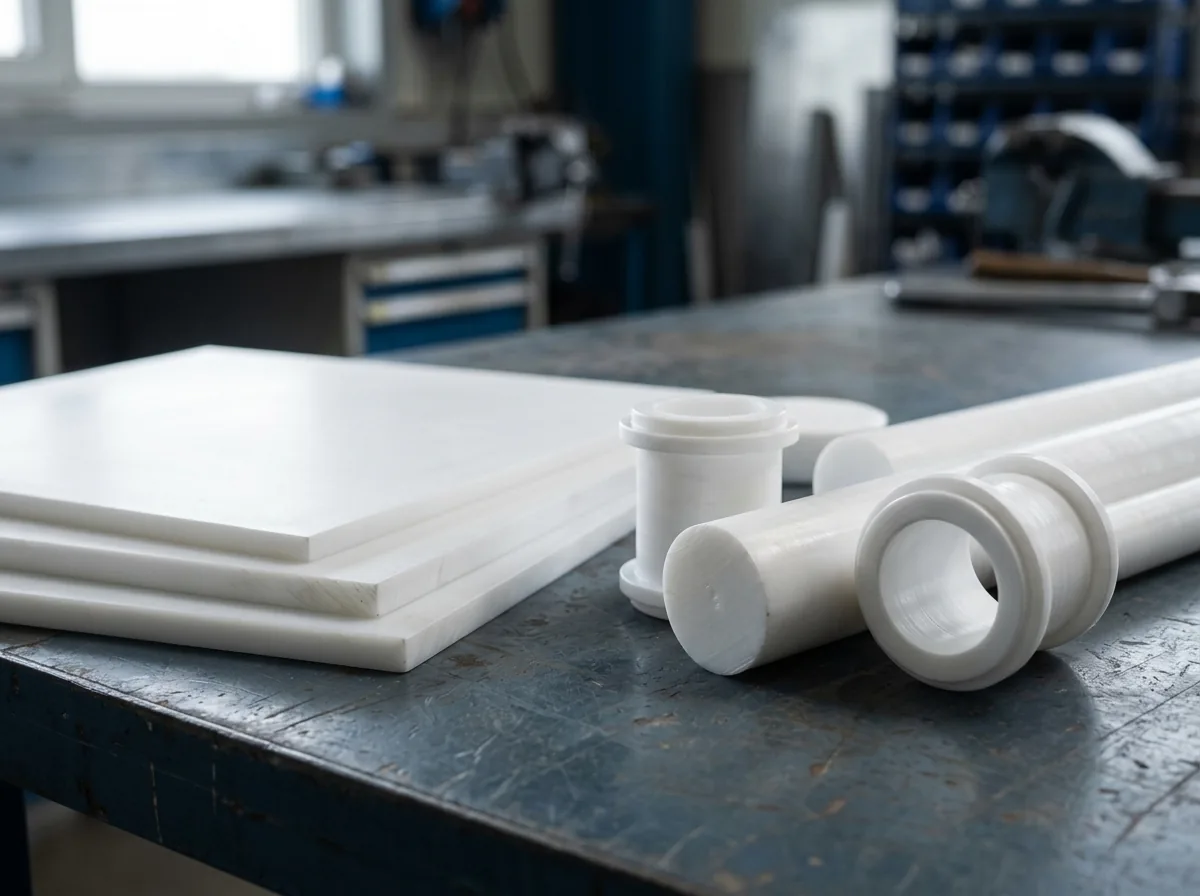
 This image was created with artificial intelligence – marked under Art. 50 of the AI Act, Regulation (EU) 2024/1689. It is a placeholder until the company's photos arrive.
Frequently asked questions about PTFE
What does PTFE mean? What are semi-finished products? Here you will find answers to your questions.
What is PTFE?
PTFE is a plastic. The plastic is composed of the elements carbon and fluorine. It is a non-segmented, linearly structured and semi-crystalline plastic. It is an odourless white solid. PTFE is the abbreviation for polytetrafluoroethylene. Or it appears under the trade name Teflon®. PTFE belongs to the group of thermoplastics. Even more information on the subject can be found at: what is PTFE?
What are semi-finished products?
Semi-finished products are, as the name suggests, tools that are semi-finished. They are raw materials and workpieces or semi-finished goods that are already formed into a simple shape. The semi-finished products serve to be further processed. Semi-finished products are generally also called source material or preliminary products.
What are the semi-finished products made of?
From polytetrafluoroethylene, also known as PTFE. They can also be made of nickel silver, aluminium, bronze, brass or other metals.
What is referred to as semi-finished products?
Sheets, cut pieces, bars, rods, solid rods, tubes and hollow rods are referred to as semi-finished products.
What are semi-finished products needed for?
Without semi-finished products it would hardly be possible to manufacture finished products. The semi-finished products are also regarded as an intermediate step, as they contribute to the manufacture of the products. Semi-finished products serve for further processing into a finished end product.
In what size are PTFE semi-finished products available?
In the sizes for sheets, panels, rods, hollow rods and films, of up to:
43000 mm length
4300 mm width
100 mm material thickness
PTFE rods can also be obtained in lengths of up to 6000 mm and a material thickness of 5 mm to 1000 mm. Special sizes can be fulfilled on request. The sizes, the material and the material thickness correspond to an international standard shape. With the material thickness it is also important that the materials are tensile and break-resistant. Thanks to the DIN standard, it is also easier for companies to manufacture the materials, as they all correspond to the standard.
Is PTFE the same as Teflon?
Yes. PTFE is the plastic, Teflon a registered trademark. Both terms are therefore used as synonyms.
In which field of application are the semi-finished products found?
Semi-finished products are found in industry and in the trades. In order to finish them with other products, as an end product.
How are semi-finished products manufactured?
Semi-finished products made of PTFE are sawn by a CNC-controlled sawing system. Metallic semi-finished products are formed into the suitable size by rolling or extrusion.
What properties does PTFE have?
- Chemical resistance to acids, alkalis and solvents
- High temperature resistance
- Low coefficient of friction
- High dielectric constant
- Electrical insulator
- Non-stick coating
Where is PTFE found in everything?
PTFE is used as non-stick coatings for pans, pots, grill grates, baking moulds and irons. In seals, tubes, containers, tubes, pumps, valves, pump components, insulation of cables and lines. Connectors, switches and in high-frequency applications, O-rings, chopping board base, medical implants, catheters, hoses and coatings of surgical instruments. As a coating for wind- and water-repellent outdoor clothing under the name Gore-Tex.
What is made from PTFE?
PTFE is made from the molecule tetrafluoroethylene. Further molecules such as hydrogen peroxide are added to the molecule. This leads to the formation of a long chain of tetrafluoroethylene molecules. These in turn form the plastic polytetrafluoroethylene, or PTFE for short.
PTFE is mainly used for the manufacture of products that are to have a high chemical resistance, a high temperature resistance and a good non-stick effect. Such as, among others, seals, sealing rings, hoses and cable insulation.
Who discovered PTFE?
PTFE was discovered by chance in 1938 by the chemist Roy Plunkett in the USA. The chemist was working at the company DuPont at the time and came across the plastic PTFE during his research work on a new coolant.
But it was not until 1954 that PTFE was used as a coating under the name Teflon. PTFE was further developed in France by the chemist Marc Grègoire and his wife Colette.
Official member of the SKZ
Since 1961, the SKZ has been a competent contact partner for the plastics industry.
Official member of the EPDA
The European Plastics Distributors Association is a membership organisation for plastic semi-finished products.