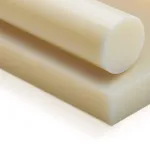
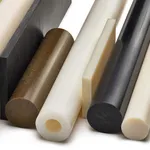
This image was created with artificial intelligence – marked under Art. 50 of the AI Act, Regulation (EU) 2024/1689. It is a placeholder until the company's photos arrive.
Diallyl phthalate (DAP)
DAP: Thermosetting plastic with electrical insulation and high heat and chemical resistance.
Diallyl phthalate belongs to the group of thermosets
Diallyl phthalate (DAP) is a thermosetting moulding material based on polyester. The material cures irreversibly under heat and pressure and is suitable for applications with high demands on dimensional stability, electrical insulation and thermal stability.
DAP is predominantly processed as a moulding compound. After curing, the material exhibits very low creep tendency, high surface hardness and stable electrical properties. These properties make diallyl phthalate an established material for technical components in electrical engineering and apparatus construction.
Compared with thermoplastics, the shape remains stable even under continuous thermal load. Within the material group of thermosets, DAP occupies a special position, as it combines good electrical properties with precise shaping.
Properties of diallyl phthalate
Diallyl phthalate is characterised by a balanced property profile that was developed specifically for precise and electrically loaded components. As a thermosetting material, the material structure remains dimensionally stable even under continuous thermal stress.
Mechanical properties
DAP has a high surface hardness and a low creep tendency. Dimensional stability is maintained even with tight tolerances. The mechanical strength is suitable for dimensionally stable, thin-walled components.
Thermal properties
The material shows good heat deflection resistance and retains its properties over a broad temperature range. Subsequent forming is impossible due to the thermosetting cross-linking.
Electrical properties
Diallyl phthalate offers very good electrical insulating properties, a high dielectric strength and stable characteristics even under temperature and humidity load. This makes the material suitable for insulating functional parts.
Within the group of thermosets, DAP is regarded as a material for applications in which electrical safety and dimensional precision are required in combination.
Application areas of diallyl phthalate
Diallyl phthalate is used when components must remain permanently dimensionally stable and at the same time ensure reliable electrical insulation. The material is particularly suitable for precise moulded parts with tight tolerances.
Electrical engineering and electronics
In electrical engineering, DAP is used for insulating bodies, switch parts, terminal housings and carrier plates. The stable electrical characteristics are maintained even at elevated temperature and humidity.
Apparatus and equipment construction
In apparatus construction, diallyl phthalate is used for dimensionally stable functional parts where dimensional accuracy and surface hardness are required. Typical applications are spacers, covers and structural insulating parts.
Technical special applications
Through the combination of mechanical strength and electrical insulation, DAP is suitable for applications in measurement and testing technology as well as for specialised industrial components.
For comparable fields of application, other technical plastics are also available, whose properties vary depending on the requirement.
Processing of diallyl phthalate
Diallyl phthalate is predominantly processed as a thermosetting moulding material by the compression moulding process. Shaping takes place under defined pressure and elevated temperature, whereby the material cures irreversibly.
Compression moulding process
DAP is generally supplied as a moulding compound and is pressed in heated tools. During the pressing process, the material cross-links completely and reaches its final mechanical and electrical property profile.
Dimensional stability and surface quality
Through shape-bound curing, components with high dimensional accuracy and uniform surface structure can be produced. Subsequent forming or welding processes are impossible due to the material.
Design notes
In component design, fixed geometries and defined wall thicknesses must be taken into account. Changes to the component can only be realised by means of new tools.
For alternative processing approaches, other plastics with thermoplastic properties come into consideration.
Advantages and limitations of diallyl phthalate
Diallyl phthalate offers a specific property profile for technically demanding applications. The selection of the material is made on the basis of clearly defined functional requirements.
Advantages
- High dimensional stability even under continuous thermal load
- Very good electrical insulating properties
- Low creep tendency and high surface hardness
- Stable properties over long service lives
Limitations
- Irreversible curing without subsequent forming possibility
- Component changes require new tools
- Lower impact strength compared with many thermoplastics
For applications with flexible further processing or frequent design changes, other plastics with thermoplastic character are suitable.
Alternatives to diallyl phthalate
Depending on the requirements for mechanics, temperature resistance or processability, other technical materials come into consideration alongside diallyl phthalate. The selection depends on function, quantity and design freedom.
Phenolic resins (PF)
Phenolic resins also belong to the thermosets and offer good electrical insulation as well as high temperature resistance. Compared with DAP, the focus is more on robust components with lower dimensional precision.
Epoxy resins (EP)
Epoxy resins are used for electrically and mechanically loaded components. They enable complex geometries, but usually require longer curing times and differ in surface quality.
Thermoplastics for insulating applications
For applications requiring subsequent forming or frequent design adjustments, thermoplastic plastics such as polyamide or PBT are suitable. These materials offer greater flexibility in processing.
Diallyl phthalate is preferably chosen when dimensional stability, electrical stability and reproducible component quality are the priority.
Diallyl phthalate – classification for material selection
Diallyl phthalate is suitable for applications with clearly defined geometries, high demands on dimensional stability and stable electrical properties. As a thermosetting moulding material, the material offers permanent dimensional stability even under thermal load.
The use of DAP is particularly recommended for precise moulded parts in electrical engineering, in apparatus construction and in technical special applications. The selection is typically made when reproducible component quality and electrical safety are the priority.
For applications requiring flexible further processing, frequent design adjustments or higher impact strength, alternative plastics come into consideration.
Frequently asked questions about diallyl phthalate
Diallyl phthalate – which type of plastic?
Diallyl phthalate is one of the thermosetting plastics. The material cross-links permanently during processing and thereby achieves high dimensional and shape stability.
What is DAP particularly suitable for?
DAP is suitable for precise moulded parts with requirements for electrical insulation, thermal stability and reproducible component quality, for example in electrical engineering and apparatus construction.
How is diallyl phthalate processed?
Processing is predominantly carried out by the compression moulding process under heat and pressure. The material cures completely and reaches its final properties.
What advantages does DAP offer compared with other materials?
Diallyl phthalate offers high dimensional stability, stable electrical characteristics and uniform surface quality over long service lives.
Which material alternatives come into consideration?
Depending on the application, other plastics such as other thermosets or thermoplastic insulating materials with a differing property profile are suitable.