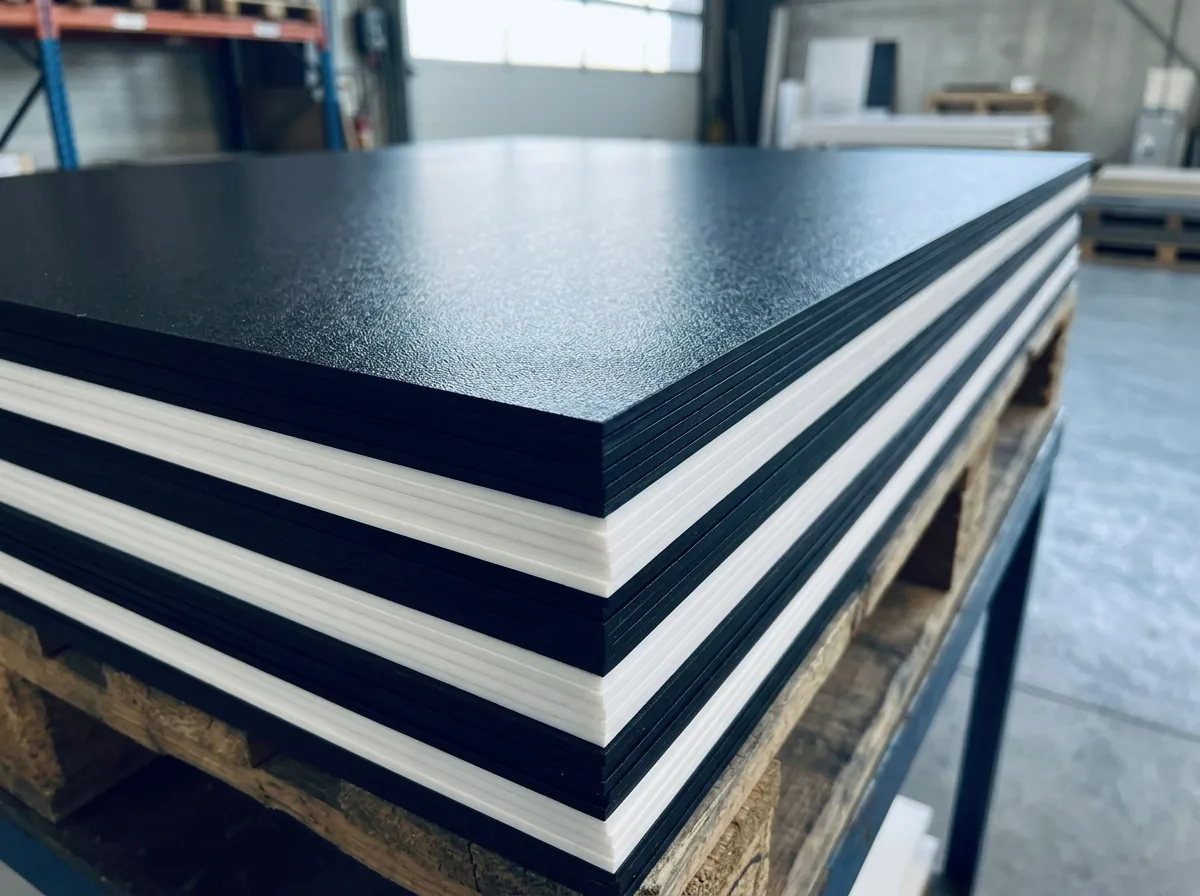
 This image was created with artificial intelligence – marked under Art. 50 of the AI Act, Regulation (EU) 2024/1689. It is a placeholder until the company's photos arrive.
Processing ABS sheets correctly: cutting, milling and cutting to size
Cutting, milling and cutting ABS to size: which tools are suitable and what to look out for when CNC machining ABS.
ABS sheets are stable and easy-to-machine plastic sheets that are suitable for technical components, cladding, housings, displays, prototypes and numerous other applications. A particular advantage of the material is its versatile mechanical machining: ABS can be cut, sawn, drilled and milled as well as brought precisely to size using suitable processes.
For a clean ABS cut, the right tool, secure fixing and controlled heat generation are above all what matter. This applies both to manual cutting and to CNC milling of ABS. In this article you will learn how to cut ABS sheets to size and machine them further, and how to avoid melted cut edges, distortion or unnecessary rework.
What is an ABS sheet?
ABS stands for acrylonitrile butadiene styrene, a versatile thermoplastic plastic that is used in a wide variety of industrial and trade applications. Characteristic of ABS is its outstanding impact resistance, which makes it particularly resistant to impacts and mechanical loads, as well as its good temperature resistance, which enables use in a wide range of environments. In addition, ABS is distinguished by high chemical resistance, so that it remains stable against oils, greases, cleaning agents and many solvents. These properties make ABS sheets particularly durable and reliable.
ABS sheets are also lightweight, dimensionally stable and can both be machined and thermally formed. They are suitable for applications such as housings, furniture, machine cladding, displays, advertising technology or technical components. A further advantage is the good thermal formability, which enables creative applications such as bending, embossing or thermoforming.
At the same time, surfaces can be aesthetically finished by polishing, painting or film lamination, whereby ABS can be used both functionally and decoratively. This combination of mechanical robustness, ease of machining and visual finishability makes ABS one of the most popular plastics for industry, trade and DIY projects.
Tips for cutting ABS sheets to size
Cutting ABS sheets to size requires precision and the right tools in order to avoid material damage and achieve clean edges.
Choosing the right tool
The choice of tool depends on the sheet thickness, the complexity of the shape and the desired cut quality. Hand-held circular saws or table circular saws with a fine plastic saw blade enable straight and clean cuts, ideal for thick and stable sheets. Jigsaws are particularly suitable for curved or complex contours, whereby a slow, controlled cutting action significantly improves the edge quality.
CNC milling delivers repeatable precision in industrial applications, while thin sheets or decorative elements can be optimally machined with hot-wire cutters. Laser cuts offer exact precision and particularly clean edges, especially with thin sheets. A sharp saw blade with a high tooth count reduces chipping and facilitates further machining.
Stability when cutting
Stable fixing of the ABS sheets is decisive for precise results. Screw clamps or clamps on a level base prevent the material from slipping during cutting, which could lead to uneven edges or cracks.
Particularly with thin sheets, an additional base of cork or MDF is recommended in order to minimise vibrations. A firm hold not only protects the material from deformation, but also ensures high cutting accuracy.
Cutting speed and temperature
ABS is sensitive to heat, so the cutting speed should be chosen moderately in order to prevent melting or distortion. Continuous working with a uniform feed ensures clean cut edges.
With thicker sheets, an intermittent cutting action can help to reduce heat generation and preserve material stability. Additional cooling measures, such as air or water supply, help to avoid overheating and protect the material from unwanted stresses.
Reworking the edges
After cutting, the edges should be carefully reworked in order to achieve a smooth surface and remove sharp edges. This can be done by sanding with grit 180–320, deburring with hand tools or deburring machines and, if required, by hot-air treatment in order to produce slight roundings.
Careful reworking prevents cracks and ensures a professional, visually appealing finish.
Drilling and milling
Pre-drilling prevents cracks when screwing, while milling with plastic milling cutters enables precise recesses. Cooling with air or water protects against overheating, particularly with thicker sheets or complex milling work.
Multi-stage drilling increases accuracy and ensures that the drilled holes remain clean, dimensionally accurate and stable, which guarantees the longevity of the end product.
Further processing techniques for ABS sheets
ABS sheets can be further processed in a variety of ways. Thin sheets can be carefully bent by the application of heat (approx. 80–100 °C), and bending tools can be used for complex shapes. ABS can also be joined with special ABS adhesives, solvents or 2-component adhesives; the bonding surfaces should be clean, free of grease and lightly roughened in order to ensure optimum adhesion.
The surfaces can be finished by polishing, film lamination or laminating, while paint finishes offer additional colour and resistance. For applications such as thermoforming or embossing processes, ABS sheets can be heated and brought into moulds, whereby uniform heating is important in order to avoid stresses in the material. Overall, these techniques allow a high degree of flexibility in the design and functionality of ABS sheets.
Typical areas of use of ABS sheets
- Machine cladding and housings: ABS is lightweight, robust and insulating, ideal for protective housings, machine cladding and technical applications.
- Furniture and interior fitting: Smooth, easy to care for and easy to form – ABS is suitable for furniture, wall cladding, shelves or panels.
- Prototyping and model making: ABS sheets are perfect for prototypes, as they can be easily cut to size, drilled and glued.
- Advertising technology and displays: Printable, film-laminatable and easy to form – ABS is ideal for signs, advertising boards or presentation displays.
- Electronics housings and consumer products: The combination of insulating capability, impact resistance and chemical resistance makes ABS ideal for electronic devices, consumer products or household housings.
Safety notes
When working with ABS sheets, observe the following:
- Wear safety goggles, gloves and, if necessary, hearing protection
- Use a well-ventilated room, particularly for heat or sanding work
- Use dust-free cutting action or extraction
- Dispose of offcuts properly in order to avoid tripping hazards
Sustainability and recycling
ABS is a thermoplastic plastic that can be well recycled and thus represents a sustainable material choice for many projects. All offcuts and trimmings should be collected and handed over to suitable recycling centres or specialised plastic recycling companies instead of being disposed of. In this way the material can be reintroduced into production cycles.
Furthermore, careful cutting to size makes it possible to minimise waste and save material costs. Offcuts can also be creatively reused, for example for craft projects, model making or prototypes, whereby resources are conserved and at the same time new application possibilities are opened up. In addition, owing to its thermoplastic properties, ABS can be used multiple times, making it advantageous both ecologically and economically.
In summary
The right cutting to size and careful processing of ABS sheets are decisive for the quality of your project. With the right tools, correct fixing, moderate cutting speed and professional reworking, you will achieve clean edges, stable joints and long-lasting results. Whether machine cladding, furniture making, advertising technology or prototypes – ABS sheets offer versatile application possibilities that can be fully exploited with the right techniques.
For professional use, we recommend high-quality ABS sheets in a suitable thickness and size in order to minimise material losses and ensure exact results.