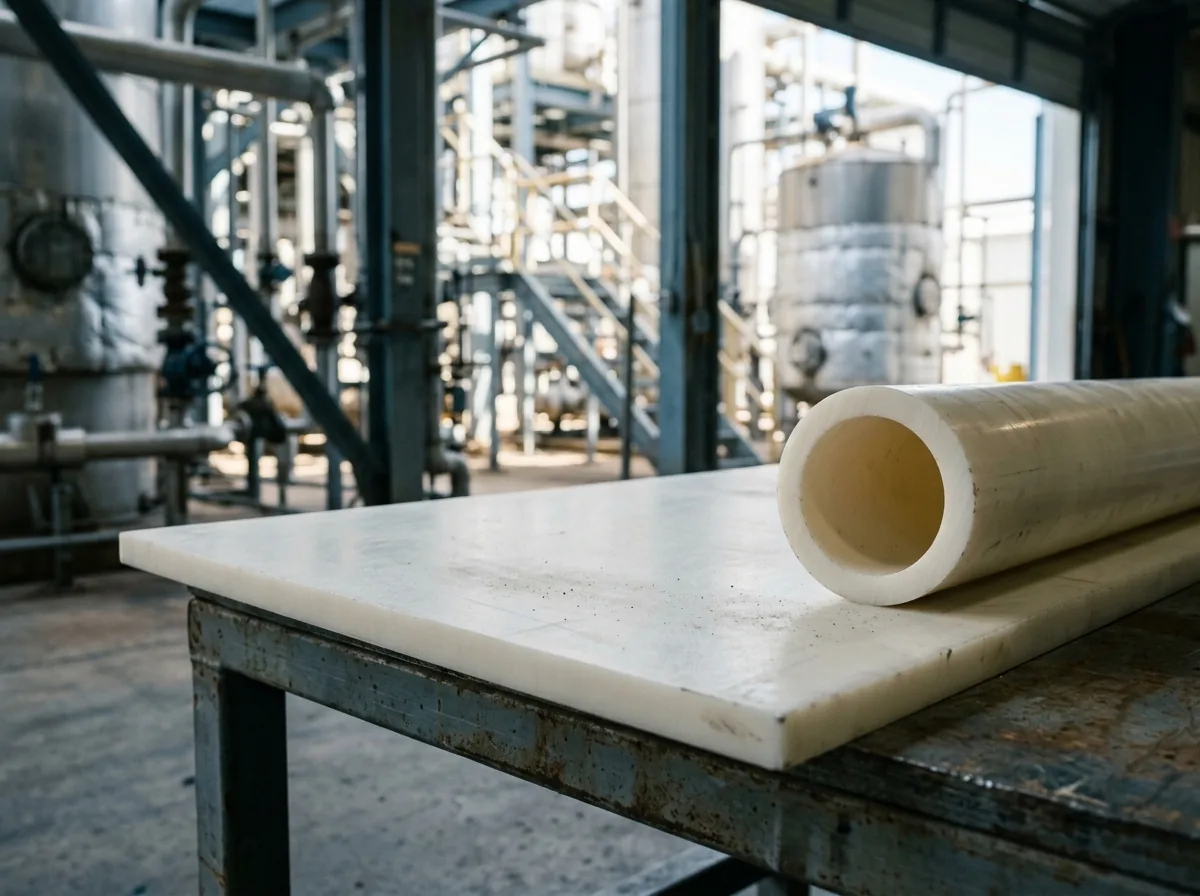
 This image was created with artificial intelligence – marked under Art. 50 of the AI Act, Regulation (EU) 2024/1689. It is a placeholder until the company's photos arrive.
Polyvinylidene fluoride (PVDF)
What is polyvinylidene fluoride? More about properties, chemical resistance, areas of application and typical uses.
Polyvinylidene fluoride, or PVDF for short, is a semi-crystalline fluoroplastic for technically demanding applications. The material combines high chemical resistance with good mechanical properties and a broad temperature tolerance.
PVDF is used when plastics are permanently in contact with aggressive media, ultra-pure substances or elevated temperatures. Typical applications are found in chemical engineering, plant construction, environmental engineering and in areas with high purity requirements.
Compared with many standard plastics, PVDF offers significantly higher media resistance and dimensional stability. At the same time, the material remains easy to process and is suitable for precision components, sheets and semi-finished products from the field of engineering plastics, for example in the context of plastic sheets.
Material properties of PVDF
PVDF is characterised by a balanced combination of chemical stability, mechanical strength and thermal load capacity. The material reliably retains its properties even under continuous stress.
The high resistance to acids, alkalis, solvents and many organic chemicals makes PVDF particularly suitable for use in aggressive environments. At the same time, the material shows low water absorption and very good dimensional accuracy.
Mechanically, PVDF offers high tensile strength as well as good impact toughness compared with many other fluoroplastics. The permissible service temperature range typically extends from about −40 °C to +150 °C, depending on the design and load.
Because of these properties, PVDF is frequently processed as a sheet or semi-finished material, for example in the context of plastic sheets for technical applications.
Typical areas of application for PVDF
PVDF is used wherever plastics work permanently under chemical, thermal or mechanical load. The material is suitable for components where a long service life and consistent material quality are required.
In chemical and process engineering, PVDF is frequently used for pipelines, vessel linings, valve components and components close to seals. The high media resistance ensures stable operation even with aggressive substances.
Further fields of application are found in plant and apparatus construction, in environmental and water technology as well as in areas with high purity requirements, for example in semiconductor or pharmaceutical engineering. Here PVDF is valued because the material hardly outgasses and offers a clean surface.
As a semi-finished product, PVDF is processed among other things in the form of sheets, rods or cut pieces, for example in the context of plastic sheets for technically defined components.
Processing and semi-finished product forms made of PVDF
PVDF can be precisely processed into technical components and is suitable for applications with tight dimensional specifications. The material is predominantly used as a semi-finished product and then machined or thermoformed.
Common semi-finished product forms are sheets, rods, tubes and cut pieces. These forms allow flexible further processing in mechanical and plant engineering as well as in chemical and environmental engineering.
During machining, PVDF shows a clean cut and stable edge quality. As a result, the material is suitable for milled, turned or drilled components with reproducible results.
In the field of technical semi-finished products, PVDF is frequently used in connection with plastic sheets when chemical resistance and dimensional accuracy are the priority.
Distinction from other engineering plastics
PVDF positions itself between classic standard plastics and high-priced fluoroplastics. The material offers high chemical resistance combined with good mechanical properties and economically sensible processability.
Compared with polyethylene or polypropylene, PVDF is suitable for significantly higher temperatures and more aggressive media. Compared with PTFE, PVDF shows higher strength and better dimensional accuracy under mechanical load.
In the direct environment of technical fluoroplastics, PVDF is frequently chosen when a combination of media resistance, rigidity and machinability is required. The material therefore represents a balanced solution for many industrial applications.
PVDF is frequently classified in comparison with other engineering plastics, in particular when selecting suitable sheet and semi-finished materials.
Selection notes for PVDF in industrial use
When selecting PVDF, operating conditions and mechanical requirements play a central role. The decisive factors are above all the medium, the temperature range and the type of mechanical load in later operation.
For applications with permanent contact with chemicals or ultra-pure media, PVDF is particularly suitable, since the material has a stable material structure and low interaction with many substances. At the same time, the low water absorption supports constant dimensional accuracy.
Depending on the application, the selection of suitable semi-finished product forms such as sheets or cut pieces is recommended in order to reduce machining effort and material losses. In the context of technical applications, the material choice is frequently made in comparison with other plastic sheets with similar application profiles.
PVDF therefore offers a reliable basis for technically defined components where chemical resistance, temperature tolerance and precise processing are required.
Quality, standards and typical delivery conditions
PVDF is used for industrial applications in defined qualities and delivery conditions. The material properties are subject to tight manufacturing tolerances in order to ensure consistent performance in use.
Depending on the manufacturer and design, PVDF meets common technical standards and is suitable for applications with increased requirements for purity, resistance and long-term stability. In sensitive areas such as chemical, environmental or process engineering, documented material quality plays a central role.
Typical delivery conditions are extruded or pressed semi-finished products such as sheets and rods. These forms allow targeted further processing and reliable dimensioning of components in an industrial environment.
When selecting materials, PVDF is frequently classified in direct comparison with other plastic sheets in order to optimally cover requirements for standards, service life and processing.
Advantages of PVDF at a glance
PVDF offers a reliable combination of chemical stability, mechanical load capacity and thermal resistance. The material is suitable for industrial applications where constant material properties are required over long periods of use.
The high media resistance supports use in aggressive environments, while the good dimensional accuracy enables precise component design. At the same time, PVDF remains easy to machine and thus covers a broad range of applications.
Compared with many alternative plastics, PVDF represents a technically balanced solution when chemical resistance and mechanical stability are equally relevant. The material is therefore frequently used as a semi-finished product in the form of sheets or cut pieces.
PVDF is regularly selected in the context of other engineering plastic sheets, in particular for applications with defined media and temperature requirements.
Typical industries and application environments
PVDF is used across industries when engineering plastics are to function reliably under defined process conditions. The material has become established above all in industrial applications with high requirements for resistance and process reliability.
In chemical and process engineering, PVDF is used in plant components, piping systems and structural components. The material is also used in plant construction and environmental engineering, since it remains permanently stable against many chemicals.
Further application environments lie in the pharmaceutical and semiconductor industry as well as in technical special applications with high purity requirements. Here PVDF convinces with a clean surface and constant material properties over long periods of use.
In these industries, the material selection is frequently made in comparison with other plastic sheets in order to determine the optimum material for the respective application profile.
Advice and selection of the right PVDF material
The selection of the right PVDF material is made on the basis of clearly defined application parameters. These include the medium, temperature range, mechanical load as well as the planned further processing of the semi-finished product.
Depending on the application, requirements for sheet thickness, surface quality and delivery form differ. A clean coordination of these factors supports stable function of the components over the entire period of use.
In an industrial environment, PVDF is frequently selected in direct comparison with other engineering plastics, in particular for applications with chemical load or elevated temperatures. A structured material selection reduces later adjustments and increases operational safety.
For the classification and selection of suitable semi-finished products, the overview of plastic sheets offers practical orientation within the range of engineering plastics.
Summary of PVDF as an engineering material
PVDF is an engineering fluoroplastic for applications with clearly defined requirements for chemical resistance, temperature tolerance and dimensional accuracy. The material is suitable for industrial fields of application in which plastics are permanently loaded.
Through the combination of media resistance, mechanical stability and good machinability, PVDF is frequently used as a semi-finished product in the form of sheets, rods or cut pieces. Typical applications are found in plant construction, in chemical and environmental engineering as well as in areas with increased purity requirements.
In practice, PVDF is selected in direct comparison with other engineering plastics, in particular when deciding on suitable plastic sheets for defined operating conditions.
Frequently asked questions about polyvinylidene fluoride (PVDF)
What is PVDF?
PVDF is a semi-crystalline fluoroplastic with high chemical resistance, good mechanical strength and a broad service temperature range. The material is used for technically demanding industrial applications.
What is PVDF used for?
PVDF is used in plant and apparatus construction, in chemical and process engineering, in environmental engineering as well as in industries with high purity requirements. Typical applications are components, semi-finished products and structural components.
What advantages does PVDF offer over standard plastics?
PVDF offers significantly higher resistance to chemicals and temperatures as well as better dimensional accuracy. As a result, the material is suitable for operating conditions that permanently overtax standard plastics.
In which delivery forms is PVDF available?
PVDF is predominantly supplied as a semi-finished product, for example in the form of sheets, rods, tubes or cut pieces. These delivery forms allow precise further processing in an industrial environment.
Is PVDF easy to machine?
PVDF is easy to machine and shows clean cut edges and stable dimensional accuracy in the process. The material is suitable for milling, turning and drilling processes with reproducible results.
How is PVDF classified in material comparison?
PVDF is frequently classified between standard plastics and high-performance fluoroplastics. The material combines chemical resistance with mechanical stability and economical processability.