Polyethylene terephthalate (PET)
What makes polyethylene terephthalate (PET) so versatile? Properties, load-bearing capacity, barrier effect & typical applications explained concisely.
Polyethylene terephthalate, or PET for short, is a thermoplastic polyester with high dimensional accuracy, good mechanical strength and very low moisture distortion. The material is suitable for precision components where dimensional stability, surface quality and reproducible properties are the main priorities.
In technical applications, PET is used as a semi-finished product, cut piece or finished part. Typical advantages are its good machinability, the clean cut finish and the balanced ratio of rigidity to impact strength. Compared with many other standard plastics, PET shows controllable behaviour under load and temperature.
As a material, PET belongs to the group of engineering plastics and is often used where alternatives such as PA or POM are viewed critically due to moisture absorption or dimensional changes. A higher-level classification is provided within the overview of engineering plastics.
Material properties of PET
PET is characterised by high rigidity, good compressive strength and uniform mechanical load capacity. Its low water absorption ensures stable dimensional accuracy even under changing ambient conditions. This makes the material suitable for applications with tight tolerances.
The surface of PET is smooth and homogeneous, which enables clean cuts and precise edges. During machining, the material shows well-controllable chip formation. This reduces tool wear and supports reproducible manufacturing processes.
Thermally, PET is dimensionally stable compared with many standard plastics and retains its properties within a moderate temperature range. For applications with higher temperature requirements, a distinction is often made from other engineering plastics with specialised heat resistance.
Areas of application for polyethylene terephthalate
PET is used in technical applications where dimensional accuracy, dimensional stability and clean surface quality are required. The material is suitable for components that are mechanically loaded and at the same time must be manufactured precisely.
Typical areas of application are found in mechanical engineering, in conveyor technology and in packaging and automation technology. There, PET is used among other things for guide elements, covers, carrier plates or functional structural parts.
Due to its low moisture absorption, PET is also suitable for environments with changing humidity. In applications where plastics such as polyamide are viewed critically, PET often represents a technically stable alternative. A classification of comparable materials is provided within the overview of engineering plastics.
Processing and cutting to size of PET
PET can be easily sawn, milled, drilled and turned. The material shows uniform chip formation and enables precise contours as well as clean edges. This makes PET suitable for accurately fitting cut pieces and near-series production.
During machining, stable fixing of the material and an adapted cutting speed are recommended. This keeps dimensional accuracy and surface quality constant throughout the entire manufacturing process.
PET is available as sheet, rod or individually cut-to-size semi-finished article. For application-specific requirements, cutting to size is often carried out according to drawing or dimensional specification. A selection of further machinable materials can be found in the area of engineering plastics.
Distinction from comparable plastics
In direct comparison with polyamide (PA), PET offers significantly lower moisture absorption and therefore more stable dimensional accuracy. This makes the material particularly suitable for applications with tight tolerances or changing ambient conditions.
Compared with polyoxymethylene (POM), PET shows higher rigidity and a very homogeneous surface. POM is often used for sliding or moving components, while PET is preferably used for dimensionally stable structural elements.
The selection of the suitable material is generally based on mechanical requirements, ambient conditions and manufacturing processes. A structured comparison of further materials is available in the area of engineering plastics.
Formats, versions and availability
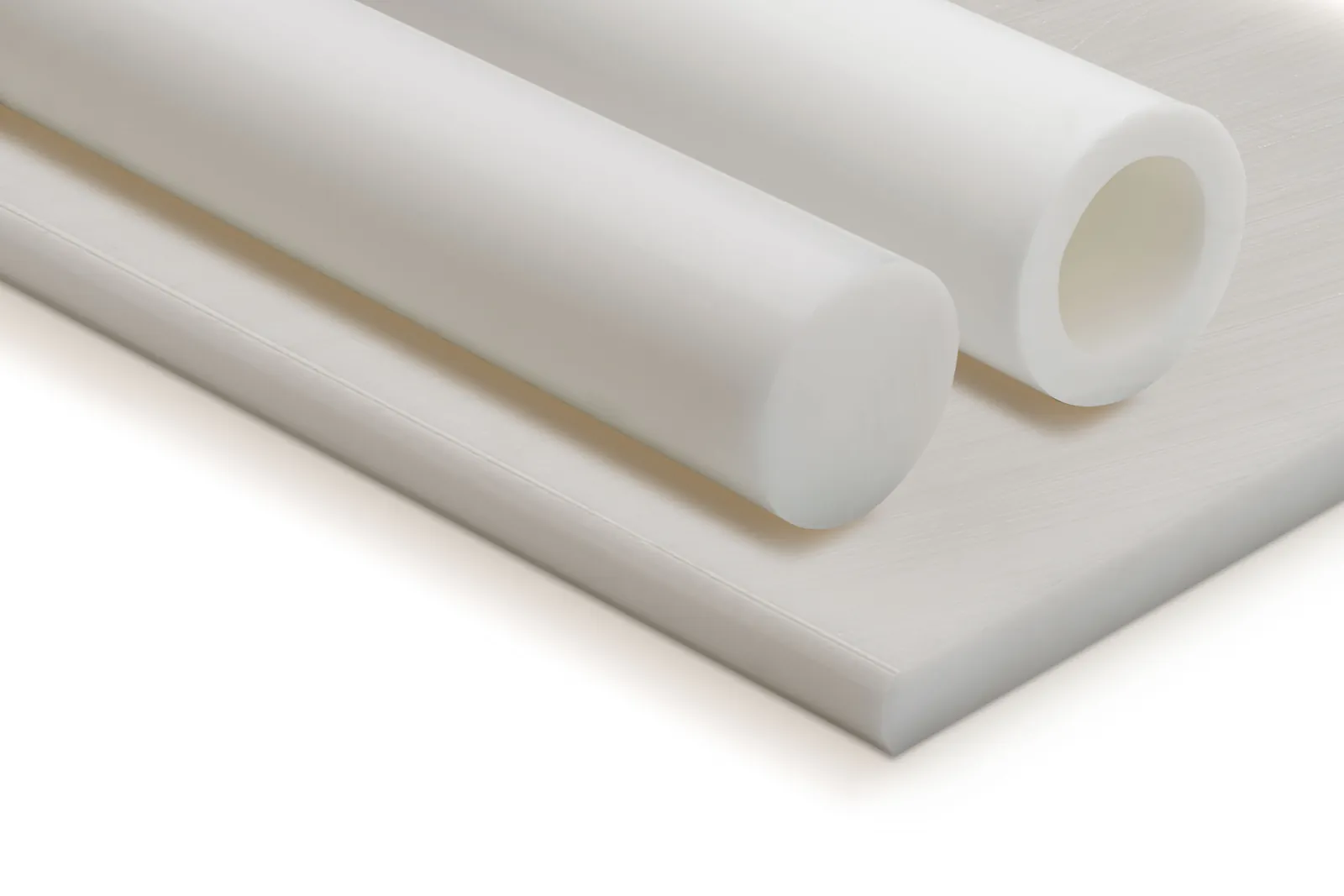
PET is available in various semi-finished product forms and can be flexibly adapted to technical requirements. Common versions are sheets and rods in different dimensions, which are intended for individual cut pieces.
Sheets made of PET are often used for covers, carrier and structural components. Rod material is suitable for turned or milled individual parts with defined diameters. The material quality supports consistent properties throughout the entire cross-section.
Depending on the application, delivery is as raw material, dimensionally accurate cut piece or machined finished part. For a systematic material selection and availability of further materials, the overview of engineering plastics serves as a guide.
Advantages of PET in technical use
PET offers a balanced combination of rigidity, dimensional accuracy and surface quality. These properties support precise designs and consistent results in series production.
The material is suitable for applications with mechanical load and high requirements for dimensional stability. The low moisture absorption supports constant dimensions even under changing ambient conditions.
Thanks to its good machinability, components can be manufactured efficiently. PET is therefore often used when reproducible quality and economical processing are required. A classification of further suitable materials is provided via the overview of engineering plastics.
Typical applications in industry and trade
PET is used in industry and trade wherever precise dimensions and consistent material properties are required. The material is suitable for structural components where dimensional accuracy and surface quality are relevant.
In practice, PET is used among other things for spacer plates, guide elements, covers as well as carrier and mounting plates. The stable structure supports reliable function even under continuous mechanical stress.
Thanks to the combination of machinability and dimensional accuracy, PET is often used in technical assemblies that are manufactured reproducibly. A classification of further suitable materials is provided via the overview of engineering plastics.
Quality, standards and technical classification
In technical use, PET is used as a defined material with reproducible properties. The uniform material structure supports consistent results across different batches and facilitates technical planning.
Depending on the version and delivery form, PET meets common requirements for industrial semi-finished products. For designs with materials subject to documentation requirements, clear coordination regarding material data, tolerances and operating conditions is recommended.
The technical classification of PET is carried out in the context of comparable plastics with a similar application profile. A structured overview of further materials and their fields of application is offered in the area of engineering plastics.
Polyethylene terephthalate at a glance
Polyethylene terephthalate is an engineering plastic for applications with high requirements for dimensional accuracy, surface quality and mechanical stability. The material is suitable for precision components that are manufactured reproducibly and used reliably.
Thanks to its low moisture absorption, good machinability and uniform material properties, PET represents a proven solution for industrial and commercial applications. It is often used where stable dimensions and clean manufacturing processes are required.
For the selection of suitable materials and versions, the overview of engineering plastics offers a structured guide within the material portfolio.
Frequently asked questions about polyethylene terephthalate (PET)
What is polyethylene terephthalate (PET)?
PET is a thermoplastic polyester from the group of engineering plastics. The material stands for high dimensional accuracy, good mechanical strength and a uniform material structure.
For which applications is PET particularly suitable?
PET is suitable for precision components in mechanical engineering, in conveyor technology and in technical designs. Typical applications are carrier plates, covers, guide elements and dimensionally stable structural parts.
What advantages does PET offer compared with other plastics?
PET offers very good dimensional stability, low moisture absorption and clean machinability. These properties support constant dimensions and reproducible manufacturing results.
In which formats is PET available?
PET is available as sheet and as rod material. Depending on the requirement, delivery is as raw material, dimensionally accurate cut piece or machined finished part.
How can PET be machined?
PET is suitable for common machining processes such as sawing, milling, drilling and turning. The material shows uniform chip formation and supports precise contours as well as clean edges.