PA6 GF30
PA6 GF30 with 30% glass fibre offers high strength, rigidity and dimensional stability. Check the properties now and request your version.
PA6 GF30 is a glass-fibre-reinforced polyamide with a glass-fibre content of 30 percent. The material combines the good machinability of PA6 with significantly increased strength, stiffness and heat resistance.
Thanks to the glass-fibre reinforcement, PA6 GF30 is particularly suitable for technical components that are subjected to high mechanical loads or must remain dimensionally stable. Typical applications are found in mechanical engineering, automation technology, vehicle construction and industrial designs.
Compared with unreinforced PA6, PA6 GF30 offers greater dimensional accuracy under load, better fatigue strength and reduced creep behaviour. The material is therefore often used as a replacement for metal parts when weight is to be reduced or corrosion resistance achieved.
Fundamentals on the properties and variants of polyamide can be found on the page PA6 plastic.
Properties of PA6 GF30
PA6 GF30 is characterised by a combination of high mechanical load capacity and good thermal stability. The glass-fibre reinforcement significantly increases stiffness and improves dimensional accuracy even under continuous stress.
Mechanical properties
Compared with unreinforced PA6, PA6 GF30 has a significantly higher tensile strength and flexural rigidity. The reduced creep behaviour ensures that components retain their shape even under long-term load.
Thermal resistance
PA6 GF30 offers increased heat resistance and is suitable for applications with elevated operating temperatures. As a result, the material remains dimensionally stable even in thermally demanding environments.
Chemical and tribological properties
The material shows good resistance to oils, greases and many chemicals. Its wear resistance is higher than that of unreinforced PA6, which predestines PA6 GF30 for moving and mechanically stressed components.
A basic classification of the base properties of polyamide can be found on the page PA6 plastic.
Typical areas of application of PA6 GF30
PA6 GF30 is used wherever components must withstand high mechanical loads and at the same time good dimensional accuracy is required. The material is particularly suitable for structural applications in an industrial environment.
Mechanical and plant engineering
In mechanical engineering, PA6 GF30 is used for bearing housings, guide elements, mounts and structural components. The high stiffness and the reduced creep behaviour ensure stable function even under continuous load.
Automation and conveyor technology
In automation technology, PA6 GF30 is used for gripper components, support parts and functional structural components. The material offers a good combination of strength, weight advantage and wear resistance.
Vehicle and apparatus construction
PA6 GF30 is used in technical vehicle components, covers and functional structural parts. The glass-fibre reinforcement supports high dimensional stability under changing mechanical and thermal loads.
For applications with lower mechanical stress, unreinforced PA6 plastic can also represent a suitable alternative.
Machining and processing of PA6 GF30
PA6 GF30 machines well by cutting and is suitable for the production of precise, dimensionally accurate components. Due to the glass-fibre reinforcement, machining differs in some respects from unreinforced PA6.
Machining by cutting
Sawing, milling and drilling are possible without difficulty using suitable tools. Wear-resistant cutting tools are recommended, as the glass fibres cause higher tool abrasion. Clean cut edges and tight tolerances can be reliably achieved with adapted cutting parameters.
Dimensional accuracy and surfaces
PA6 GF30 offers high dimensional stability during and after machining. The surface is technical-functional in appearance and shows a visible glass-fibre structure, which is usual for structural components in industrial use.
Notes on design
The increased stiffness should be taken into account in component design. Compared with unreinforced polyamide, PA6 GF30 has lower toughness, which is relevant for suddenly acting loads.
For less stiff or more impact-resistant applications, PA6 plastic without glass-fibre reinforcement can also be used.
Comparison of PA6 GF30 and unreinforced PA6
PA6 GF30 differs significantly from unreinforced PA6 with regard to mechanical properties and possible applications. The glass-fibre reinforcement fundamentally changes the material behaviour and extends the application range to highly loaded structures.
Strength and stiffness
PA6 GF30 achieves a substantially higher tensile and flexural strength than unreinforced PA6. The increased stiffness ensures lower deflection and a stable component geometry even under load.
Dimensional accuracy and creep behaviour
Due to the glass-fibre content, PA6 GF30 shows significantly reduced creep behaviour. Components retain their dimensions over longer periods, while unreinforced PA6 tends more strongly to deformation.
Toughness and impact stress
Unreinforced PA6 has higher toughness and is better suited to applications with sudden or dynamic loads. PA6 GF30 is preferred for stiff, dimensionally stable components.
A detailed overview of the properties of unreinforced polyamide can be found on the page PA6 plastic.
Delivery forms and dimensions of PA6 GF30
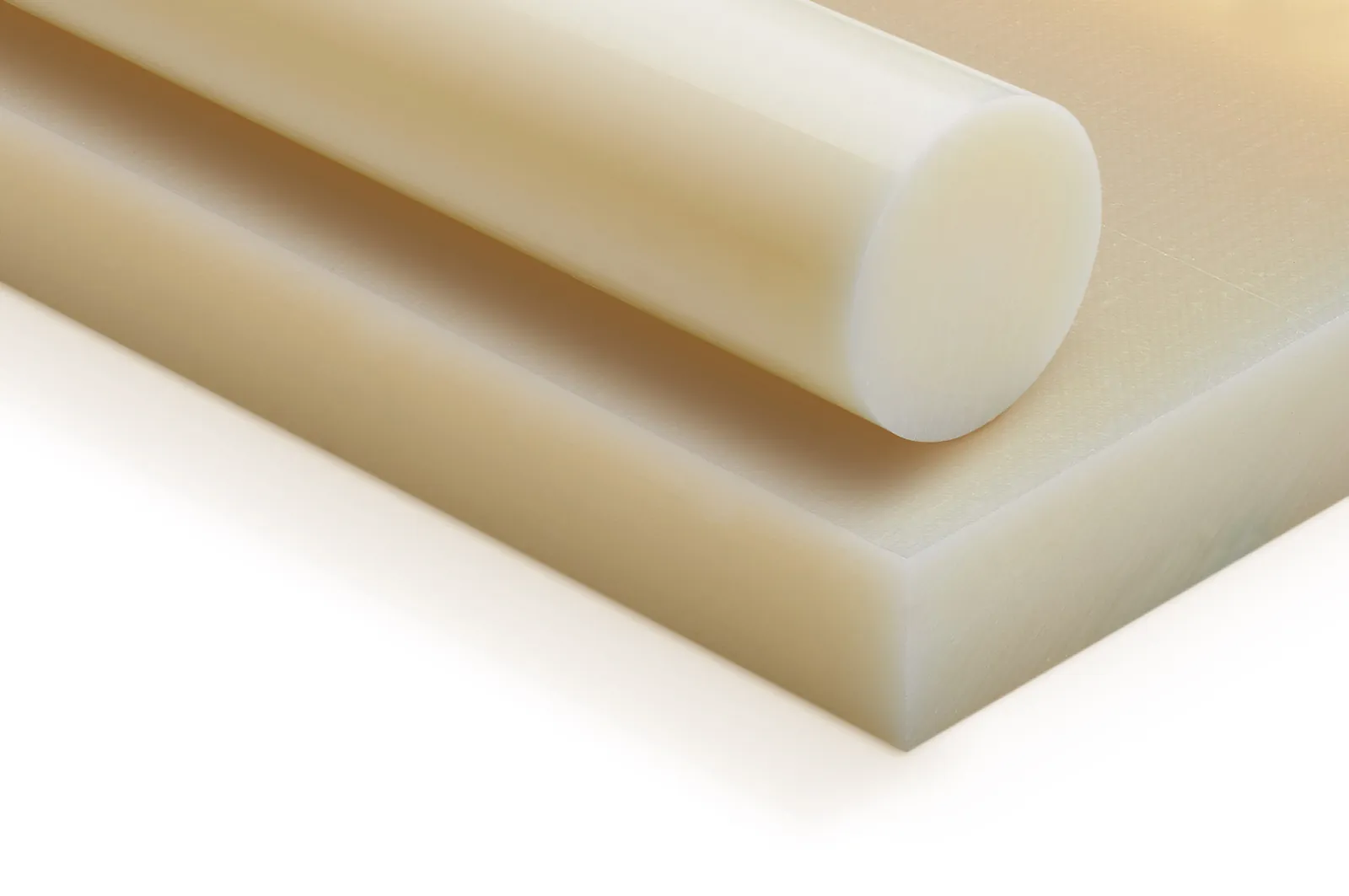
PA6 GF30 is available in various semi-finished product forms and is suitable for the manufacture of individual components to drawing or dimensional specification. The choice of the suitable delivery form depends on the planned use and the subsequent machining.
Sheet material
PA6 GF30 sheets are used for flat, structural components. They allow precise machining by cutting and offer high dimensional stability even with larger dimensions.
Rods
Rods made of PA6 GF30 are suitable for turned components such as bushes, rollers or bearing components. The glass-fibre reinforcement ensures uniform stiffness across the entire cross-section.
Cut pieces to size
Depending on the requirement, sheets and rods can be cut to exact size. This gives you material-appropriate cut pieces that can be processed further directly.
Further information on polyamide semi-finished products can be found on the page PA6 plastic.
Typical advantages of PA6 GF30 in industrial use
Compared with many unreinforced plastics, PA6 GF30 offers clear advantages for industrial use. The material is used specifically where structures are to be durably loadable, dimensionally stable and economically realisable.
High load capacity at low weight
Thanks to the glass-fibre reinforcement, PA6 GF30 achieves high strength while at the same time weighing significantly less than metallic materials. As a result, moving components can be made lighter and mechanical systems designed more efficiently.
Corrosion and media resistance
PA6 GF30 is suitable for environments in which metallic materials reach their limits due to corrosion. The material shows stable resistance to moisture, oils and many industrial media.
Economic alternative to metal
In many applications, PA6 GF30 replaces aluminium or steel. The combination of easy machinability, dimensional accuracy and material properties reduces production effort and overall costs.
An overview of alternative polyamide materials can be found on the page PA6 plastic.
Limits and notes on material selection
PA6 GF30 is suitable for many highly loaded applications, but requires a material-appropriate selection. The glass-fibre reinforcement influences certain properties that should be taken into account in design and use.
Impact strength and notch sensitivity
Compared with unreinforced PA6, PA6 GF30 has lower impact strength. Localised or impact-type loads have a greater effect on the component, particularly with sharp edges or notches.
Anisotropic material behaviour
Due to the orientation of the glass fibres, the mechanical behaviour can be direction-dependent. For load-bearing components, a structural design that specifically takes this property into account is recommended.
Surface character
The surface of PA6 GF30 shows a technically characterised structure with visible glass fibres. The material is less suitable for visually demanding applications, but for functional industrial components this is not a disadvantage.
For applications with higher toughness or visual requirements, PA6 plastic without glass-fibre reinforcement may be the more suitable choice.
Selection aid: When is PA6 GF30 the right choice?
PA6 GF30 is particularly suitable for applications in which high mechanical strength, stiffness and dimensional accuracy are the focus. The material selection should always be based on the actual loads and the functional requirements.
Suitable for static and continuous load
PA6 GF30 is recommended for components that are mechanically loaded over long periods. The reduced creep behaviour ensures a stable component geometry and reliable function in continuous operation.
Suitable as a metal replacement
If weight is to be reduced or corrosion resistance achieved, PA6 GF30 represents a practically proven alternative to aluminium or steel. Typical fields of application are load-bearing structural elements and functional structural components.
Check alternative materials
For applications with high impact stress, increased toughness or visual requirements, other polyamide variants are better suited. A comparison of the properties facilitates the selection.
An overview of the available polyamide materials can be found on the page PA6 plastic.
Frequently asked questions about PA6 GF30
What does PA6 GF30 mean?
PA6 GF30 designates a polyamide 6 with a glass-fibre content of 30 percent. The glass-fibre reinforcement significantly increases strength, stiffness and dimensional accuracy.
What is PA6 GF30 particularly suitable for?
PA6 GF30 is suitable for highly loaded components in mechanical engineering, automation technology and vehicle construction. The material is used when high dimensional stability and fatigue strength are required.
Can PA6 GF30 replace metal?
PA6 GF30 is frequently used as a replacement for aluminium or steel. The material offers high strength at lower weight and shows good resistance to corrosion.
How can PA6 GF30 be machined?
PA6 GF30 can be sawn, milled and drilled. Wear-resistant tools support clean machining, as the glass fibres cause increased tool abrasion.
What differences are there compared with unreinforced PA6?
PA6 GF30 offers higher stiffness, better dimensional accuracy and lower creep behaviour. Unreinforced PA6 is more suitable for applications with higher toughness.
Is PA6 GF30 suitable for precise components?
PA6 GF30 is very well suited to precise components. The glass-fibre reinforcement supports tight tolerances and a stable component geometry in continuous operation.