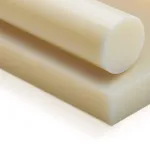
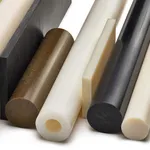
This image was created with artificial intelligence – marked under Art. 50 of the AI Act, Regulation (EU) 2024/1689. It is a placeholder until the company's photos arrive.
Melamine resin (MF)
What are melamine resins (MF)? Everything about the properties, advantages, resistance and typical applications of melamine resin.
Melamine resins belong to the group of thermosets
Melamine resin is a thermosetting plastic based on melamine-formaldehyde resins. The material is characterised by high surface hardness, temperature resistance and chemical resistance and is used primarily where dimensionally stable, electrically insulating and wear-resistant components are required.
In the cured state, melamine resin remains permanently dimensionally stable. Thermal deformation after processing practically does not occur. This makes the material suitable for precise technical applications in which constant properties are required over long service lives.
Melamine resin is typically used as a moulding compound or as a resin-bonded composite material, for example in combination with cellulose or glass fibres. Within the thermosets material group, melamine resin occupies a position between phenolic resins and epoxy resins.
Properties of melamine resin
Melamine resin has a clearly defined property profile that is designed for high mechanical load capacity, thermal stability and good electrical insulation values. This combination makes the material suitable for technical applications with constant requirements.
Mechanical properties
The surface of melamine resin is hard, scratch-resistant and low-wear. The material exhibits high compressive strength as well as good dimensional stability under continuous load. Impact strength and elasticity are at a lower level compared with thermoplastic plastics.
Thermal properties
Melamine resin remains dimensionally stable even at elevated temperatures. Temperatures up to around 160 °C are possible for short periods. Subsequent softening does not occur due to the thermosetting cross-linking.
Electrical properties
The material acts as an electrical insulator and exhibits high dielectric strength. This makes melamine resin suitable for components in the field of electrical engineering and for applications with increased requirements for electrical safety.
Compared with phenolic resin, melamine resin offers higher surface hardness as well as better colour stability.
Areas of application for melamine resin
Melamine resin is used in technical applications in which dimensionally stable, hard and chemical-resistant components are required. The material is particularly suitable for serial industrial products with constant load profiles.
Electrical engineering and electronics
Due to its good electrical insulating properties, melamine resin is used in switches, connectors, insulating bodies and housing parts. The high temperature resistance supports safe operation under continuous electrical load.
Mechanical and plant engineering
In mechanical engineering, melamine resin is used for covers, spacers, moulded parts and technical components where dimensional accuracy and wear resistance are required.
Furniture and interior fitting
As a resin-bonded material, melamine resin is used in coated sheets, laminates and surfaces with high scratch and abrasion resistance. The focus is on functional surfaces for industrial and commercial use.
For applications with higher chemical or thermal requirements, epoxy resin can be used as an alternative.
Processing and production of melamine resin
Melamine resin is produced as a thermosetting material in a chemical reaction process and then processed under pressure and temperature into dimensionally stable components. After curing, a permanently cross-linked material is present.
Production of the resin
The basis is the polycondensation of melamine and formaldehyde. Depending on the area of application, the resulting resin is combined with fillers, reinforcing fibres or pigments in order to achieve specific properties.
Shaping and curing
Processing typically takes place in a pressing process. Under defined temperature and high pressure, the material cures completely. Subsequent reshaping or thermal adjustment is not possible after curing.
Machining after shaping
Mechanical machining such as drilling, milling or grinding is possible to a limited extent and requires adapted tools. Due to the high hardness of the material, dimensional accuracy is clearly the priority.
Compared with thermoplastics, the processing of melamine resin is less flexible, but offers a permanently stable material structure.
Advantages and limitations of melamine resin
Melamine resin offers a clearly defined performance profile. The material is suitable for applications with stable framework conditions and constant requirements.
Advantages
- High surface hardness and good abrasion resistance
- Permanent dimensional and shape stability after curing
- Good temperature resistance in the technical application range
- High electrical insulating effect
- Good resistance to many chemicals
Limitations
- Low impact strength compared with elastic plastics
- Brittle material behaviour under point loading
- Limited post-processing after curing
- One-time shaping without subsequent adjustment options
For applications with higher mechanical load or increased impact stress, alternative materials such as polyamide are suitable.
Distinction from comparable plastics
Melamine resin is often assessed in the context of other thermosetting and engineering plastics. The following classification supports material-appropriate selection depending on the requirement.
Melamine resin and phenolic resin
Compared with phenolic resin, melamine resin exhibits higher surface hardness as well as better colour and light stability. Phenolic resins, in turn, offer advantages at higher continuous service temperatures and in mechanical load capacity.
Melamine resin and epoxy resin
Epoxy resin achieves higher mechanical values and better adhesion to substrates. Melamine resin, on the other hand, scores with economical processing in near-series applications with constant loads.
Melamine resin and thermoplastics
Compared with thermoplastics, melamine resin offers higher temperature and dimensional stability. Thermoplastics, in turn, enable flexible reshaping, higher toughness and simpler post-processing.
Summary and decision-making aid
Melamine resin is suitable for industrial applications with clearly defined requirements for dimensional stability, surface hardness and electrical insulation. The material offers a permanently stable material structure and proves itself above all in near-series application scenarios.
Melamine resin is particularly recommended when constant mechanical and thermal loads are present and subsequent reshaping of the component is not required. For applications with varying loads or increased impact stress, alternative plastics should be considered.
In overall comparison, melamine resin positions itself as a technically reliable thermosetting material between classic phenolic resins and higher-performance epoxy resins. The decision should always be made on the basis of the specific application conditions.
Further technical materials and classifications can be found in the Plastics section.
Frequently asked questions about melamine resin
What is melamine resin?
Melamine resin is a thermosetting plastic based on melamine-formaldehyde. After curing, a permanently dimensionally stable, hard and chemical-resistant material is formed.
Is melamine resin heat-resistant?
Melamine resin remains dimensionally stable even at elevated temperatures. Temperatures up to around 160 °C are technically usual for short periods.
Is melamine resin electrically insulating?
The material has good electrical insulating properties and a high dielectric strength. This makes it suitable for applications in electrical and device engineering.
Can melamine resin be reshaped subsequently?
After curing, melamine resin remains permanently cross-linked. Subsequent thermal reshaping is not technically intended.
How does melamine resin differ from phenolic resin?
Compared with phenolic resin, melamine resin offers higher surface hardness as well as better colour and light stability.