Food industry
Plastic parts for the food industry to drawing. Guides, slide sheets, rollers and components made from PE, POM-C, PTFE, PEEK and silicone.
Plastic parts for the food industry
In the food industry, hygienic, wear-resistant and reliably machined components are required. We manufacture plastic parts for the food industry that are designed for good cleanability, moisture resistance, long service lives and safe production processes. Depending on the application, these become guides, slide plates, covers, rollers, cutting boards and other technical components for processing, conveyor technology and packaging.
Why plastics are used in the food industry
Plastic components in the food industry are used wherever hygiene, corrosion resistance and low-wear operation play an important role.
Compared with many metallic materials, suitable engineering plastics do not rust. They can also offer low coefficients of friction, good sliding properties and high resistance to moisture.
Typical advantages are:
- good cleanability
- resistance to moisture
- low friction
- good wear resistance
- low component weight
- electrical insulation
- corrosion-free materials
- good machinability
- individual production to drawing
Which properties are actually achieved depends on the particular plastic, the specific material grade and the operating conditions.
Typical plastic parts for food machinery
Technical plastic parts are used in virtually all areas of food processing.
Typical components are:
- guide rails
- slide plates
- sliding guides
- rollers
- bushes
- spacers
- stops
- holders
- cutting boards
- mounting elements
- covers
- protective parts
- carrier plates
- distance rings
- gears
- fixture parts
Many of these components are manufactured individually to drawing or CAD data.
Our plastic milled parts can be used to produce, for example, guides, plate components, holders and complex contours.
Rotationally symmetrical components such as bushes, rollers or distance rings can be manufactured as plastic turned parts.
What requirements must plastic parts in the food industry meet?
The requirements differ considerably depending on the production process.
For a guide within a conveyor system, for example, wear and sliding properties are the main focus. For a cover, on the other hand, cleanability and moisture resistance can be decisive.
Particularly often relevant are:
Good cleanability
Components in food-adjacent areas must be designed so that contamination can be removed as easily as possible.
In addition to the material, the design also plays a role. Edges, undercuts or hard-to-reach areas can make cleaning more difficult.
Moisture resistance
Production systems are often cleaned regularly. Components can therefore come into permanent or repeated contact with water, cleaning agents or high humidity.
Wear resistance
Guides, slide plates and rollers are often exposed to permanent movement. A suitable plastic can reduce friction while at the same time enabling long service lives.
Chemical resistance
Depending on the operation, various cleaning and disinfecting agents are used for cleaning.
Resistance must therefore always be tested against the specific medium used.
Temperature resistance
In addition to normal production, cleaning processes or warm foods can also cause higher temperatures.
The permissible temperature range of the material must match the application.
Which plastics are suitable for the food industry?
Various plastics are available for technical components. Which material is suitable depends on load, temperature, cleaning, friction and, where applicable, direct food contact.
PE 1000
PE 1000 is often used when good sliding properties and high wear resistance are required.
Typical applications are:
- guide rails
- slide rails
- slide plates
- conveyor technology
- chain guides
- supports
- components subject to wear
The low coefficient of friction makes PE 1000 particularly interesting for moving applications.
PE 500 and PE 300
Other polyethylene types can also be used in the food industry.
PE 500 offers good wear properties and can be used, for example, for mechanically stressed components.
PE 300 is particularly suitable for simpler structural components where high wear resistance is not the main focus.
POM-C
POM-C is often used for precise technical components.
The material offers:
- good dimensional stability
- high strength
- good sliding properties
- good machinability
- low moisture absorption
Typical applications are bushes, guides, rollers, holders and precise functional parts.
POM-C is particularly suitable where tight tolerances or higher mechanical loads are required.
Polypropylene
Polypropylene offers good chemical resistance and low moisture absorption.
The material is used, for example, for:
- container components
- covers
- sheets
- structural parts
- chemically stressed components
Which cleaning agents and temperatures are permissible in the long term must be tested for the specific application.
PTFE
PTFE is characterised by very low friction and very high chemical resistance.
Typical applications are:
- sliding elements
- sealing components
- guides
- chemically stressed components
- bearing and insulation elements
However, PTFE is considerably less rigid than POM-C, for example. For highly loaded components or those requiring particularly high dimensional stability, it must therefore be carefully checked whether the material is structurally suitable.
PEEK
PEEK is used when particularly high requirements are placed on temperature resistance, mechanical load capacity or chemical resistance.
The high-performance plastic is suitable, for example, for heavily stressed components where classic engineering plastics reach their limits.
Due to the higher material costs, PEEK is generally used specifically for technically demanding applications.
Silicone sheets in the food industry
In addition to thermoplastic plastic parts, elastic materials are also required in the food industry.
Silicone sheets can be used, for example, for elastic intermediate layers, supports, seals, protective layers or temperature-stressed applications.
Silicone is characterised in particular by its elasticity and its comparatively high temperature resistance.
Here too, the following applies: if a component has direct food contact, the specific silicone grade must be suitable for this use and documented accordingly.
Materials compared
| Requirement | Often suitable materials |
|---|---|
| Good sliding properties | PE 1000, POM-C, PTFE |
| High wear resistance | PE 1000, POM-C |
| High dimensional stability | POM-C, PEEK |
| High chemical resistance | PTFE, PEEK, PP |
| High temperature resistance | PEEK, PTFE |
| Elastic components | Silicone |
| Guides and slide rails | PE 1000, POM-C |
| Precise functional parts | POM-C, PEEK |
This assignment serves as guidance. The specific operating conditions must always be taken into account for material selection.
What does food-compliant plastic mean?
Not every plastic of a particular material group is automatically suitable for direct food contact.
What is decisive is the specific material grade or the specific semi-finished product and its documented conformity.
In the case of direct food contact, requirements from European regulations for food contact materials, among others, may be relevant.
A blanket statement such as "POM is food-safe" or "PE is always approved for food" would therefore not be sufficient.
Before production, the following should be clarified:
- Is there direct food contact?
- Which foods does the component come into contact with?
- How long does the contact last?
- What temperatures occur?
- Which cleaning media are used?
- Which certificates are required?
Only on this basis can a suitable material grade be selected.
Direct and indirect food contact
For material selection, it is important whether a component actually comes into contact with foods.
For direct contact surfaces, the regulatory requirements are generally higher than for components that are used exclusively inside a machine and have no food contact.
However, indirect or possible contact can also be relevant.
This information should therefore be provided already at the enquiry stage.
Wear and friction in conveyor systems
Conveyor technology is one of the most important areas of application for engineering plastics in the food industry.
Guides, slide rails and supports are often in permanent contact with chains, belts, containers or products.
Here, materials such as PE 1000 can play to their strengths.
Low friction can:
- reduce drive forces
- reduce noise
- minimise wear
- support uniform movements
- increase service lives
For more precise mechanical components, on the other hand, POM-C may be the better choice.
Cleaning and chemical resistance
In food operations, machines and systems must be cleaned regularly.
Depending on the production area, different media are used.
For material selection, the following are therefore particularly relevant:
- cleaning agents
- disinfectants
- acids
- alkalis
- fats and oils
- temperature
- concentration
- exposure time
The chemical resistance of a plastic should always be tested for the specific medium.
A material may be resistant to a cleaning agent at room temperature but be attacked considerably more at elevated temperature.
Design suitable for plastics
When designing components for food machinery, the special properties of engineering plastics should also be taken into account.
Relevant factors include:
- thermal expansion
- moisture absorption
- wall thicknesses
- fits
- tolerances
- bolted connections
- threads
- mechanical loads
- cleaning-friendly geometries
Tolerances from metal designs should not automatically be transferred to plastic components.
A design suitable for plastics can improve both the function and the cost-effectiveness of the component.
CNC plastic parts for the food industry
With plastic machining, individual components can be produced directly from semi-finished products.
CNC machining is particularly suitable for:
- individual parts
- prototypes
- spare parts
- small series
- series components
- special designs
- variants of existing components
Contours, pockets, grooves, holes and threads, among other things, can be produced.
In contrast to injection moulding, no mould is required for this. This makes machined plastic parts particularly interesting for individual geometries and smaller quantities.
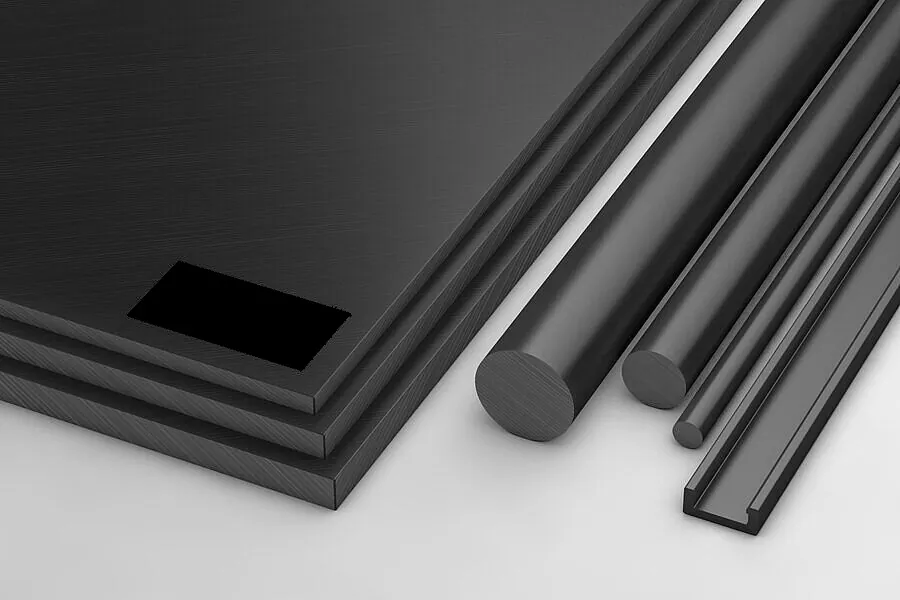
Plastic sheets as starting material
Many components for food machinery are manufactured from engineering plastic sheets.
Plate material is used to produce, for example:
- slide plates
- cutting boards
- guides
- mounting plates
- carrier plates
- covers
- supports
- machine protection parts
The sheets can first be cut to size and then adapted to the desired geometry by milling, drilling or further machining steps.
Having plastic parts manufactured to drawing
For the production of customised components, technical information should be provided as completely as possible.
This includes:
- drawing or CAD file
- dimensions
- tolerances
- quantity
- desired material
- service temperature
- mechanical load
- cleaning media
- contact with foods
- required material certificates
If the material has not yet been specified, details on load, temperature, friction and cleaning in particular help with the preliminary selection.
Frequently asked questions about plastic parts for the food industry
Which plastics are used in the food industry?
Frequently used materials include PE 1000, PE 500, PE 300, POM-C, PP, PTFE and PEEK. Silicone can also be relevant for elastic components. The specific material choice depends on the application, load, cleaning and food contact.
Is every PE or POM plastic food-safe?
No. What is decisive is not the material group alone, but the specific material grade and its conformity certificate for the intended food contact.
Which plastic is suitable for guide rails?
PE 1000 is often used for guide rails and slide rails. Where there are higher requirements for dimensional stability and mechanical strength, POM-C can be a suitable alternative.
Which plastics are suitable for high temperatures?
PEEK and PTFE, among others, are options for high temperature loads. Suitable silicone grades can be used for elastic components. The permissible temperature range must be tested for the specific material in each case.
Can plastic parts be manufactured individually to drawing?
Yes. Milled and turned parts can be manufactured to technical drawings or CAD data. Individual parts, prototypes, spare parts as well as small and series production are possible.