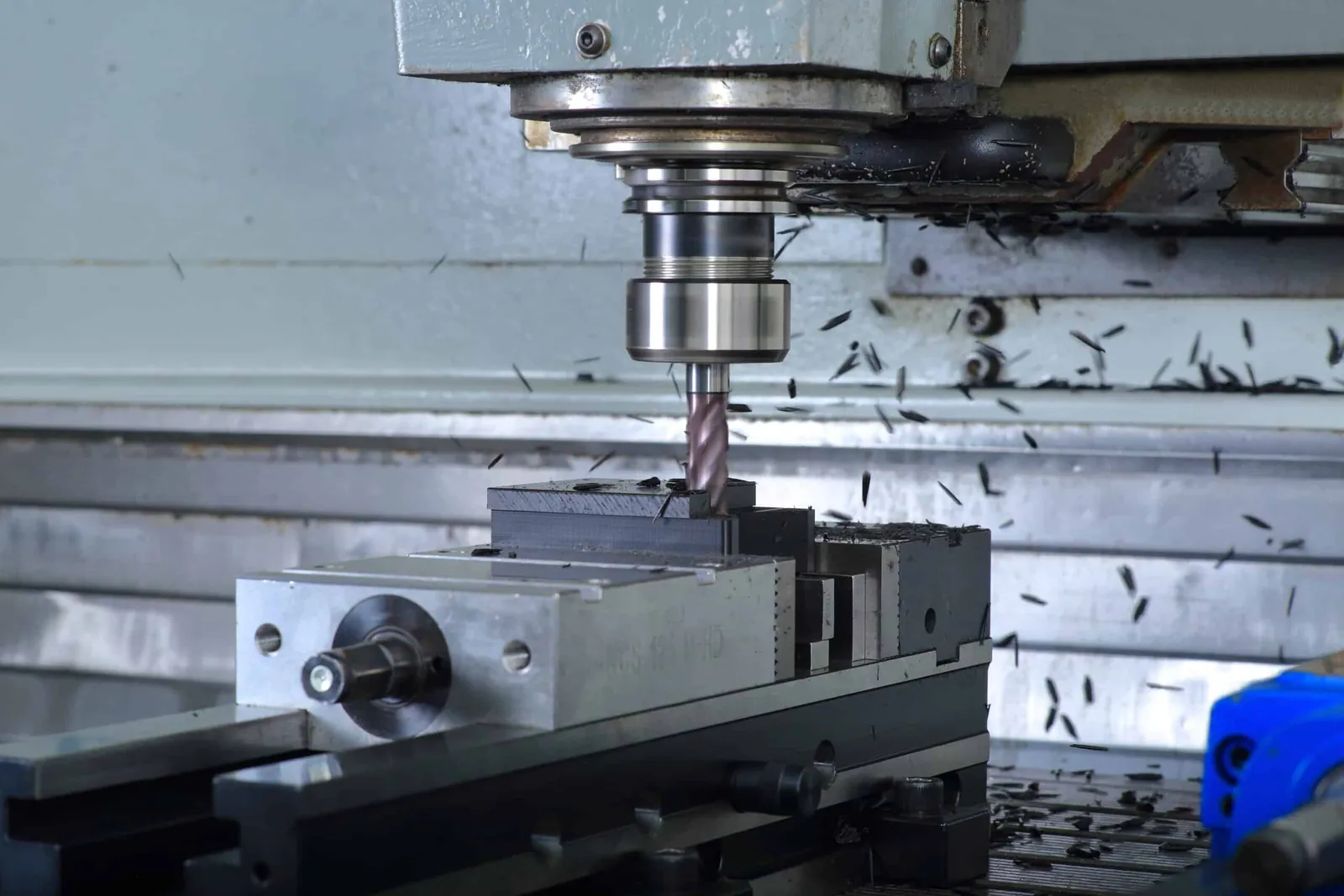
This image was created with artificial intelligence – marked under Art. 50 of the AI Act, Regulation (EU) 2024/1689. It is a placeholder until the company's photos arrive.
CNC machining
High-quality CNC manufacturing for precisely fitting turned and milled parts. Benefit from innovative technology and reliable machining.
What is CNC machining
(Computerized Numerical Control) is a precise manufacturing process that uses computer-controlled machines for the machining of materials such as metal, plastic or wood. In this process, blanks are brought into the desired shape by milling, turning, drilling or grinding.
This process is characterised by high accuracy, repeatability and efficiency and is used in many branches of industry such as aerospace, automotive production or medical technology.
This is CNC milling
CNC milling
is a machining process for producing geometrically defined blanks. As with all cutting processes, the material is removed from the workpiece in the form of chips.
During milling, the raw material is removed with a milling tool. The milling instrument rotates at high speed around its axis, while either the tool is pushed towards the contour to be machined or the workpiece is moved accordingly.
This feed motion runs perpendicular or at an angle to the rotational axis of the tool during CNC milling; during turning, the workpiece rotates around its axis while the tool travels over the contour.
CNC milling is used in particular for producing flat surfaces. These include guides or grooves for moving machine parts. However, modern milling machines can also produce complex three-dimensional shapes such as dies or turbine blades.
CNC milling has some characteristics compared with other machining processes. During milling, individual cutting edges do not always come into contact with the workpiece.
In one revolution, they penetrate the material, remove chips in the process and then detach from the workpiece again. In the literature, this property is referred to as an interrupted section. This leads to strong fluctuations in the cutting force acting on the tool.
The chip thickness changes during the reversal and, as with most processes, is not constant. Therefore, blades that do not come into contact with the workpiece are cooled and therefore do not heat up as much. In addition, due to the interrupted cut, chips break in the form of a comma, which cannot become caught in the machine.
Therefore, no separate measures for chip breaking are required.
How are CNC milled parts produced?
are machined on CNC milling machines with rotating tools. CNC milling machines with different degrees of freedom of movement are used: milling machines with 3, 4 and 5 axes.
3-axis milling machines can machine CNC milled parts in only one direction. They are cheaper than other types of milling machines. 4-axis milling machines have an additional rotary axis for the milled part, for example for producing spindles and different helical geometries. Depending on the setup, 5-axis milling machines can machine CNC milled parts on all sides and produce complex geometric shapes.
Thanks to modern and efficient milling technology, precise parts can be produced. Here too, milling machines process various materials, whether plastic, metal or special materials. You will find various examples of the CNC milling of materials such as metal, beech wood or acrylic glass. CNC application in metal variants such as brass, aluminium and even steel and stainless steel is also possible.
CNC milling in focus
CNC milling is one of the main applications of CNC machines. Various machining processes, such as climb milling and conventional milling, are used in a range of applications. There are many such examples that have been implemented on CNC milling machines.
Discover the countless possibilities for gantry milling machines from the large range of machine tools.
CNC milling: processes and advantages
How does CNC milling work?
During CNC milling, a milling tool rotates at high speed and removes material from the workpiece. A distinction is made between
3-, 4- and 5-axis milling machines
, which differ in their machining options:
- 3-axis milling: movement along the X, Y and Z axes, suitable for simple geometries.
- 4-axis milling: additional rotary movement for more complex contours.
- 5-axis milling: high-precision machining for complex components in a single setup.
Advantages of CNC milling
✔ High precision and repeatability ✔ Processing of different materials (metal, plastic, wood) ✔ Fast production of prototypes and series parts ✔ Automated production reduces errors and rejects
Materials for CNC milling
| Material | Properties | Areas of application |
|---|---|---|
| Aluminium | Light, corrosion-resistant | Automotive, aerospace and medical technology |
| Stainless steel | High strength, heat-resistant | Mechanical engineering, medical technology |
| Plastics (POM, PA, PTFE) | Light, wear-resistant | Prototype construction, electronics |
| Brass | Good conductivity, corrosion-resistant | Electronics, automotive construction |
CNC milling vs. other manufacturing processes
| Process | Advantages | Disadvantages |
|---|---|---|
| CNC milling | High precision, versatile | Material loss through chips |
| Laser cutting | Very fine cuts, fast machining | Not suitable for all materials |
| 3D printing | Complex geometries possible | Less robust than milled parts |
Milling machine for combined metalworking
The production of metal pieces is one of the most common applications for CNC milling machines worldwide. Some areas of application include, for example, the machining of the front panel, the production of parts for model railways or the industrial production of control cabinets.
Regardless of whether aluminium, brass or even steel and stainless steel are processed. Reliable and stable gantry milling machines machine these metals with the same precision as milling on wood or plastic. For this reason, metalworking often requires a model from the cost-effective High-Z T series, since the selected motion paths for this CNC milling series almost always cover the machining of the material size intended by the user.
Anyone who mainly wants to cut sheet metal should familiarise themselves with a plasma cutter. In this case, the milling machine takes over the function of plasma cutting, but can be reused at any time as a milling, engraving and embossing machine.
Difference between plasma cutting and milling
The difference between plasma cutting and milling certain steel sheet shapes lies mainly in the quality of the edges. Plasma cutting produces clean edges that do not need to be machined. CNC milling always leaves burrs on the edges of thicker sheets, which must subsequently be removed.
A good example of combined use is picture blocks. They often have to be provided not only with milled recesses but also with lettering. The milling machine carries out both material handling operations with one CNC program. And only on one machine.
CNC milling machines
Operating a CNC milling machine does not require constant support, as these machines carry out their work completely independently. For this reason, very few employees are still employed on these devices. Even quality control is carried out by it.
The CNC system offers a wide range of possibilities that can integrate the entire production process. The monitoring of tool breakage and wear is also fully automatic and independent. In principle, any machine can be converted into a CNC milling machine by adding standardised components.
The milling machine is a multifunctional tool that is used in a wide variety of craft businesses as well as in industry. As a rule, drilling and universal tool milling machines are used. This is one of the most complex machines used nowadays for processing a wide variety of materials. These include, for example, metals, various types of wood and various plastics. In addition, it works with rotating cutting tools and can therefore process materials of various shapes.
CNC milling machines or milling machines are comparable to drills, but since they operate in three different feed directions, extremely large materials can also be milled without difficulty. In addition to machining very large materials, these machine types can also handle simple tasks such as friction or drilling.
A simple milling machine is used with a CNC milling table, which is used both horizontally and vertically. The milling head on it is movable, which enables various applications. Inclined tables are also used, but these are normally used only for CNC milling. When working on inclined surfaces, two milling heads must be set to their angle. Computer tables also make working with the CNC milling machine easier. Table milling machines are used exclusively for machining wood shapes.
Nowadays, a CNC machining centre is often used, a complete machining machine that has an extended range of CNC milling machines that can handle the drilling of deep holes as well as the cutting of gears.
CNC milling units
As a rule, you will find a milling machine in various workshops and factories that corresponds to the type of CNC universal milling machine. Thanks to the corresponding design, it is divided into bed-type, console and special milling machines. The universal tool milling and drilling machine is part of the console milling machines and offers the user the possibility of expansion. This milling machine type is equipped with a vertical and horizontal milling spindle. The console is located in the front part of the machine and extends in the vertical direction. The machine table, however, is used horizontally. The milling machine is driven by its motor, which supplies the milling operation with feed. However, the precise settings of this system must be made manually.
With normal CNC milling, it is also possible to control the milling machine with cranks or automatic feeds. The dimensions are read from the so-called verniers, which are attached to the arms. At the same time, almost every productive milling machine is equipped with an optoelectronic position measuring system.
CNC milling – modern and fast
The production of precision parts is one of the most everyday tasks. CNC milling machines of the latest generation are used for this. Modern and powerful CNC milling operations are excellent and are characterised by speed, accuracy and above all flexibility. In order to be able to manufacture components without moulds and finished parts, CNC millers rely on modern work tasks with a computer-controlled milling machine. Most current work areas are equipped with powerful 5-axis milling machines.
Through material removal, the milling machines form the components you need. They leave production only when they meet the highest requirements placed on the task and the machines. Thanks to the considerable speed that the milling machines can achieve and realise, materials such as stainless steel are also optimally processed with CNC milling. In this way, CNC millers can not only accept complex orders but also respond individually to requirements.
CNC TURNING
CNC turning
is, alongside CNC milling, drilling and grinding, one of the most important technological machining processes. As with all these processes, the chips are separated from the workpiece in order to obtain the desired shape. During turning, the workpiece rotates – it is the rotating part – around its axis, while a cutting tool – the turning tool – travels along the contour to be created.
The machine required for CNC turning is a lathe; there is no manual option. Since with turning tools all corners and radii of the cutting edge are known, CNC turning refers to a machining group with a geometrically defined cutting edge, which also includes drilling and milling. In principle, all machinable materials can be turned.
CNC turning is divided into numerous machining options. In addition to flat and cylindrical turning for producing flat or round surfaces, there are options for thread cutting or for any rotationally symmetrical shapes (such as cones or spheres) that can be produced by means of CNC turning. CNC lathes are used, whose CNC control guides the tools along the desired paths.
With the CNC turning process, individual prototypes and production parts for final use can often be produced in just one working day. During turning, a CNC lathe uses tools for producing axial and radial bores, face surfaces, grooves and slots.
This is how the process works in CNC turning
During CNC turning, the bar stock rotates. The cutting tool is pressed against the workpiece in order to remove material and produce finished parts. During CNC turning, a lathe with a power tool produces work parts in a short time. It is also possible to produce threads based on outside diameter (OD) and inside diameter (ID). The machined parts can then be left in the machined, unmachined state with the markings of the tool used or machined with balls. At the end of the production cycle, the workpieces are briefly inspected, packaged and dispatched.
CNC turning and machining
CNC turning is best suited for prototyping, testing and setting up moulds, accessories and functional parts for final use. There are hundreds of CNC lathes and milling machines that produce all parts at high speed on time and ahead of time.
Rotating parts in CNC turning – How are parts produced in CNC turning?
are created on CNC lathes with the rotational movement of the workpiece in combination with the translational movements of the tool. CNC turning offers a high degree of material removal and is therefore very economical. In contrast to CNC milling, the tool is constantly engaged during CNC turning and is not subject to intermittent cutting conditions. In addition, CNC lathes are mechanically constructed and therefore cost less than milling machines with the same capacity and the same dimensions. In addition to clean lathes, combination machines with driven tools and milling spindles are often used. With such turning and milling machines, complete machining of workpieces in a single setup is possible.
CNC turning: how it works and applications
During
CNC turning
, the workpiece rotates around its own axis while a stationary cutting tool removes material. This process is particularly suitable for rotationally symmetrical components such as shafts, bushes or screws.
Advantages of CNC turning
✔ High material removal, ideal for series production ✔ Very good surface quality ✔ Efficient production of rotationally symmetrical parts ✔ Combination with milling possible (turn-mill centres)
CNC programming and control
The CNC machines are programmed by means of
G-code
, which controls movements, feeds and tool changes. Modern machines can be programmed directly from
CAD drawings (Computer-Aided Design)
, whereby production runs automatically and without errors.
Example of a simple G-code:
CNC lathe – the more precise definition
A CNC lathe is a CNC machine and a lathe at the same time, that is, a rotating machine in which the movements of the tool are directed by numerically stored programs. Most CNC machines, in contrast to NC lathes, have a program memory and an interface via which CAD drawings are read and encoded.
Computerised means that the processing information can be read into the control memory and used again and again for machining without further information being provided. Numerical states that all control settings are transmitted in encrypted digital form and are constantly compared with control devices in the workflow during CNC turning:
- Tool position and speed
- Speed and position of the workpiece and the main spindle
- Coolant supply
- Material supply / bar loader
- Programming of the CNC machine
- Before machining the workpiece with the CNC machines, it is important to encode the required CNC program. Programming is done either directly in the workshop at the machine, via a data carrier or using a special network. The programming procedure always follows the DIN standards, in this case standard 66025. The program is started with O and "xxxx" or % and "xxxx". The "x" are replaced by numbers in the workflow. Information about the tool number, the spindle speed and the direction is created in a process line.
Tools
There are many tools for CNC turning and for almost all common operations. The most important work aids are various indexable inserts for machining round or square material as well as drills and taps.
More on the subject of toolmaking
For some years now, there have even been power tools with which, for example, milling or engraving can also be carried out on conventional CNC lathes. Special measuring tools for measuring produced parts are also worth mentioning. One of the most important features of a CNC machine is the possibility of using several different tools for different machining operations in one work step without workshop setups having to be re-equipped during a work step. Even on simpler machines, you can program up to 99 tools.
However, the disadvantage of such devices is often a lack of space in the machine's working area, so that often no more than four or five tool holders can be used. Special machines (CNC with turret heads, machining centres) can place up to 50 tools in already installed holders.
Areas of application of CNC machining
CNC technologies are indispensable in various industries:
- Automotive industry: engine components, chassis elements
- Aerospace: high-precision aluminium and titanium components
- Medical technology: implants, surgical instruments
- Mechanical engineering: housings, shafts, precision components
Practical example: manufacturing process of a component
- Create CAD model (e.g. with AutoCAD, SolidWorks)
- CAM programming (translation into G-code)
- CNC milling/turning (automatic machining)
- Quality control (checking for dimensional accuracy)
- Surface treatment (e.g. polishing, anodising)
FAQ – Frequently asked questions about CNC machining
What does CNC machining cost?
The costs depend on material, geometry and quantity. Simple aluminium parts cost a few euros, while complex stainless steel parts are more expensive.
What tolerances are possible?
High-precision CNC machines achieve tolerances in the
micrometre range
(0.001 mm), depending on material and process.
What is the difference between CNC milling and CNC turning?
During
milling
, the tool moves, the workpiece remains fixed. During
turning
, the workpiece rotates while the tool remains stationary.