CNC machining of engineering plastics: precision and efficiency
Learn all about the CNC machining of engineering plastics: precision manufacturing, tight tolerances, fast implementation – ideal for prototypes, individual parts and small batches.
CNC machining has established itself as a precise and economical method for processing engineering plastics. In many industrial sectors, it is increasingly replacing conventional machining processes, as it offers outstanding accuracy, repeatability and flexibility. The potential of this technology is particularly evident with complex geometries, tight tolerances or small batch sizes. Companies benefit from short delivery times, high quality and economical production – without costly tools or long set-up times.
Here you can order your CNC parts online
Engineering plastics such as POM, PA, PE or PTFE can be processed with CNC machines not only to fit precisely, but also particularly efficiently. The ability to produce prototypes, one-offs and small series quickly and precisely makes CNC machining a key technology in modern plastics processing. In this article you will gain a well-founded insight into the CNC machining of engineering plastics, get to know suitable materials and find out why this method outperforms classic processes in many applications.
What is CNC machining?
CNC stands for "Computerized Numerical Control" and describes the computer-aided control of machine tools. A control system – based on digital CAD/CAM data – takes over the exact execution of all movements and machining steps. This produces components that can be manufactured with high precision and, if required, reproduced identically.
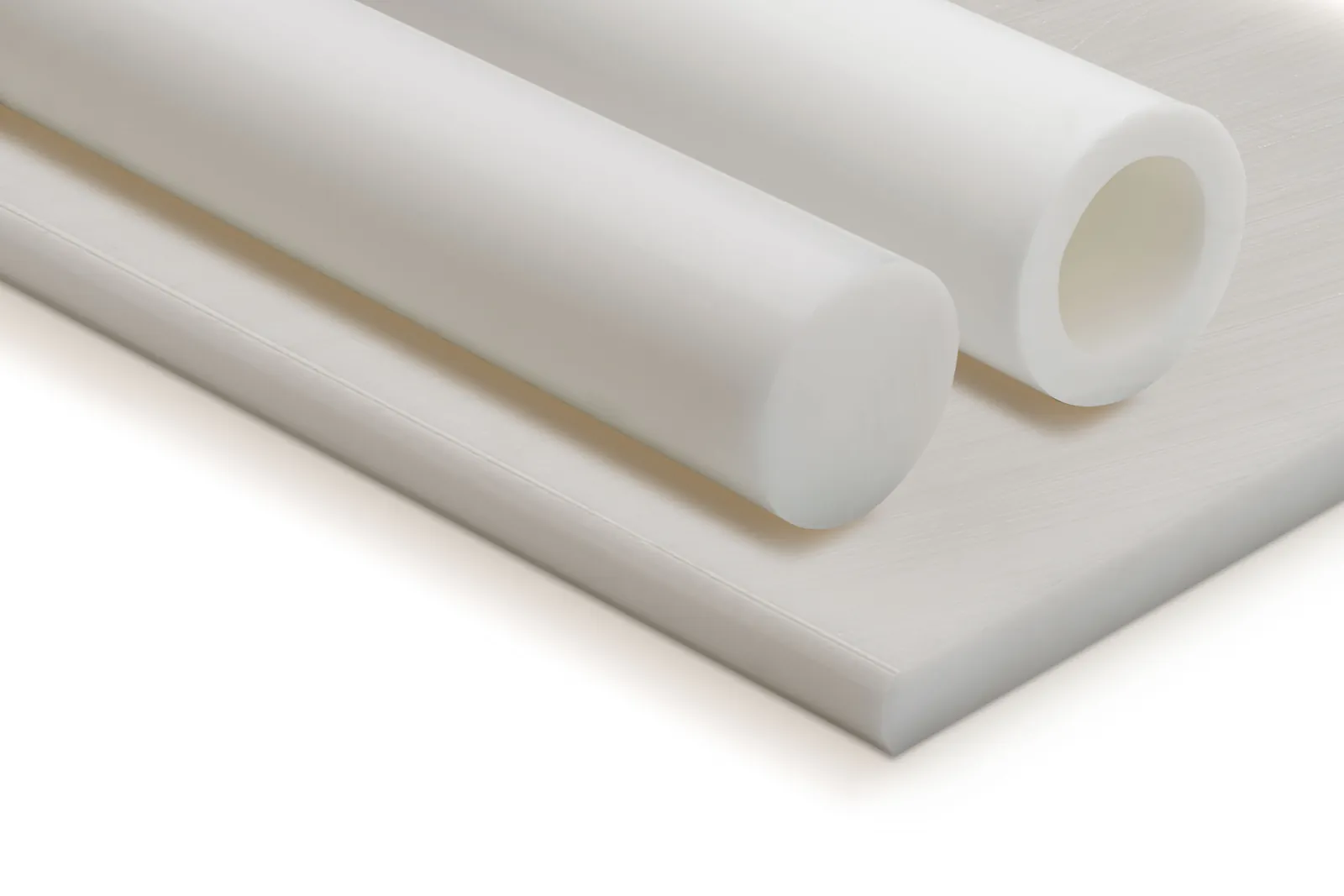
In plastics processing, CNC milling and CNC turning machines in particular are used. These machines process semi-finished products such as sheets, blocks or rods by controlled removal of material. The entire process is automated and is therefore not only precise but also economical. Thanks to modern software, even complex 3D shapes, free-form surfaces or multi-side machining can be implemented without difficulty.
A further advantage lies in the high degree of adaptability: design changes can be made directly in the digital data without having to adjust or remake expensive tools. CNC machining thus offers a high degree of flexibility combined with consistently high manufacturing quality.
Suitable plastics for CNC machining
Engineering plastics are characterised by high strength, good machinability and stable material properties. Particularly suitable are, among others:
- POM (polyoxymethylene): for precise functional parts with low friction losses
- PA6 / PA6G (polyamide): tough and abrasion-resistant, ideal for bearing and sliding components
- PE (polyethylene): chemical-resistant and easy to machine
- PET: high dimensional stability and low moisture absorption
- PTFE (Teflon): excellent sliding properties and chemical resistance
- PVC, PVDF, PEEK and others
Advantages of CNC machining over traditional processes
CNC machining offers significant advantages both technically and economically:
1. Highest precision and repeatability
Thanks to digital control, even the tightest tolerances can be achieved – particularly important for fits, seals and technical functional parts.
2. Flexibility in one-off and small-series production
In contrast to injection moulding, no expensive tool is required. Design changes can be implemented at short notice.
3. Fast production times
From the CAD drawing to the finished product, the path is short. Prototypes or special parts can be manufactured within a few days.
4. High material utilisation
Optimised milling strategies and nesting minimise waste.
5. Machining of complex geometries
Multi-axis CNC machines enable the production of highly complex components without manual reworking.
Typical applications in industry
The CNC machining of engineering plastics is used, among others, in the following areas:
- Mechanical engineering (e.g. gears, bearing bushes, guide elements)
- Medical technology (sterilisable components, holders)
- Food technology (FDA-compliant components made from POM, PE or PTFE)
- Automation technology (assembly supports, sensor holders, protective elements)
- Electrical engineering (insulating sheets, housings, carrier elements)
Conclusion: CNC machining as an economical route to plastic precision
The CNC machining of engineering plastics offers an optimal combination of flexibility, quality and economy. Particularly in areas where high demands are placed on fit accuracy and material properties, CNC technology is clearly at an advantage.
With modern machine parks, well-thought-out CAM programming and a broad range of materials, technischekunststoffe24.de is your experienced partner for the CNC machining of plastic semi-finished products.
FAQ on the CNC machining of engineering plastics
What tolerances are possible with CNC machining? Depending on the plastic type and component shape, tolerances down to ±0.05 mm can be achieved.
Is CNC machining worthwhile for small batch sizes too? Particularly for prototypes, samples or small series, CNC machining makes economic sense.
Can all engineering plastics be CNC machined? Most can, as long as they are thermoplastic and have sufficient dimensional stability. Some fibre-reinforced or filled plastics require special tools.
What is the difference between milling and turning? In milling, the tool rotates; in turning, the workpiece rotates. Both processes can be combined, depending on the component geometry.
How quickly can delivery be made? Standard parts from stock material are often available within a few days. Special materials or complex parts require correspondingly more lead time.







