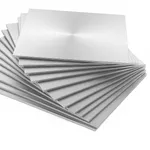
This image was created with artificial intelligence – marked under Art. 50 of the AI Act, Regulation (EU) 2024/1689. It is a placeholder until the company's photos arrive.
Calculating aluminium sheet weight: how to determine the weight to size
How much does an aluminium sheet weigh? With a formula, calculation example & table you can easily calculate the weight of aluminium sheets cut to size.
Anyone who orders, installs or transports aluminium sheets needs to know how much they weigh. The weight influences not only the costs for logistics and shipping, but also plays a central role in technical planning, for example for substructures, force calculations or the selection of suitable fasteners. The good news: the weight of an aluminium sheet can be calculated very precisely.
Why the weight of an aluminium sheet matters
In practice, the weight of aluminium sheets is a decisive criterion for many industries. Whether in mechanical engineering, façade construction, transport or exhibition stand construction – weight plays a central role everywhere.
Load-bearing capacities must be correctly designed
Excessive weight can affect the structural integrity of constructions or make additional reinforcements necessary. Especially for large-area applications, it is crucial to know the weight of the materials used exactly.
Shipping costs depend directly on weight
Whether by freight forwarder or parcel service – the shipping weight directly influences logistics costs. Exact calculation allows costs to be planned in advance and possible additional costs to be avoided.
Installation work requires plannability
During installation on construction sites or in workshops, weight is decisive for the use of lifting equipment, personnel effort and scheduling. Lighter sheets often allow simpler and faster handling.
Material requirements can only be calculated exactly via volume and weight
Anyone who wants to calculate production costs must know the exact material usage. Together with density, weight provides a reliable basis for raw material costs.
Especially for large projects or repeated cuts, precise weight specifications are an economic factor.
The weight of a rectangular aluminium sheet can be determined with a simple physical formula:
Weight (kg) = Length (m) × Width (m) × Thickness (m) × Density (kg/m³)
The standard density of aluminium is 2,700 kg/m³. This value applies to pure aluminium and most common alloys used in industrial applications.
Example calculation
An aluminium sheet with the dimensions:
- Length: 1,000 mm (equivalent to 1.0 m)
- Width: 500 mm (equivalent to 0.5 m)
- Thickness: 2 mm (equivalent to 0.002 m)
is calculated as follows:
1.0 × 0.5 × 0.002 × 2,700 = 2.7 kg
Table: weight of aluminium sheets per square metre
The following table provides guide values for the weight of common thicknesses:
| Thickness (mm) | Weight per m² (kg) |
|---|---|
| 1 mm | 2.7 kg |
| 2 mm | 5.4 kg |
| 3 mm | 8.1 kg |
| 4 mm | 10.8 kg |
| 5 mm | 13.5 kg |
| 6 mm | 16.2 kg |
| 8 mm | 21.6 kg |
| 10 mm | 27.0 kg |
| 12 mm | 32.4 kg |
| 15 mm | 40.5 kg |
| 20 mm | 54.0 kg |
These values apply to solid aluminium sheets and allow quick orientation during preliminary planning.
Calculation aid for other formats
The weight can also be calculated for non-rectangular sheets, e.g. round cut pieces. Here the area is adjusted accordingly:
Circular aluminium sheet:
Formula for the area: A = π × r²
Weight = π × (radius in m)² × thickness in m × 2,700
Example:
Diameter = 300 mm = 0.3 m radius = 0.15 m, thickness = 4 mm = 0.004 m
Weight = 3.14 × 0.15² × 0.004 × 2,700 ≈ 0.76 kg
Special cases: perforated, textured or multi-layer aluminium sheets
Not all aluminium sheets are solid. In the following special cases, different calculations or estimates apply:
- Perforated aluminium sheets: Depending on the perforation ratio, the weight is reduced. With a perforation ratio of 30%, the total weight is around one third lower.
- Chequered plates (tear plates): The embossed pattern slightly increases the weight because more material is used per m². The specific value of the respective product should be used here.
- Aluminium composite panels: These consist of two aluminium cover layers and a plastic core (e.g. PE). The average is usually 3.4 to 5.6 kg/m² depending on the type.
Influence of the alloy on weight
Aluminium is available in various alloys that offer different strengths, machinability and surface behaviour. The density varies slightly:
| Alloy | Density (kg/m³) | Remark |
|---|---|---|
| EN AW-1050 | 2,710 | pure aluminium |
| EN AW-5754 | 2,670 | high corrosion resistance |
| EN AW-6082 | 2,700 | frequently used in mechanical engineering |
| EN AW-7075 | 2,810 | particularly strong |
Anyone who wants to calculate particularly precisely should determine the specific density of the chosen alloy.
Step-by-step guide: determining the weight of an aluminium sheet
- Convert dimensions to metres: State length, width, thickness in metres (e.g. 500 mm = 0.5 m)
- Calculate volume: Volume = length × width × thickness (in m³)
- Multiply by density: Weight = volume × density (e.g. 2,700 kg/m³)
- Note the result in kg
This method works for both standard formats and custom cut pieces.
Common practical application examples
- Transport planning: How many sheets fit on a pallet with a maximum of 500 kg?
- Load-bearing capacity check: Is the substructure suitable for 12 m² of aluminium sheets at 8 mm each?
- Calculation of material costs: How many kg of raw material are required for 100 pieces of 300×200×3 mm?
Here, weight calculation not only provides orientation, but saves time and costs.
Conclusion
The weight calculation of aluminium sheets is based on simple physical principles. Anyone who knows length, width and thickness can determine the weight exactly using the volume formula and the density. Tables with guide values are particularly helpful, as they allow a quick assessment. For special shapes, alloys or composite panels, a closer look is worthwhile, as specific values apply here. Knowledge of the weight is essential for purchasing, design and logistics.