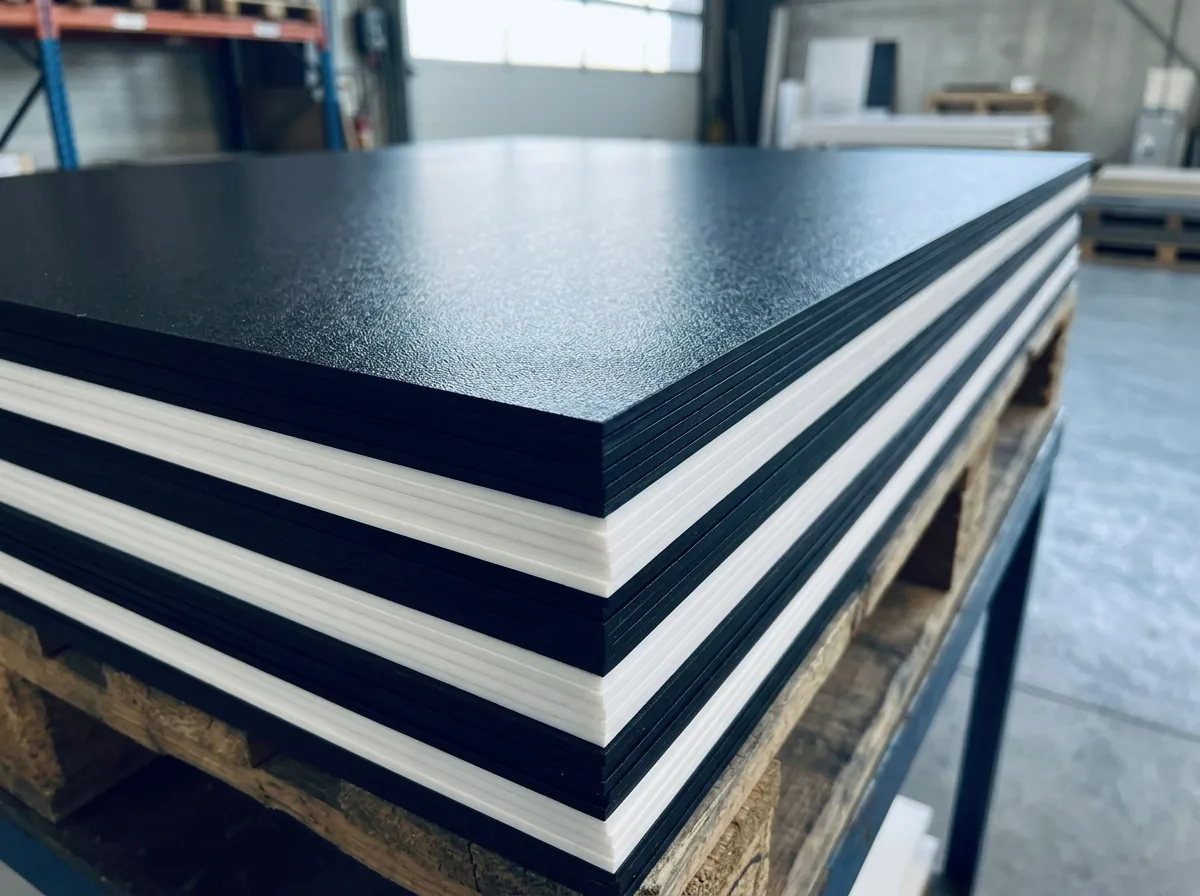
 This image was created with artificial intelligence – marked under Art. 50 of the AI Act, Regulation (EU) 2024/1689. It is a placeholder until the company's photos arrive.
Plastic triangular strip – properties, concrete & areas of application
Plastic triangular strips for concrete, formwork and industry: properties, materials, applications and selection explained.
Plastic triangular strips are triangular profiles used to protect, finish or specifically shape edges. They are particularly widespread in construction and in concrete formwork, where they serve, for example, to produce cleanly chamfered concrete edges. Plastic triangular strips are also used in mechanical engineering, furniture making, vehicle construction and in numerous technical constructions.
Depending on the application, the terms plastic triangular strip, triangular strip or plastic triangular profile are also used. In addition to the dimensions, the decisive factors for selection are in particular the plastic used, the required dimensional stability and the thermal, chemical and mechanical requirements.
Triangular strips can be made from materials such as PVC, PE, PP or ABS. Plastic profiles are light, corrosion-free and, depending on the material, easy to process. For industrial applications, profiles can also be specifically adapted to the respective construction in terms of geometry, material and dimensions.
What is a plastic triangular strip?
A plastic triangular strip is a profile with a triangular cross-section. Depending on the design, the cross-section can be isosceles, right-angled or specially adapted to a technical application. The terms triangular strip, triangle strip and triangular profile are sometimes used synonymously.
Triangular strips perform various tasks. They can protect edges, cover transitions, guide components or be used as a structural profile. A particularly important application is found in concrete formwork: there, triangular strips are used to specifically chamfer sharp concrete edges and form defined bevels.
Suitable materials include PVC, PE, PP or ABS, for example. Which plastic is suitable depends on the specific application. Requirements such as moisture, weather, temperature, contact with chemicals, mechanical load and the desired rigidity should be taken into account when selecting the material.
Plastic triangular strips are often produced as extruded profiles. Further information on the production of custom profiles can be found under Extruding.
Properties of plastic triangular strips
Plastic triangular strips combine several properties that make them versatile:
- Light and stable: Despite their low weight, they offer high strength and stability.
- Weather-resistant: Plastic is resistant to moisture, corrosion and many chemicals.
- UV- and colour-resistant: Many types of plastic lose neither colour nor shape even under strong sunlight.
- Easy to process: Sawing, drilling, milling or gluing is no problem.
- Aesthetic: Thanks to their clear geometric shape, they are also suitable for visible applications, e.g. as a finishing edge or design element.
- Cost- and time-efficient: Standard lengths and simple installation save time and material costs.
- Flexible in use: Adaptations to unusual angles or special constructions are no problem.
Typical areas of application
Plastic triangular strips are used in numerous areas:
- Furniture making: As edge protection, corner reinforcement or decorative element.
- Mechanical and plant engineering: For protecting corners, covers, as a guide rail or spacer.
- Window and door construction: For seals, finishes, joints or frame reinforcements.
- DIY and home improvement projects: For shelves, decorations, partition walls or as spacers.
- Construction: As edge protection or connecting piece in constructions made of wood, metal or glass.
- Automotive and transport industry: For protecting edges and corners in vehicles, trailers or containers.
- Electronics and enclosure construction: For safe clearances and protection of sharp edges.
Comparison table of common plastic triangular strips
| Plastic type | Hardness | Weather resistance | Machinability | Typical application |
|---|---|---|---|---|
| PVC | Medium | High | Easy | Furniture, construction, seals |
| PE | Medium-soft | Very high | Very good | Outdoor applications, protective strips |
| PP | Medium | High | Good | Mechanical engineering, container construction |
| ABS | Hard | Medium | Good | Furniture, electronic enclosures |
Plastic triangular strips for concrete and formwork
An important area of application for plastic triangular strips is concrete processing. In formwork, the profiles are positioned in the corresponding corners so that after concreting no sharp-edged 90-degree edge is created. Instead, a defined bevel or chamfered concrete edge is formed.
As a result, triangular strips can be used, among other things, for precast concrete parts, fair-faced concrete components, columns, walls, recesses and other formworked concrete components.
Depending on the design, the following variants are possible, for example:
- Triangular strips as a solid profile
- Hollow profiles
- Profiles with fastening or nail holes
- Triangular strips with nailing flange
- Different leg lengths and profile dimensions
- Various plastic materials
With non-absorbent formwork skin surfaces, plastic triangular strips can offer advantages over absorbent wooden strips. Which profile shape and fastening is suitable, however, always depends on the formwork system used and the desired concrete appearance.
More on applications of plastics in construction can be found in the section Construction industry.
Advantages over wood or metal
Plastic triangular strips have a large number of significant advantages over wood or metal, which make them superior in many areas of application. They are considerably lighter, which greatly simplifies handling and installation while at the same time reducing transport costs. Unlike wood, they are not susceptible to rot, warping or cracking, and unlike metal there is no risk of rust or corrosion. Plastic strips also offer high flexibility, so that they can be adapted more easily to specific construction requirements, for example by cutting to size, adaptation to angles or integration into existing structures.
In addition, they are low-maintenance, durable and resistant to weather, chemicals and mechanical load. These properties make them not only functional but also visually attractive, as they ensure clean edges, smooth surfaces and a professional appearance. Overall, plastic triangular strips are an economical, durable and versatile alternative to wood and metal that combines many practical and aesthetic advantages.
Processing tips
For precise processing, the following points should be observed:
- Cutting to size: Cut with fine-toothed saws or special plastic saws to obtain clean edges.
- Drilling: Use plastic drill bits, drill slowly to avoid fraying.
- Gluing: Use suitable plastic adhesives or assembly adhesives, depending on the material and load.
- Installation: Screws, nails or clamping devices can be used depending on the project.
- Surface finishing: Sanding or polishing is possible in order to create smooth edges or attractive surfaces.
Sustainability and recycling
Plastic triangular strips are increasingly made from materials that are recyclable or already recycled, which makes them a more sustainable construction and manufacturing solution. The long service life of the strips reduces waste and the need for frequent material replacement. Many manufacturers also rely on bio-based plastics, which further reduce the ecological footprint. Recycling production remnants and surplus materials enables efficient reuse, which conserves resources and lowers costs. Overall, these measures contribute to a more environmentally friendly and more economical use of plastic triangular strips.
Quality characteristics
The quality of a plastic triangular strip is determined by several factors that are decisive for durability and reliability. High-quality plastics without fillers ensure stability, while precise dimensions ensure problem-free installation and a precise fit. The surface condition is also important: strips without cracks, air pockets or unevenness offer better functionality and an attractive appearance.
Certifications and test marks such as DIN or ISO provide additional assurance and confirm that the strips meet high standards both technically and in terms of quality. High-quality strips are characterised by their resistance to weather, chemicals and mechanical load, which makes them reliably usable for a wide range of applications.
Purchase and selection
When purchasing a plastic triangular strip, the following points should be observed:
- Material choice: PVC, PE, ABS or other plastics depending on the area of application.
- Dimensions: Choose length, width and triangular dimensions to suit the application.
- Surface: Smooth, textured or coated, depending on installation or visual requirements.
- Load capacity: Check for static or dynamic loads.
- Colour options: Selection of colours for visible applications.
With the right tool, material and the right strip, precise results can be achieved.
In conclusion
Plastic triangular strips are extremely versatile, stable and durable profiles that can be used successfully both in industrial areas and in home improvement and furniture making. They impress with their easy processing, high resistance, flexibility and the possibility of implementing different projects efficiently. Due to their weather- and chemical-resistant properties, they are suitable for both indoor and outdoor applications.
The strips offer an optimal combination of functionality and aesthetics and contribute to durable, safe and professionally appearing constructions. With the careful selection of the material, attention to the quality characteristics and the right processing, excellent results can be achieved that impress both practically and visually and stand the test of time.