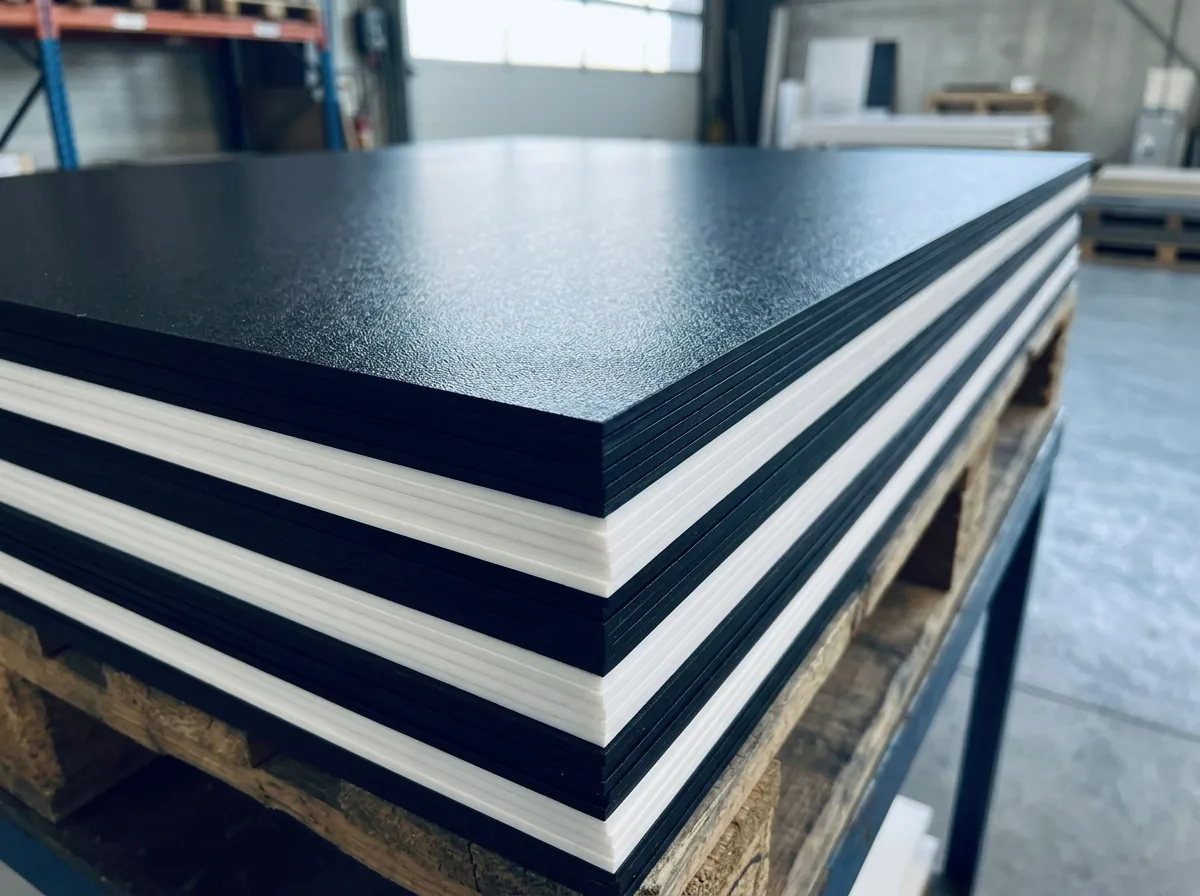
 This image was created with artificial intelligence – marked under Art. 50 of the AI Act, Regulation (EU) 2024/1689. It is a placeholder until the company's photos arrive.
Polypropylene: properties, applications and technical information
Learn more about polypropylene: applications, advantages and technical data. Ideal for mechanical engineering, the chemical industry and more.
Polypropylene (PP material) is a semi-crystalline thermoplastic and is one of the most important standard engineering plastics for industrial use. As a polypropylene plastic, PP is primarily processed as a PP sheet, PP rod or as a cut-to-size piece to exact dimensions. Typical industries are mechanical engineering, the chemical industry, apparatus engineering, water technology, environmental technology and food technology.
For design engineers, buyers and technical managers, PP material offers an economical solution with high chemical resistance, low density and good rigidity. In many applications, polypropylene replaces heavier materials or corrosion-prone metals and thus contributes to weight reduction and cost efficiency.
What is polypropylene?
Polypropylene is a thermoplastic plastic based on propylene and belongs to the group of polyolefins. Thanks to its semi-crystalline molecular structure, PP combines comparatively high rigidity with good toughness and pronounced chemical resistance. This material structure ensures that polypropylene remains dimensionally stable under mechanical load while at the same time being sufficiently flexible to absorb stresses.
In an industrial environment, polypropylene is used primarily as PP sheet, PP plastic sheet or as a cut-to-size piece to exact dimensions. The material can be produced economically, processed well and supplied in different grades. Typical fields of application range from tank and apparatus construction through mechanical engineering to food and water technology.
Polypropylene sheets are usually available in natural, grey or black. Industrial standard thicknesses are often between 3 mm and 30 mm, and above that for specific projects. In addition to sheets, rods, welding rods and prefabricated construction components are used.
Material structure and material behaviour
The semi-crystalline structure of polypropylene significantly influences its mechanical and thermal behaviour. As temperature rises, rigidity falls, while at lower temperatures impact strength may be reduced. These relationships must be taken into account in structural design.
Creep behaviour under sustained load should also be considered. Under long-term mechanical load, deformation can occur, which is why adequately dimensioned wall thicknesses and structural reinforcements are advisable.
Technical characteristics of polypropylene (PP-H as reference)
| Property | Typical range |
|---|---|
| Density | approx. 0.90–0.91 g/cm³ |
| Tensile strength | approx. 25–35 MPa |
| Modulus of elasticity | approx. 1,000–1,500 MPa |
| Notched impact strength | medium |
| Coefficient of thermal expansion | approx. 0.10–0.15 mm/mK |
| Continuous service temperature | approx. -10 °C to +100 °C |
| Short-term temperature resistance | up to approx. +130 °C |
| Melting temperature | approx. 160–170 °C |
| Water absorption | very low |
| Dielectric strength | good |
These values vary depending on the grade (PP-H, PP-C, PP-GF). Glass-fibre-reinforced grades show significantly higher rigidity with reduced thermal expansion.
Differences between PP-H and PP-C
| Property | PP-H | PP-C |
|---|---|---|
| Rigidity | higher | lower |
| Impact strength | lower | higher |
| Low-temperature behaviour | limited | improved |
| Typical application | tank construction | mechanical engineering |
PP-H is suitable for rigid constructions with chemical exposure. PP-C is preferred where increased impact stress occurs or lower temperatures play a role.
Chemical resistance of PP
Polypropylene shows high resistance to:
- acids
- alkalis
- salt solutions
- alcohols
- many organic media
Resistance is limited with:
- strongly oxidising acids
- aromatic hydrocarbons
- certain solvents at elevated temperature
Chemical resistance depends heavily on concentration, temperature and duration of exposure. For safety-relevant applications, an individual test depending on the medium and temperature is advisable.
Advantages of polypropylene (PP material)
- Low density: lightweight construction with good mechanical stability
- High media resistance: suitable for chemically exposed environments
- Low moisture absorption: stable in wet and humid conditions
- Good electrical insulation: can be used in the electrotechnical sector
- Economical material costs: attractive compared with high-performance engineering plastics
Thanks to these properties, PP is a standard material with broad acceptance in many industries.
Limits and application restrictions
For a well-founded material decision, the following points must be taken into account:
- Limited continuous service temperature compared with high-performance plastics
- Lower impact strength at very low temperatures
- High coefficient of thermal expansion compared with metals
- Flammability without flame-retardant additives
In applications with high sustained load or high temperatures, engineering plastics such as POM or high-performance plastics are often used.
UV resistance and outdoor use
Standard polypropylene has limited natural UV resistance. Under permanent solar radiation, the surface can become brittle and mechanical properties can gradually degrade. This process depends heavily on the intensity of UV radiation, the temperature, the component geometry and the mechanical load.
For outdoor applications, UV-stabilised or black-pigmented grades are therefore often used. Thanks to its carbon black content, the black pigmentation acts as additional UV protection and significantly increases service life under direct weathering. Nevertheless, a realistic service life estimate should be made for long-term outdoor applications, especially where safety-relevant components are involved.
For structural solutions outdoors, a combination of suitable material selection, structural UV protection and regular visual inspection is advisable.
Typical applications of polypropylene
- Mechanical and plant engineering: housings, covers and technical cladding with chemical exposure.
- Chemical industry: tanks, vessels, pipelines and linings for aggressive media.
- Water and environmental technology: components with moisture and media contact.
- Food technology: components with food contact where the relevant conformity applies.
- Apparatus engineering: constructions with moderate mechanical stress.
Polypropylene is particularly suitable for applications where corrosion resistance and low weight are the main priorities.
Design notes for PP components
When designing with polypropylene, creep behaviour under sustained load must be taken into account in particular. Under long-term mechanical stress, PP shows a certain tendency to deform, which is why adequately dimensioned wall thicknesses and, where necessary, structural reinforcements are advisable. The comparatively high thermal expansion compared with metals should also be taken into account in the design, especially for components with greater lengths or with fluctuating temperatures.
Fastening points should be designed so that stresses are distributed evenly and no localised sustained loads occur. With bolted connections, large-area washers or suitable inserts can improve load distribution. A design adapted to the material contributes substantially to the service life and functional reliability of PP components.
Decision aid: when is PP suitable?
| Requirement | Assessment |
|---|---|
| High chemical exposure | Very well suited |
| Temperature up to 100 °C | Suitable |
| High dimensional stability | Conditionally suitable |
| Very low temperatures | Check alternative |
| Permanent UV exposure | Use stabilised material |
This overview serves as initial guidance for material selection.
Polypropylene vs. polyethylene (PP vs. PE)
| Criterion | PP | PE |
|---|---|---|
| Rigidity | higher | lower |
| Impact strength | medium | high |
| Temperature resistance | higher | lower |
| Density | lower | higher |
PP is suitable for more rigid constructions with higher temperature requirements. PE is suitable for impact-stressed components or very low temperatures.
Comparison with other plastics
PP vs. POM: POM offers higher mechanical strength and better dimensional accuracy, but is more expensive and is often used for precise machine parts.
PP vs. PVC: PVC has higher rigidity and better flame resistance, but lower temperature resistance.
PP vs. ABS: ABS offers higher impact strength indoors, but shows lower chemical resistance.
Standards and conformity
Depending on the application, the following requirements may be relevant:
- Food conformity according to EU 10/2011
- FDA-compliant grades
- Material specification according to DIN / ISO
The specific suitability depends on the respective material grade, processing and documentation.
Processing of PP plastic sheets
Polypropylene can be sawn, milled, drilled and welded well. Cut-to-size pieces to exact dimensions allow direct integration into existing constructions. Due to thermal expansion, the structural design should allow for appropriate tolerances.
Welding processes such as heated-tool butt welding or extrusion welding are often used in tank and apparatus construction.
Polypropylene sheet and cut-to-size pieces for industrial projects
PP plastic sheets are available in different thicknesses, formats and colours. Cut-to-size pieces to exact dimensions according to drawings or CAD data allow technical requirements to be implemented on a project-specific basis.
A precise material selection taking into account temperature, media contact, mechanical load and standard requirements increases operational safety.
Technical advice and enquiry
For industrial projects, a material-specific assessment of the operating conditions is advisable. Temperature range, media contact, mechanical load, fastening situation and ambient conditions significantly influence the suitability of polypropylene.
A well-founded selection of the right PP material reduces failure risks and increases operational safety in the long term. We will be happy to support you in selecting the suitable polypropylene sheet or a cut-to-size PP piece to exact dimensions based on your drawings, CAD data or technical specifications. Together we will define the right material grade, thickness and machining for your project.
Summary
Polypropylene (PP material) is a chemically highly resistant, light and economical engineering plastic with a broad range of industrial applications. Its semi-crystalline structure enables a good combination of rigidity, temperature resistance and media resistance.
PP is particularly suitable for applications with moderate temperature exposure, chemical media contact and structural requirements in mechanical, plant and apparatus engineering. At the same time, the material requires a design adapted to it with regard to thermal expansion and sustained load.
By systematically considering properties, grades, limits, alternatives and normative requirements, polypropylene can be selected on a technically sound basis and used on a project-specific basis.
FAQ on polypropylene (PP material)
What is polypropylene (PP material)?
Polypropylene is a thermoplastic plastic with high media resistance and low density, which is often used as PP sheet or as a technical cut-to-size piece.
What is polypropylene used for?
PP material is used in mechanical engineering, in the chemical industry, in water technology and in applications close to food.
What is the difference between PP and PE?
Polypropylene offers higher rigidity and temperature resistance, while polyethylene has higher impact strength.
What temperature can polypropylene withstand?
The typical continuous service temperature is around -10 °C to +100 °C; higher temperatures are possible for short periods.
Is polypropylene UV-resistant?
Standard PP has limited UV resistance. Stabilised material is suitable for outdoor applications.
Is polypropylene suitable for food contact?
Certain PP types meet food-law requirements where the corresponding material grade is used.